• Skip to main content
  • Skip to main content
Choose which site to search.
University of Arkansas for Medical Sciences Logo University of Arkansas for Medical Sciences
Medicine and Meaning
  • UAMS Health
  • Jobs
  • Giving
  • About Us
    • Submission Guidelines
  • Issues
  • Fiction
  • Non-fiction
  • Poetry
  • Conversations
  • Images
  • 55-Word Stories
  • History of Medicine
  1. University of Arkansas for Medical Sciences
  2. Medicine and Meaning
  3. Author: UAMS Online
  4. Page 8

UAMS Online

The Isolated Room

By Michal Mahgerefteh

Since midnight,
no place to sleep
just a coffee machine
with no sugar or cream.

My fear tightened,
I rushed to his room
through hallways that
smelled dry and sour.

With urgency, two nurses
led me to a wooden chair
by his bed, and I so wanted
to hold his tiny body;

so weak and tender like
a seedling soft and pliant
dressed in colorful tubes
and straps and needles.

I kissed him on his
lips and cried. I cried
so intensely I almost
burned in that cry.

Into his chest I leaned
my blood and wishes,
so truly  so lovingly
’til all my limbs idled.


Michal Mahgerefteh is an award-winning poet and artist from Virginia. She is the author of four poetry chapbooks, with two forthcoming in 2022. Michal is the managing editor of Poetica Magazine and Mizmor Anthology.

Filed Under: 4 - Poetry

Long Term Care

By Jeff Rawlings

How much of me is you,
And you, me?
When I remember the first of us,
It’s just a blur of becoming.

There we were: We, a new thing.
I did not know there were so many ways
To marry, to transfigure, to be astounded.
You and I settled each into the other’s bones.

Oil and water? Yes, but together a balm.
I like to think we wore ourselves out
Falling and rising and laughing back into the fray.
Oh, I hope you are filled now with rightful sleep.

Were we enough, love,
Now that we’re old, filling our listless hours
Between spoons and sleep
With idle talk of spoons and sleep?

I never had a grand plan, dearest.
I knew only where I’d gone for you
But not where we were taking ourselves.
But just this:  I always came home to you.

How shall we live?
You there, me here, and nowhere for us.
I will come play my guitar for you
And your lady friends in the drab hallway.

How shall we end, you and I, and us?
Let’s be in the same dream some night
Where you are singing the old songs
While I’m flying us away to anywhere together.


Jeff Rawlings is retired following a military stint, a long career in quality systems management, and a delightful four and a half years on the staff of the Donald W. Reynolds Library serving Baxter County. He is a 1972 U of A Fayetteville English Lit graduate, and he was most active in writing and publishing during the 1990s and early 2000s. In recent years, he have reclaimed my passion for the language and the written word. He was the poetry critic for the Poet’s Roundtable of Arkansas for the 2015-2016 term, and he is now connected with several local poets with whom he shares his scribblings and observations.

Filed Under: 4 - Poetry

Arkansas River

Old wooden piers in the Arkansas River

One of our family’s favorite pastimes has been to take a leisurely walk at the Big Dam Bridge on the North Little Rock side of the Arkansas River. These pile dikes have always intrigued us as we have walked the trail. As they stand strong and tall against the natural elements, they convey a sense of strength and timelessness. I wanted to highlight these imposing qualities and hence it is the focal point for this particular shot. Based on trial shots using lower exposure time, I decided on using long exposure for this picture. 

Taken on a sunny afternoon with clear skies. In this shot, the smooth texture of the choppy flowing river and the dull hue of the sky was achieved by utilizing a prolonged exposure time (30 seconds) with the aid of a density filter and the camera stabilized with the use of a tripod.

Pile dikes such as these have been used since the early 1800s to tame the rivers. Numerous pile dikes (also known as wing dams) line the Arkansas River as it flows into the Mississippi. They consists of alternating timber piles supported by a horizontal spreader as part of the river navigation system. They help maintain navigation channels by directing river flow toward the main channel, resulting in reduced dredging requirements, increased channel stabilization and bank protection.​


Parthak Prodhan, M.D., FAAP, FCCM, MBA, is a Professor of Pediatric Critical Care and Cardiology at UAMS.

Filed Under: 3 - Images

Sunset Over Pinnacle Mountain

Image shows the sun setting over Pinnacle Mountain. The sky is orange, and the water is reflecting the orange color.

The picture was taken from a steep ledge off a walking trail behind the old Veterans Administration Hospital in North Little Rock. With the sun setting rapidly, it was a race against time to frame the shot properly. I myself was surprised with the end result, which was achieved by minimal post-picture manipulation.

Summers in the Natural State are on most days hot and humid. This flaming shot of the setting sun aims to convey this feeling of intense heat on a hot summer day in the Natural State. The framing against Pinnacle Mountain and the Arkansas River in the foreground give a sense of welcome respite from this heat.


Parthak Prodhan, M.D., FAAP, FCCM, MBA, is a Professor of Pediatric Critical Care and Cardiology at UAMS.

Filed Under: 3 - Images

The Many Faces of the Little Rock Zoo

By Indranil Chakraborty, M.D., FASA

Photography has been my passion for years. In my free time, I would pick up my camera gear and venture out in pursuit of that “perfect” shot! My favorite time was on post-call mornings when I had the whole world to myself. It was a warm spring morning in 2012 and I ventured out into the fascinating natural world of the Little Rock Zoo. Just me, my camera and nature in its full glory! Here are some of the photographs.   

Image of a chimpanzee holding its hand over its nose and looking at the camera.
Close up image of a yellow flower with a bee on one of the petals. Shallow focus.
Image of a bird hiding its beak under orange-accented wings
Image of a light-colored cockatoo

Indranil Chakraborty, M.D., FASA, is a Professor and the Division Chief of Neuroanesthesiology at UAMS.

Filed Under: 3 - Images

White Coats and Blue Collars

By Eric Moorehead

A sultry, sunny day greeted denizens of the mid-Atlantic region in July 2016. I was driving on Pulaski Highway—U.S. Route 40—with my wife, son and daughter on an exhausting, albeit enjoyable road trip that carried us through most states east of the Mississippi River and Ontario, Canada. Some 100 miles southwest of Philadelphia where we stopped earlier, I drove into another big city in a neighboring state. I exclaimed to them, “This is where I was born.” The grit of the city shrouded business after business and rowhouse after rowhouse that we passed as Pulaski Highway turned into Orleans Street. I drove under a railroad overpass with large letters spelling out “BALTIMORE.” We arrived in Maryland’s largest city – its indelible blue-collar image starkly contrasting that of the elite nation’s capital 40 miles to the southwest, its quirky ambience as colorful as the state flag. I wanted to show my family Johns Hopkins Hospital, my father’s employer when I was a small child.

We parked our mini-van on the street, got out and began to walk around the perimeter of the hospital campus to take pictures. “So this is where Dr. Ben Carson got started,” my wife said, referring to the man of Gifted Hands fame. 

All I knew is that Johns Hopkins Hospital appeared unrecognizable to me overall from those erstwhile days of my childhood, with several modern buildings constructed decades after my last visit with my father when I was around five or six years old. Only the old red Queen-Anne style building – the original hospital, now the administration building – captured any familiarity. The old hospital was the place I remember telling my father’s work friends there that I wanted to be a doctor when I grow up. I didn’t know any better.    

Let me continue to take you back seemingly eons before the revitalized Inner Harbor (which I haven’t seen) and The Wire (which I have). In my childhood, Johns Hopkins Hospital symbolized Maryland as much as the clams, the crab cakes and the Colts — pre-Indianapolis. My father worked there for three years. He was not a doctor – he was a technician who worked on medical machines. In fact, he worked on a machine that saved the life of my uncle following a brain aneurysm. He was one of several relatives of mine who lived in Baltimore in the 1960s. All of those relatives are gone. The historically black Provident Hospital where I was born is gone. P.S. 69 where my two older brothers and I attended school is gone. Yet, this historic Star Spangled Banner city lives on. I was happy to show my family a city that I really knew only as a boy. Of course Johns Hopkins Hospital still symbolizes Maryland – in the modern Ravens era.

My father earned an associate’s degree from Maryland Technical Institute – a trade school that no longer exists – in 1959. Shortly afterward, he started his new job at Johns Hopkins. Unbeknownst to me, as a kid I didn’t know Johns Hopkins was world renowned in medicine, but I was too young to grasp that concept anyway. I just took it for granted, like any other place. To me, the hospital was no different from Sinai Hospital in northwest Baltimore where my brothers and I would go to get vaccinations or anyplace else that required a trip to the hospital.

Then there was my mother. I don’t want to say she followed in my father’s footsteps, but she too worked at a hospital. I believe about a year after her first job as a cashier at a dairy store on Liberty Heights Avenue, a job that according to her lasted about three weeks (she admitted she wasn’t cut out for it – counting money fast wasn’t her forté), she began her first real job as a nurse’s aide at what was then known as St. Joseph’s Hospital, a suburban Catholic hospital in Baltimore County. I must have been six years old, maybe seven. Anyway, this job ushered in a long and more successful stint of similar positions at hospitals in Havre de Grace and the Army base at Aberdeen Proving Ground. 

My mother held those jobs after my family moved out of Baltimore to be closer to my father’s next job in Cecil County. Following his years at Johns Hopkins, he began work at the VA Medical Center in Perry Point – a residential government village in the northeast corner of the state between Baltimore and the Delaware line and across the Susquehanna River from Havre de Grace – and spent four years commuting on the 80-mile round trip between there and Baltimore on Route 40 before we settled there in 1966. The facility houses many Maryland veterans with psychiatric disorders; its idyllic campus with stately, early-20th-century architecture and white facades sits at the point where the Susquehanna flows into Chesapeake Bay.    

Perry Point was an interesting place for a child to grow up. Forty miles from Baltimore, 75 miles from Washington and 60 miles from Philadelphia, this quaint, Mayberry-esque village  was a world away from urban life. It comprised World War I-era houses, a police station, fire station, post office, credit union and community center, but no grocery stores – those were in nearby Perryville and Havre de Grace. Farms dotted the landscape a few miles to the north. Quiet streets where I rode my bike graced the neighborhood. Little League baseball occupied my brothers’ time as I, a less gregarious kid, was more interested in just watching Orioles games on TV. And all the working residents – primarily men – held positions at the VA hospital. Many of them were doctors. My neighbor friend’s father was a doctor, many of the guys I knew in Boy Scouts – that is, the ones who lived in Perry Point — had fathers who were doctors, and just about all the residents who lived on the street overlooking the Susquehanna were doctors. Yet again, my dad was a blue-collar technician.  

It was during this time – elementary school and high school – that I vacillated in my dreams of a chosen profession. I wanted to be either a doctor or a writer. Medical dramas like Marcus Welby, M.D. — one of my favorite shows from the early 1970s – inspired me, with Robert Young as the friendly family doctor walking into his office wearing a stethoscope around his neck and donning a white coat. However, since I figured my parents didn’t have the cold hard cash and I didn’t have the scientific acumen for medical school, a reality check set in with a penchant for the latter profession (more precisely, a newspaper writer in my adult years). On summer days I would sit in my room writing stories when I wasn’t hanging out with my best friend, whose dad was a psychiatrist. By the way, we’re still friends some 50 years later as two old guys – he has long since left Cecil County. 

I earned my driver’s license at age 16 around the time my father announced his training for a new job at a VA hospital in Little Rock, Arkansas. This occurred around the time he simply wanted to make a change for the family, as my middle brother and I set our plans for college. The nearest four-year school was the University of Delaware, 20 miles away, and apparently plans for living on any college campus were out. Anyway, due to the training, he would fly between Baltimore and Little Rock for weeks at a time over a period of roughly six months.              

On return trips home, my father would mention the grades he received on tests in his training. Overall they were pretty good, even though I didn’t remember all the scores. I distinctly remember his pride in telling my mother, middle brother and me (my oldest brother had left home to join the military by this time) about an A he received on one test. 

An adventurous type, I always liked to travel and experience new places. By this time I anticipated rather than dreaded the move not only to a new state, but also a new part of the country –   well, new to me since I never considered Maryland a real Southern state like Arkansas, not entirely new to my parents since they grew up in Louisiana. However, I was dating, and I knew I would forfeit my senior year at Perryville High School in the town next to Perry Point, so I was prepared to eventually tell the girl and my classmates goodbye by June of 1975. Two months prior to that month, my dad made it official when he came home from work and asked me, “How would you like to move to Arkansas?” I expressed my OK. Due to his job transfer, my mother would leave her job at the Army hospital in Aberdeen for a same job at the VA hospital in Little Rock. 

Initially he had prepared to move the family to Little Rock until some of his acquaintances at the VA hospital told him about a college town called Conway, 30 miles north of the city. I suppose he anticipated my brother and I attending college there following high school – yes, a new high school with a new mascot. My dad’s acquaintances told him about a Wampus Cat and he had fun explaining it to me.  

I remember sitting in my bedroom and getting out a road map showing Arkansas as I tried to locate Conway, then wondered if the town was in proximity to mountains. I heard Arkansas had mountains. No, it wasn’t the desert, as my high school French teacher envisioned.

Summer break arrived as we began the 1,100-mile drive across four states from Perry Point to Conway. As my dad drove across the Susquehanna River bridge on Route 40 with my mother in the front seat, I sat in back, turned around and glanced in the rear windshield at Perryville, wondering if I will ever see that town and Perry Point again. 

His official title as biomedical engineering technician, my father would commute to work at the VA hospital, a reprise of his commute to work during my formative years in Maryland — this time on Interstate 40 instead of U.S. 40, this time to Pulaski County instead of on Pulaski Highway. Gone was the camaraderie of kids whose parents were mostly in the medical field. Gone was the quaint village where those parents resided. Gone were the banks of the Susquehanna River where I played as a kid. I adjusted to a new environment of friendly high school students with Southern accents. I simply lived in a 1960s-era subdivision in Conway. I discovered a different river — the Arkansas River — and an adjacent place called Toad Suck. Furthermore, nobody rooted for the Colts – they called the Hogs.  

Unlike the verdant surroundings and unique architecture of the Perry Point VA hospital, the Little Rock hospital was situated amid urban, bustling surroundings, its brown, high-rise structure towering above Roosevelt Road and Interstate 30. I don’t remember ever entering the hospital with my father, at least during his early years there. I certainly don’t remember meeting any doctors there. Anyway, both my parents felt contentment about the move away from the East Coast. So did I, although I found the tornado drill at my high school quite unnerving.  

Eight years later, 1983. I had moved to Los Angeles almost two years earlier and returned to Arkansas to visit my parents for the Christmas holidays during a bitterly cold December. At least one night the temperature dropped close to zero degrees Fahrenheit and the snow stayed on the ground in what seemed like the entire two weeks of my visit. Anyway, I found it a nice change of scenery and climate from an early winter in Southern California.

I met some of my dad’s fellow technicians in the hospital basement. Talk among them and other hospital employees referred to the move to a new VA hospital under construction in midtown Little Rock. Many employees eagerly anticipated the move to more modern facilities compared to the dated atmosphere of the Roosevelt Road location, an east Little Rock landmark since the late 1940s. 

A year passed until my next visit to Arkansas, again for the Christmas holidays. My father showed me the new VA hospital where he and my mother were employed for just a few months. I remember as he drove up to the hospital with what I viewed as its avant-garde architecture, he revealed it to me like a long-awaited Christmas present. “Ol’ Blue Eyes,” he called the hospital, referring to the blue circular shadows surrounding the outer windows of the octagonal pods on the upper floors, much of the hospital still surrounded by soil from the new construction. 

We went inside. Its surroundings impressed me, quite futuristic I thought. It even had a robot that would roam up and down the halls like a voiceless teacher pacing back and forth. The interior kept the theme of the exterior circular designs in some of the walls. This time I did see some doctors but I don’t remember my father introducing me to any of them. 

My father would remain employed at the new VA hospital until his retirement in 1988, ending a 29-year career as a technician working on medical machines, 26 with the VA. My mother, as a nurse’s aide, would then carry the mantle of the commute between Conway and Little Rock until her retirement a few years later.

       *            *            *

It’s the 21st century, a new millennium, a new age in medicine. In my layman’s mind I still demonstrate some interest in the field. Long ago I kicked Marcus Welby to the curb and recently streamed an episode of ER. I have an administrative position at a medical facility but insistently denied to my uncle in Louisiana – my dad’s youngest brother – that I followed in my father’s footsteps, even with my move back to Arkansas, even with my father’s pleading back in the ‘80s that I should apply for a job at the VA where I am not employed. Yet my closest inclination to anything technical is my love of electronics – audio and video equipment and computers, that is. Medical machines? Nada. 

In February and March 2005, I would walk to the VA hospital to visit my father. Long retired, he wasn’t an employee this time – he was a patient. Gravely ill, he was connected to a machine – that very tool that epitomized his long career. Oftentimes in his critical state he would ask about my work, his work at his former employer remaining a distant memory. One day in March, I drove from home with my mother to visit him – it was a Sunday. That day would be my last time to see him before he passed away, in the very same place where he loved his career. 

Neither of my parents had a four-year degree, nor did they have the desire to earn one. But if there’s one example they set for me, it is that anyone who contributes to the medical profession is just as important as the scientists and researchers at the forefront. I carried that notion back when I was a kid and still do today.  

Almost five years after that road trip, I muse wistfully about my Maryland childhood and accept the reality that I can never get those times back. I’m settled in central Arkansas where fine health care exists without the marquee hospital names. I may never see Johns Hopkins Hospital again, except through documentaries and Hollywood-style renderings in movies like the Ben Carson one. However, through my blue-collar parents, I’ll never forget how hospitals managed to shape my life, regardless of my title or my attire. I’m also grateful for the professionals with whom I collaborate, and I’m grateful to be one of them without an M.D. or Ph.D. after my name. Most of those professionals work in administration, but I’m proud to say that I get to rub elbows with a few of those who don white coats.


Eric Moorehead, part of the Medicine and Meaning staff, is an administrator for the Institutional Review Board, Division of Research and Innovation. 

Filed Under: 3 - Non-fiction

Conversation with Dr. Gina Drobena

Interview by M. Paige Plumley and Jace C. Bradshaw

Dr. Gina Drobena is an Associate Professor in the Department of Pathology. An Arkansas native, she is board certified in clinical pathology, transfusion medicine, and lifestyle medicine. 

What brought you to the field of medicine?

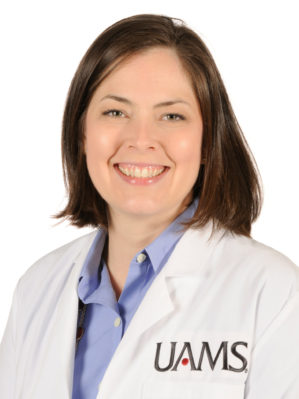
Gina Drobena, M.D.
Gina Drobena, M.D.

I think my family realized I was bright at a young age. They always told me, “You’re smart enough to be a doctor.” My family held doctors in really high esteem, and because of that, I always thought I might be a doctor. When I got to college and started looking at things more, I was unsure if I wanted to be a human doctor or go to veterinary school. I was actually planning on applying for both—this was sort of like a trial run because it was my junior year. I ended up getting my application to medical school submitted on time but not my application for veterinary school, and UAMS accepted me.

During medical school, what brought you to pathology?

Probably my anxiety. I was afraid of hurting someone; I did not want to harm a patient. I realized that pathologists got to read about the diagnosis, think through the process, and get others’ opinions. That really appealed to me. I knew I did not want to make the minute-by-minute life-changing decisions that I saw in other places like the emergency department. The adrenaline rush is not my game.

During medical school and residency, what struggles did you have, if any?

I struggled. I feel it is important to be honest here: I struggled with anxiety and depression from a young age. I saw my first mental health professional in first grade; I was started on medication as a teenager. I have had more therapists than I can remember. It has been a lifelong struggle for me that was especially bad during medical school and residency. The intensity was so high. I don’t think I would have made it through without the student mental health section at UAMS. They are a big reason I was able to finish medical school.

During my training, [my mantra] was “fake it till you make it.” Over time, it has transitioned to “if you are with your people, you do not have to fake it.” Find your people; find your place. When you have done that, you will know—you don’t have to fake it anymore. As you go into your career, be patient because it might not be the first place you work or the first people you befriend. It takes time to know what really matters.   

What advice would you give to medical trainees struggling with mental health issues or the motivation to finish their training?

Talk to people. Find people who are willing to help you, hear your struggles, and advise you. I think we have a fabulous framework for people who are struggling here at UAMS not just for students but for residents and faculty as well. I still use the mental health professionals available on campus; I have been thrilled with the care I have received. I think it is very noble to care for your peers and make sure that they are able to function at their highest level. I would always encourage students, residents, and faculty to reach out whenever they need it. I think one of the things that has helped me over the long term is not ever needing to be hospitalized or needing an escalation of care. Over the years, I have gained the insight to know when I need to reach out to someone. If you don’t have that self-awareness, listen to those around you—they’ll tell you.

Did you develop any role models in the field, especially ones who displayed this kind of vulnerability?

I think that came later for me. During medical school, I was able to go back to my family doctor in Malvern, AR, and do rotations there. I felt encouraged by him, but I didn’t have any real role models. I had family members in healthcare, but none were doctors. My mom actually went back to nursing school when I was a teenager, so I had some exposure to healthcare, but I didn’t really know many doctors.

Can you share how you became interested in culinary medicine and what that has taught you?

That journey is an interesting one. I have always been interested in food, especially food as medicine. I remember telling my mom during medical school that I wish people would pay me to clean out their pantries and get them on track for a healthier diet. Of course, that was usually at the times that I was considering quitting medical school.

During medical school, I would get sick a lot. I would have a cough that would progress to pneumonia or bronchitis. I finally got sick of it. I started reading about common causes of inflammation, and I came across dietary causes in the medical literature. After reading more, I decided to go on a plant-based diet. I cut out meat, dairy, sugar, and alcohol. Shockingly, I felt a lot better. I stopped getting pneumonia and my eczema disappeared. 

In 2018, the chancellor of UAMS purchased the culinary medicine curriculum from Tulane. I had just taken the board exam for lifestyle medicine and was trying to find a way to transition from pathology into lifestyle medicine. I immediately volunteered for the culinary medicine program and co-chaired the curriculum committee. I now teach a senior elective in culinary medicine; it is the highlight of my week. It feels refreshing to teach medical students. I give as many CME talks as I am invited to give because it is important to discuss culinary medicine and its impact on Arkansans.

Now I am trying to move the lifestyle medicine parts forward on campus. We are starting an interest group, and I am in the middle of writing a grant to start more interprofessional simulations. Hopefully, we will develop a track so that interested people can participate.

For specialties that might have reduced contact with patients, what is a way to incorporate a couple of small things from what you have learned about lifestyle medicine or culinary medicine into their practices?

One of the easiest things you can do is incorporate some of the screening tools into your encounters. In emergency medicine, screening for food insecurity would be great. It is going to have short– and long–term consequences for your patients’ wellness. If you do this, you will be able to refer these patients to an on-campus or local food bank. Patients also present because they are out of insulin or other medicines. It is important not just to treat these patients but get them in contact with the resources they need. Finally, you should always consider counseling patients who smoke. Just because you are in a setting where your patient follow-up is limited does not mean that you can’t refer these patients to smoking cessation programs.

A lot is going on in the world right now. What advice do you have for medical trainees on incorporating events and problems happening in the world into their patient care?

I think doing a sincere check in with your patient. Not just going through a checklist, but using the relationships you have with your patients to ask how they really are. Try to connect with them on a deeper level because this can have an impact beyond just refilling medication but caring for the whole person. When you have back-to-back 15-minute visits all day, it can be easy to lose sight of that person you are caring for. Also, make sure that you are taking good enough care of yourself so that you can take care of others at this deeper level.

Advocate for the changes that need to happen within medicine. This advice isn’t always feasible, and we need to advocate for a system that allows it. Get involved in things that are on a larger scale. I am a member of the Arkansas Medical Society. Being able to have a way to advocate for my fellow Arkansans is meaningful for me. Some of these changes might not happen on a local level; you might have to go to the state or national levels. It might not be a policy problem at all, so you might have to consider the billing and reimbursement side. Taking part in this process allows you to have a voice and gives you the feeling that these things aren’t just happening to you.

Filed Under: 3 - Conversations at UAMS

A Life of Faith: Sister Marietta Fecteau

by Susan Van Dusen

Image of a Second Place medal and ribbon

Second Place,
The Drs. Paulette and Jay Mehta Award in Creative Writing


No one knows how long the tattered box lay by the side of the road. Maybe a week passed before a curious traveler stopped to peel back the tape and take a peek inside. Or perhaps it took months for the rain and snow to slowly erode its precious contents. Either way, the box, and everything it contained, was lost to Lilianne.

“Attendez! Arrêtez! Une boîte est tombée!” She pleaded when the box fell from the precarious pile in the back of their truck. “Wait! Stop! A box has fallen!” Surely he would stop, she thought. Why wouldn’t he? She leaned over to implore him, wanting to grab the wheel but not daring to, lest more boxes — and children — might topple onto the bumpy country road. Their possessions were so few that each and every one held value to their life and family and future.

“Nous ne nous arrêtons pas!” The answer was quick, and the decision final. They would not stop. The box, and whatever it held, was gone forever. Lilianne turned toward the window. The passing pine trees blurred as tears filled her eyes. “Dieu soit avec nous,” she prayed, silencing her mind to the rattle of the engine and the voices of eight of her children clattering in the background. “God be with us.” She looked down at little Marietta snuggled securely in her lap and hugged her a bit tighter as they continued to roll away from their old life and toward an uncertain future.

Only two years old at the time, Marietta would not remember any of this — not the box or the truck or the little white house they left behind. But when I asked about her childhood 65 years later, she recounted the story in such intimate detail, I assumed she was pulling it from her own distant memory. Having heard it over the years from Lilianne and her older siblings, Marietta’s vivid retelling indicated this moment was a turning point in both her own life and the life of her family.

It would be years before Lilianne revealed the contents of that long-forgotten box. Her husband had never asked, and she had no one else in which to confide such a personal loss. A simple question by one of her sons — “Mama, why are there no baby pictures of us?” — brought back the memories of that day and what she discovered missing as she unpacked the remaining boxes and settled into a house in the Québec countryside outside her hometown of Coaticook. She pictured the truck with its cargo packed to the brim and her children tucked into nooks and crannies, filled with anxiousness and wonder about what lie ahead. She closed her eyes as she remembered the box tumbling to the ground and being left behind as little more than trash tossed onto a heap.

“Don’t blame your father,” she told them. “He just lost his job and was very angry. He didn’t know what he was doing.” With her gentle voice, she urged them to forgive Lionel for his shortcomings and reminded them — as she often did — that God has a plan for every soul.

“My mother always told us that God had protected us from the dangers of riches and the pleasures of having too much. He wanted it this way so we would know that happiness doesn’t come from material possessions but from His love instead,” Marietta said. That faith and eternal optimism were what carried Lilianne and her children through years of hardship most people would find unimaginable. Instead of dwelling on those challenges, though, Marietta came to understand them as the hand of God guiding her, step by step, toward a life of servanthood and devotion more than one thousand miles away from her quiet beginnings in the Canadian countryside.

Nestled in southeastern Québec, the quaint town of Coaticook rests just thirty minutes from the Vermont border. Split down the middle by the winding Coaticook River and surrounded by expansive forests, the area, whose name is derived from the Abenaki Native American word for “river of the land of pine trees,” is known for both its scenic beauty and fertile farmland. Orchards and farms dot the landscape, offering not only bountiful supplies of fresh fruits and vegetables, but also a place where men like Lionel could envision a self-sufficient life working a plot of land to support his young family.

Founded in 1830, Coaticook had been on the map for 120 years when Marietta came into the world. The ninth child of Lionel and Lilianne Fecteau, her arrival was greeted with joy and relief by her young parents, who had married at the tender ages of 19 and 14 respectively. Just one year prior, Marietta’s sister, Chantal, had nearly died shortly after her birth, striking fear in her parents’ hearts that any future children might suffer the same fate.

“When my mother was pregnant with me, my father would often put his hands on her and bless me so I would be healthy,” Marietta said. Healthy she was, and three days after her birth on March 30, 1950, she was baptized and consecrated to the Virgin Mary in the parish church of St. John the Evangelist.

The first two years of her life, Marietta was later told, were relatively uneventful. The family rented a small house across from Lilianne’s parents and lived as normally as a family with nine children could. Roger, the eldest, left to join the Navy not long after Marietta was born, and the other children filled the house with noise and activity from morning till night.

Although small in stature, Lionel boasted a larger than life personality. A jack-of-all- trades, he would often entertain his family and friends with the violin, playing by ear songs he heard on the radio or television. At times, he would play for money, passing a hat and collecting a healthy sum from generous strangers. In his lifetime, Lionel would hand-construct eighteen violins and teach some of the children to play alongside him, including left-handed Marietta, whose early attempts sounded “more like a cat crying than anything else,” she said.

Annual New Year’s Day family get-togethers, even after hard times struck, were always filled with lively music and dancing. Lilianne would often sing along in a soft melodious voice that captivated young Marietta. In later years, Marietta realized that Lilianne’s singing became a type of therapy, providing an escape from the harshness and challenges that would follow much of her life.

Whatever caused Lionel to lose his job prior to the family’s ill-fated move to the country is lost to time. However, his decision to take up the difficult and unfamiliar life of farming did not serve his family in the way he had hoped. Even with friends offering support, Lionel had no training and lacked the knowledge to successfully operate a profitable farm. The older children often skipped school to help in the fields, but the crops didn’t grow and the family’s problems soon went from bad to worse. With the stress mounting, Lionel found himself spending more and more time at the taverns with his friends, his meager income buying rounds of alcohol instead of necessities for his family.

As food at the Fecteau home became more and more scarce, Lionel’s drinking and violent outbursts intensified.

“My mother cried a lot and very often went without meals so we could have a little something to eat,” Marietta recalled. Despite their worsening situation, Lilianne never allowed the children to show disrespect or resentment to their father. Instead, she told them to pray for him and refrain from judgement. Even now, Marietta speaks of her father with mixed emotions, recalling him both as an intense man prone to drinking and obscenities, as well as a talented musician and artist who always begged forgiveness and remained steadfastly faithful to her mother through more than fifty years of marriage and a debilitating illness.

“When my father was sober, he was a wonderful person, a hard worker, and the heart of any party. He could speak with anyone about anything,” she said. Unfortunately, Lionel’s artistic talents and outgoing personality were not enough to lift his family from the poverty that had set in, and, in 1954, life changed significantly for Marietta and two of her sisters.

A Beacon of Hope

Sister Maria made her slow, methodical walk up and down the aisles of the elementary school lunchroom. She watched as the children removed carefully wrapped sandwiches, fruit, and cookies from metal lunch boxes, many of which were adorned with images of cowboys on horseback and characters with silly names like Howdy Doody and Casper the Friendly Ghost. Although their faces didn’t mean much to Sister Maria, she knew the 1950s had brought televisions into most homes and the children’s attention was being drawn more and more toward these worldly diversions and away from their schoolwork and prayers.

Today, however, as she made her lunchroom rounds, she didn’t think about the lunchbox characters or the hushed giggles of the children secretly swapping their meals under the table. Instead, she stopped and watched from across the room as 11-year-old Lise Fecteau and her three brothers pulled single pieces of bread from crumpled paper bags. She had noticed the Fecteau children before, their unkempt hair and downward gaze indicating something in their lives was not as it should be.

As she watched them remove the bread, something unbelievable caught her eye. Lise’s piece was green with mold, and it was the only thing the girl had to eat. Shocked, Sister Maria slipped out of the lunchroom and into the kitchen, where Sister Garand was busy cleaning. “I’m concerned about the Fecteau children,” she said. “We must tell Sister Gabriel.”

Sister Mary Gabriel the Archangel was a dignified woman with a joyful sense of humor and “a great capacity for love,” as Marietta recalled decades later. As Mother Superior, she was charged with making decisions and overseeing operations for the Coaticook convent of the Sisters of the Presentation of Mary and the school they operated for the local children. Sometimes these decisions were easy, and sometimes — as she was about to be reminded — they deeply touched her heart. In the years that followed, Sister Gabriel would become a formative figure for Marietta, greatly influencing her own decision to become a religious woman and leave Canada for a life of service more than 1,500 miles from home. For now, however, she would quietly become a beacon of hope for the Fecteau family at the moment they needed it most.

An Unexpected Gesture

As Lise and her classmates continued their lessons that afternoon, the door to their classroom opened and Sister Gabriel appeared.

“Lise,” she said. “Would you please come with me?” Wide-eyed and apprehensive, the young girl arose, straightened her skirt, and followed Sister out the door and down the long, wide hallway. When they reached the dining room, Sister Gabriel stopped, pushed open the door and gestured for Lise to enter. Hesitantly she stepped forward, and there she saw it: A steaming plate of hot food set waiting for her.

“We thought you might be hungry,” Sister Gabriel said. Lise hesitated, unsure of what to say or where this unexpected gesture had come from. Her tears began to flow. Casting her eyes to the floor, she whispered, “I have two little sisters at home, and they don’t have anything to eat. Sometimes my mother doesn’t eat, just so we can have a little something.”

Sister Gabriel’s heart sank. This was clearly a much bigger problem than one meal could fix. After sending Lise back to the classroom, Sister Gabriel took a seat to ponder her next step.

If the Fecteau children were indeed living in such extreme poverty, the Sisters were not only capable of helping, but morally responsible as well. She quickly made arrangements to call on the family and see for herself the situation facing Lise and her siblings.

A few days passed and Lise had not told a soul about her unsettling encounter with Sister Gabriel in the school kitchen. Now, however, as Sister Gabriel and Sister Garand walked in the front door of her house, she was afraid that perhaps she had revealed too much. Was she in trouble? Would she get suspended from school? What would her parents say? The pit in Lise’s stomach grew as her mother quickly shuttled the curious children out of the room so she could speak to the Sisters in private.

Huddled together, Lise, four-year-old Marietta, and their siblings pressed their ears to the door in the hopes of hearing a bit of the conversation occurring behind it. It wasn’t often they had visitors, and even less often were they as important as the women who currently stood next to their mother in the kitchen. In fact, the entire scene was unprecedented. Dressed in their immaculately clean and pressed black habits, the Sisters’ presence was a stark contrast to the faded backdrop of the family’s country home.
Sister Gabriel had spent the days since her encounter with Lise praying for guidance. While it was no secret the Fecteau family was struggling, no one realized the extent of their plight. Now, here in their home, she knew what must be done. It didn’t, however, make it any easier for her, and it certainly would not be easy for their mother.

As they sat down at the kitchen table, Lilianne wondered what was about to transpire. The children had gotten in trouble at school before, but never had Mother Superior come to their home to discuss the matter. This is serious, she thought, as her stomach tied itself in knots. How will I tell Lionel? What will he say?

The women surveyed each other. An uneasy nervousness filled the space between them. On one side, a young mother filled with devotion and faith, but plagued by exhaustion and hunger and a deep longing for her children to have a better life. On the other, two gentle nuns who had no worries about where their next meal would come from or if a clean bed would be waiting for them when they were ready to turn in for the night. Although their circumstances were miles apart, in that moment, they were one in the same — three women of God, who cared for nothing more than the health and well-being of the children huddled in the next room.

Lilianne listened intently as Sister Gabriel spoke. Her proposal was simple, yet shocking. Uplifting, yet heartbreaking. The three youngest girls — Lise, Marietta, and Chantal — could leave the farm and move just a few minutes away to live with the nuns at their boarding school and convent. They would have plenty of food, warm beds, and the unwavering love and attention of the Sisters. It would be an honor, Sister Gabriel, said to have the children grow up under their watchful eye.

Lilianne could not believe what she was hearing. An honor to have my children live with you? My children, Lilianne thought. How dare this woman I barely know come to my house and tell me that she can raise my children better than I? I could never consider such a thing!

As Lilianne opened her mouth to tell Sister Gabriel that her offer was kind, but unnecessary, something deep inside made her stop. She closed her eyes and took a breath. How many times she had prayed for her children to have enough to eat? For the crops to grow? For Lionel to find a job that paid a salary they could depend on? How many times had she set out on foot, walking four miles to mass as an ever-faithful and obedient servant? Hundreds of times, she thought. She had prayed morning, noon, and night with the promise that God heard every prayer and wept along with her as the children went to bed tired and hungry. Could this be what she was asking for all along? Was the nun in front of her the answer to her prayers? As a tear streamed down Lilianne’s cheek, she knew the answer.

A few days later, a taxi pulled up to the Fecteaus’ front door. Dressed in long, faded t-shirts that seemed to swallow their fragile bodies, the girls stepped out of the house to greet Sister Gabriel and prepare for the short drive to their new home just a few miles away. Lilianne had sat them down and explained that eleven-year-old Lise, five-year-old Chantal, and four-year- old Marietta were going to live with the nuns who taught at the school that Lise and their brothers attended. Over objections, questions, and tears she explained that the girls would not be gone forever and that they would be cared for, with plenty to eat, and a warm place to sleep. While it was hard to understand how leaving their home could be for the best, the girls had no choice but to trust their mother, whom they loved with all their hearts.

After hugs were given and goodbyes said, the three sisters crowded into the backseat of the unfamiliar car. The engine started and Marietta turned to sit on her knees and wave to her mother through the open window. The tears on Lilianne’s cheeks glistened as she blew her girls a silent kiss as the car pulled away. As the farmhouse slipped out of sight, Marietta back turned around, shifted her gaze straight ahead, and wondered what came next.
Years later, when Marietta recalled that moment and how it set in motion a series of life- altering events, she spoke fondly of her mother and the sacrifices she made for her family.

“My mother was a great woman of faith, although she suffered a lot and at times was discouraged. It was hard for her to let her little ones go away from her. She made a big sacrifice, but she knew we were in the best of care with those good nuns,” she said.

Marietta’s New Life

“Have you seen Marietta,” whispered one of the Sisters to another. “She’s not in her bed.” After four years, the Sisters of Presentation of Mary were familiar with Marietta’s antics and mischievous nature. She was a spirited, creative girl who loved to dance and spent her playtime pretending to be the saints she learned about in religion class. Living at the convent’s boarding school gave Marietta the freedom to experience childhood “with my whole heart,” as she later described it. She performed in talent shows, learned gymnastics, and made up songs she sang with gusto during recess on the school’s playground. Most significantly, though, Marietta found at the convent the seeds of a deeply fervent faith that would plant in her heart and grow stronger with each passing year.

That’s why it was no surprise that particular evening when Marietta was not where she was supposed to be. Everyone knew she had a reputation for keeping the nuns on their toes. This evening’s infraction, however, was not one for which they could find a reason to punish her.

“Look,” said the Sister, pointing into the darkened room. “There she is.” Beside the twin bed, almost hidden from view, eight-year-old Marietta knelt on the floor with her head bowed down to the ground. Her mouth moved as she silently repeated the Pardon Prayer delivered in 1916 by the Angel of Peace at Fatima, Portugal:

“My Lord, I believe, I adore, I hope, and I love You. I ask pardon for those who do not believe, do not adore, do not hope, and do not love You.”

Marietta heard the story of Fatima from the nuns and grew fascinated by the fact that Mary appeared from on high to three lowly shepherd children, who were not unlike herself. She often imitated the children by kneeling with her head to the ground and repeating the prayer over and over again.

“I prayed a great deal; also, I wanted to see the Blessed Mother. I thought that if I pray a lot and I say many rosaries I would see her someday,” she said. To keep track of her devotion, Marietta made a note of each prayer and rosary she recited, marking it in a small book she carried with her.
“The blessed Virgin Mary said many souls go to hell because there is no one to pray for them. I was nearly obsessed with that, so I prayed a lot and many times.”

Even before Marietta began her daily routine of praying for souls to find their way to heaven, the Sisters were praying for her. Shortly after moving to the boarding school, her innate curiosity brought cause for alarm when she became ill from eating one of the mud pies she and her sister made in the schoolyard. With Marietta’s stomach and intestines “full of worms,” the doctor prescribed medicine, but told the nuns it was not guaranteed to be a cure. Taking the matter into her own hands, Sister Gabriel gathered Marietta up in her arms and carried her down a long hallway to the statue of Mary, where she asked for the young girl to be healed. The proceeding nights and days saw the nuns taking turns at Marietta’s bedside, entertaining her with a doll that had a smiling face on one side of her head and a crying face on the other, until finally the combination of prayers and medication took effect and she was back to her old mischievous self.

Even as Marietta grew up safely ensconced in the bubble of the convent’s boarding school, the reality of the outside world began to seep in. Her father eventually abandoned his quest to be a farmer, found another job, and moved the family back to Coaticook, but the years of poverty and strife had taken a toll. Her brothers engaged in behavior that frightened and worried Marietta to the point that she avoided returning home for any reason, a decision that would haunt her for the rest of her life.

“I loved my mother very much, and I felt so bad to stay away from her, but I found myself unable to return home,” she said.

During the summers, when Marietta was required to go home, she attended as many church services as possible to avoid her family’s turmoil. It was at church where she felt the comforting embrace of God, Mary, and her guardian angel. It also was where she developed a great love for Saint Joseph, Mary’s husband, whom she secretly prayed to become her own father.

Even after moving their family back into town, Lilianne and Lionel’s struggles continued. Lilianne, who was by now living with severe headaches and the early stages of multiple sclerosis, would often stay with friends, leaving the younger children in the care of their elder siblings, a situation that Marietta says her mother truly believed was safe, but in reality was “a nightmare.” But just as Marietta was reluctant to tell Sister Gabriel about her teacher’s maltreatment, she also never divulged the true cause of her distress to her parents. Instead, she chose to live under the care of the nuns for more than eleven years, never returning to her family’s home for longer than a brief visit.

“I actually felt sorry for my parents, so I endured a lot,” she said. “My mother taught me many things, and to this day I remember the good things she said, even during times when the suffering was impossible to describe.”

Returning Home

It was mid-December 1964 when Marietta boarded a bus and arrived at her parents’ home in Coaticook to celebrate Christmas. Now fourteen, she had outgrown the boarding school, and Sister Gabriel arranged for her to live in nearby Drummondville at a college that also was operated by the Sisters of the Presentation of Mary. Marietta began tucking money away from her job cleaning stairs and drying silverware in the college’s kitchen to purchase a bicycle, which she rode to and from classes at the Immaculate Conception School.

Marietta’s sister, Chantal, had long since left the Sisters and moved back home; her mother had given birth to another girl, Jacinthe, now eight years old; and Lise had married, divorced, and moved to nearby Lennoxville with her two young children. Marietta and her mother had pleaded with Lise to reconsider her decision to marry at only eighteen, but strong- willed Lise moved forward, unaware that her decision would not only impact her own future, but Marietta’s as well.

While she was worried about Lise and the emotional fallout from her divorce, Lilianne knew her own failing health prevented her from making a trip to check on her daughter and grandchildren. Instead, Lilianne appealed to Marietta, asking if she would mind repacking her bags and traveling to Lennoxville, where Marietta could spend the Christmas holiday with Lise’s family and ensure Lilianne they were being properly cared for. Sensing her mother’s anxiety, Marietta agreed, and soon she was on the road again, traveling about thirty minutes from her parents’ home, a world away from her little room at the college, and straight into a new, unexpected phase of her life.

A Life-Changing Encounter

For all practical purposes, Marietta should not have been in the basement of Saint Anthony of Padua Catholic Church on that December night. Lise had been invited to a Christmas party by a priest who befriended her during a recent hospitalization, and since Marietta was visiting, she agreed to accompany her sister to the party. As the Fecteau sisters admired the festive desserts and decorations, the priest approached them with a smile.

“Ladies, there is someone I’d like you to meet,” he said, glancing toward the young couple beside him.

“Let me introduce myself,” the man said, extending his hand in a greeting to the sisters. “I’m Jean-Louis Dionne, and this is my wife, Theresa.”

As the foursome began to talk and the story of how Lise and Marietta came to be at the church party unfolded, the first flickers of a spark ignited in Marietta’s heart for this young, devout couple — a spark that was returned in equal measure by the Dionnes.

While it’s impossible to know exactly what drew the couple so intensely to Marietta, it is obvious they were immediately captivated by the young girl’s engaging personality and story of growing up among the nuns. After the party, they made plans to visit Marietta at the college in Drummondville, and as she become acquainted with them and their young daughters, a great love and respect developed. It was a bond that, apart from her deep affection for her mother, Marietta was not accustomed to feeling for most of her biological family, but found readily apparent in others whom God placed in her path.

The bond between Marietta and the Dionnes grew stronger with each passing month. “They were like parents to me. I loved them so much,” Sister Marietta said. She fondly recalled Jean-Louis’ devotion to the Church and her hours spent with Theresa at a nursing home where they organized bingo games Theresa would kindheartedly rig so everyone got a chance to win.

“She taught me to be cunning,” Sister Marietta said with a smile, using the word she often referred to when describing her own personality.

With Marietta’s graduation drawing near, Jean-Louis and Theresa invited her to spend her summer vacation at their home. Together, they enjoyed the simple pleasures of a normal family life, and as each day passed, Marietta felt her dream of following in Sister Gabriel’s footsteps coming closer to reality. She already attended a vocational event where she visited fourteen convents near her home, including the one where Sister Gabriel and the other nuns had lovingly raised her, and went so far as to write a letter to the convent’s Superior saying she would like to join them, if that was where the Lord called her.

One evening at home, Marietta told Jean-Louis and Theresa about her visits to the convents and how she longed to find one with a boarding school, where she could work with children and return the favor that God had granted her when she was four years old, hungry, and unsure where her next meal would come from.

Although there were plenty of convents with boarding houses nearby, an inner voice must have told Jean-Louis that those were not the places Marietta sought. He asked if she knew about his sister, Fernande, who lived as a Sister of Charity in America. After pulling out a projector and screen, Jean-Louis, Theresa, and Marietta watched a film about Fernande’s order and the work they did with children in their community of Hot Springs, Arkansas. Marietta was captivated by the nuns and smiling children that filled the screen, creating an image she found both familiar and comforting. After the film ended, Jean-Louis handed Marietta a pamphlet for the monastery that also pictured a nun surrounded by happy children. Although French-speaking Marietta could not read the English words, something sparked in her heart as she looked at the pamphlet and then placed it on the bread box before retiring to her room for the night.
It was around midnight when a sleepless Marietta arose and made her way out of the bedroom and down the dark hallway.

“I looked around, and everything was very quiet. I was looking out the window at a beautiful sky full of stars, but one star seemed bigger and more sparkly than the others. I then tiptoed toward the kitchen and walked to the bread box. I reached out and picked up the pamphlet. More and more I thought that the nun in that picture could be me,” she said, positive that she had finally found what she was looking for.


Susan Van Dusen was the communications manager for the Winthrop P. Rockefeller Cancer Institute.

Filed Under: 3 - Non-fiction

A Surprise Visitor

By Fred Guggenheim, M.D.

Darrell and Donald, the Schwartz twins, are the last of the Schwartz’ eleven children. Donald would sometimes brag, tediously, that “I am older than Darrell, by six minutes.” A mohel performed a bris milah, ritual circumcision, on their eighth day of life. Parents Herman and Sadie Schwartz always dressed the twins differently to help them distinguish which was which. Even through college, the twins remained so similar in appearance that their dates, at times when stoned, could not tell one from the other. 

The twins were never apart at night until they were eleven, when Donald, but not Darrell, went for a sleepover. Darrell and Donald did their bar mitzvahs at Detroit’s Downtown Synagogue. But after that, the twins became non-observant, to the consternation of their Orthodox parents. The twins kept using their secret language through elementary school. They graduated from high school with highest honors. Then, Darrell went to Stanford while Donald matriculated to the University of Michigan. 

As adolescents the Schwartz twins were a muscular athletic pair, with curly brown hair, Schwartz brown eyes and Paul Newman good looks. Identical twins often have subtle differences in personality: Donald, usually the leader, Darrell the follower. Donald the risk-taker, the dominant one, while Darrell is more of a stay-at-home, submissive type. 

The twins were the responsible ones of their peer group. They were doers, not much interested in just meditating or “being” for its own sake. They were potential Chief Operating Officers, not visionary CEOs. Darrell’s and Donald’s interest in computer science stemmed not from their interest in mathematics, but rather from their interest in finances. They followed Willie Sutton’s law: “Why rob banks? Because that’s where the money is.” Darrell and Donald were always competing, if not with each other, then with their peers. They both saw themselves as winners amongst their talented friends. 

Darrell began dating Madeline Goselin when they were Stanford sophomores, both majoring in computer science and taking core classes together. Maddie is tall and slender, fair skinned, with blue eyes, fine blond hair hanging loosely past her shoulders, and generous cleavage. They often tried sitting next to each other in lectures and seminars. Like an extension of classroom work together, they soon began dating. They enjoyed sharing ideas, and sex added to their pleasures.  

Then, while attending Stanford’s graduate program for their Ph.D.’s, Darrell and Maddie enrolled in similar, complementary programs. During this time they seemingly mutually decided to live together. Actually, Maddie invited Darrell to live with her in ways that were so subtle that he thought it was his idea. She would eventually marry Darrell.

About Maddie, she now is a lapsed Unitarian, far away from her high church Episcopalian roots. She grew up in Washington, D.C., and attended the National Cathedral School for Girls. In prep school, she played field hockey and lacrosse. She had a wide circle of friends. She never drank or smoked. She was not one of her class’s rebels. She was achievement-minded and became her senior class’s president and valedictorian. 

Maddie is an only child. Her father had a high-profile position at the National Security Agency, so he wasn’t around the house much as she was growing up. She loved him, but hardly knew who he was. Then, when she was sixteen, he rapidly succumbed to lung cancer. Maddie didn’t let her grieving for him, which was brief, interfere with her school activities. 

Maddie received a full merit scholarship to Stanford, which helped out with family finances. Then in her junior year, her mother, a dedicated middle school math teacher, suddenly died of a heart attack. With this death, at least Maddie was able to cry at the funeral, but most of the time she tried to put her mother’s “absence” out of her thoughts. After all, she’d been on her own in college. Her mother’s lawyer told her that she would now have a small trust fund that would allow her to maintain her independence for a few years.

Maddie was fascinated by mathematics, and the beauty of mathematical proofs, whether in geometry, calculus or in astrophysics. By nature, she was not competitive, since she knew she could always win if it was important to her. So, Maddie and Darrell were complementary, not like Bonnie and Clyde with their similar outlaw ways, but rather in letting each do his or her own thing without interference.  They were pleased that they were both working in similar, but not overlapping, fields of study. 

Maddie preferred to wear long skirts and Birkenstocks. Darrell would have been wearing Dockers khakis, a white button-down shirt with Gucci loafers if he wouldn’t have been mocked by his peers. So, he conformed to the Silicon Valley dress code of black jeans and a black T-shirt without a brand name. Darrell thought it was he that initiated sexual activity, but Maddie was almost always the quiet instigator. He was the predictable, responsible one; she was the serene maverick, marching to her own drumbeat, when it served her purposes. When Donald visited Darrell in San Francisco on some college vacation breaks, Maddie and Darrell often double-dated with Donald and whomever they fixed him up with. Back then Maddie had lots of sexual fantasies about each of the twins. 

In their last year of graduate school, Darrell finally told his parents about his attentions towards Maddie, “I am going to marry her. You need to know that she does not want to convert to Judaism, but I have chosen her as my life partner.”

 “Marry her, and we disown you!” his father, Herman Schwartz, cried out over the telephone in dismay, and then hung up. When the couple did marry at graduation time, parents Herman and Sadie Schwartz refused to attend. Maddie and Darrell chose the bare-bones ceremony available at San Francisco City Hall. Bachelor Donald flew in from Ann Arbor to witness and to be Darrell’s best man. 

Soon after Darrell and Maddie secured their Ph.Ds., they land lavishly paid positions in Cupertino’s Apple Park. They hastily buy a condo nearby to work. She begins working in computer software, mostly consumer electronics. He starts off in Artificial Intelligence. 

That’s when their troubles begin. Eighty-hour work weeks. Vacations planned, vacations cancelled. Meetings here, meetings there. Darrell begins a long-term plan to get in shape for Hawaii’s Iron Man Marathon. The couple does not have much overlapping bedtime. Copulation was almost athletic, especially after fighting. To the statement, “Why don’t you break up?”  they would have answered “Because the sex is so good!” But after two years of lessened time for pillow talk, they even found themselves thinking of separate vacations. 

Darrell leaves on a late spring bicycle vacation in Hawaii. “Bye, I’ll miss you,” says Darrell. “Good bye, go!” Maddie spits out angrily. Reluctantly, she stays behind.

Anyway, she is burdened with deadlines for Apple’s next Operating System update for cell phones. For the past three months she has been feeling somewhat distant, even some disdain, with guilt, rather than love. Now she begins to think, “Is he just one more significant person in my life that has abandoned me? Has he been using me at his convenience? Is the problem, maybe, that I’m not very emotionally available to Darrell?”

        Darrell had been in Hawaii for a week when his parents call Maddie in the middle of the night. She has not spoken to the Schwartzs for two-plus years. Herman makes sure that he is talking to Maddie. “Is that you? I must be the first to tell you bad news. My son Darrell, he has been hurt. Bad, very bad, it was a hit-and-run driver. You hear that? He was on his bike, on Oahu. They just called me from the hospital. The only identification he had on him was a letter that Sadie and I had just written him. Anyway, we’re in the airport now on our way.” 

            Maddie is stunned. She thinks about getting airplane reservations, but is unsure what to do, as she imagines how both of the Schwartzs will be hovering over Darrell. Maddie spends some of the next morning hours pacing back and forth, then, paralyzed, she decides to go to work, which she does in a perfunctory fashion, not speaking to any of her colleagues. Back home, and long past her dinner time, it is Herman calling again. “Is that you? The neurosurgeon tells me my Darrell is as good as dead. They warn me they really should be taking my son off life support.”

            Then mother-in-law Sadie Schwartz, always the quiet one, this time forcefully speaks up over the telephone in a plaintive tone, “The least you can do to honor my Darrell is to allow his body to be sent back to Detroit. My family has a plot in B’nai David Cemetery. All my family is buried there since 1903.” Herman Schwartz gets back on the telephone, “The Kahuku Medical Center will FedEx you some papers to sign.”

After a sleepless night, Maddie stays home, awaiting the papers, which duly arrive next morning. Maddie quickly signs the forms, not even reading them. She drives over to the local FedEx office to send their Rush Envelope back to the Kahuku Medical Center. 

Madeline’s regular routines are blown akimbo. “I can’t believe it. I can’t believe it. Why?” She finds it difficult even to cry. She stops everything, including going to work, leaving a message on her boss’s cell phone, “I feel badly, I won’t be coming in to work for now.” Nothing more. She is barely eating. She is crying much of the time, agitated, ill. Her sleep is fractured, occasionally non-existent. She ceases going to the gym, and makes no effort to apprise her regular social contacts of the catastrophe that had just occurred. She keeps on ruminating, “If I had been there with Darrell, he’d still be alive. I’m so angry at him for deserting me.” She has no more telephone calls from the Schwartzs.

Maddie realizes that hers is a very complicated grief. Her feelings for Darrell are highly ambivalent. She hates him, she misses him, and she blames him for taking a vacation when she was not able to go with him. She is unable to put to rest her raging conflicts and can barely sleep.

The next morning, she makes an important decision, “The only way I can manage my grief is to get rid of all the images and remembrances of ‘the late Darrell Schwartz.’” 

She flushes a pair of goldfish, named Maddie and Darrell, down the toilet. She begins singing: “I’m going to wash that man right out of my hair.” 

A frenzy of activity. She knows Darrell’s passwords: She deletes his Facebook, Twitter, Instagram, Gmail and other app accounts. Deletes his Word files on Cloud, his backups with Carbonite. Pays off and closes out his charge accounts. She throws away his written work files, diplomas, toiletries. She puts all Darrell’s clothes, shoes, boots, tennis racquet, and Leki hiking poles into large plastic bags, with plans to drop them off at Good Will on the way to the airport. Takes off bed sheets, washes them and all other sheets and towels, also puts them in another plastic bag for Good Will. Orders new sets of bed sheets and towel from Amazon. Cleans out the refrigerator. Puts Darrell’s baseball cards, and his watch collection in a small Ziploc bag in back of her closet, out of site, to be dealt with later.

She gives Darrell’s 17-inch MacBook Pro to a neighbor she just met in the elevator of their condo. Calls the local NPR station, KQED, to donate their classic old BMW, that they’d bought together in graduate school, leaving the ownership papers, keys and location of that car with the condo’s concierge. 

Yet she keeps on having the recurring dread that he will return to be with her, that he might reappear after she had trashed his mementoes, to chastise her for not grieving in the right way. She anticipates a generous bereavement package from Apple, although she lacks the energy to examine the fine print of her recruitment package. Then she leaves a message for her boss at Apple, “It’s because of my husband. I apologize for taking a leave on such short notice. It’s best for everyone.”  No more details than that. 

Maddie makes an overly simple plan for her near-term future. “I’m off to Paris!” She has never been there before. Since she will have rid herself from any remembrance of Darrell, “I’ll now be able to look at my life in perspective, do whatever grief work is supposed to be. Hopefully I’ll be able to re-establish my sense of self without Darrell.” She decides to be completely out of touch with her former world, except for her charge cards, which she expects will generously fund her stay.

           Four-day supply of clothes in a large backpack with wheels. Sun glasses. Sun screen. Charge cards, $26,000 limit on each, passport and Kindle loaded with her ten favorite books. Over the internet, she purchases an open return-trip ticket to Charles de Gaul airport from the San Francisco. She will buy a Vespa and helmet when she gets to France. “I’ll spend down my charge cards until I’m ready to come home. No advance plans for me about cathedral-tripping, chalet-visiting, museum-marching, or pick-up sex.” 

Puts her own MacBook Pro in a desk drawer, turned off. Same with her cell phone, on which she does not change her old answering message. Does not reorder her birth control pills. Tells concierge, “I’m to be away, probably for three months. No forwarding address. Just put my mail and packages in the front hallway.” Finally, after accomplishing all that, she drops off Good Will items and returns her own auto with its soon-to-be-expired lease, to the dealer. She gets to the airport by Uber.

***

            By the time Maddie returns to San Francisco three months, and many two to four-star hotels and restaurants later, always as a solitary soul, she has maxed out her Visa Card. She is thankful for her MasterCard. 

She returns from the San Francisco airport by Uber to her Cupertino condo. That late afternoon Maddie stops by a nearby stationary store to buy a batch of elegant paper invitations, with a detailed party list. The store also provides postage stamps and will mail out her invitations. It also will send out email party invitations to those on her list. Maddie wants to invite close personal friends, and work friends, to her Reintegration Cocktail Party.

Returning home, Maddie remembers “Oh shit, I haven’t paid my mortgage or my condo fees! Now they’ll be late charges,” for the one bedroom, one bathroom $850,000 condo. She forages in her very untidy desk, and is able to retrieve her check book, which does have an adequate balance to pay those burdensome overdue condo bills, but not sufficient to pay off what’s owed on her credit cards. New worries. But at least she isn’t obsessed with grieving. For the moment she puts her complex, strong feelings of anger toward Darrell in the back of her mind. She still occasionally ponders what is more than a theoretical question, “Was Darrell really my soulmate or was he just a handy solution to a complex set of issues in an unsettling time?”

Before the catered party, several days later, she realizes that “If I serve Dom Perignon Champagne I’ll be over the max for my second charge card.” Low on her priority list is recharging her abandoned cell phone and her personal computer. 

Among those invited is Donald Schwartz. “I doubt he’ll turn up. I hope he does. I still do have some sexy thoughts about him…I’m still too bummed out to announce that my party is a memorial to Darrell.” She does use a magnet to pin a somehow-remaining photo of Darrell on the refrigerator. 

As the Saturday late afternoon party begins, seeming hordes of her favorites invade. She is so busy hugging her first guests, she doesn’t even see late comers enter. It is a forty-person, crowded party full of busy conversations fully saturating her 850-square foot home. “I’m not sure who has come in, or who is yet to come. So what. Will Donald Schwartz arrive?” muses Maddie. An hour into the party, she hears the chime of her door bell, and, breaking off a conversation with a friend, she goes to answer it.  

 Maddie opens the front door. There appears a gaunt, slender, tired, dirty man, with some facial features strikingly similar to Darrell Schwartz. He has arrived, unannounced, ringing Madeline’s door bell. His head is partially shaven, with a blue-blackened area under his left eye. There is a drooping of his left facial musculature and his lips on that side. He is limping and using a cane to support his right leg.  

Looking down at a piece of yellow sticky note paper clasped in his trembling right hand, and reading from it, without looking at Madeline, Darrell slowly stammers out, “Hello, are… you… Mrs. Madeline…Schwartz… at 204…88…. Stevens Creek …Boulevard?”

            Totally surprised by the ghost of her suddenly non-dead husband, Madeline let out a blood-curdling shriek, and, for the first time in her life, she faints. Her guests, startled, are suddenly silenced. Donald, who had come in without greeting his hostess, rushes to the front door. He glances at bandaged, banged-up Darrell while racing towards the fallen Madeline, who gradually recovers her wits. Darrell, confronted by the unfamiliar, stands stark still, a pillar of stone, waiting for something to happen.

            As Donald helps an ashen-pale Madeline to sit up, he glances up at his twin. He had known, unlike Madeline, that Darrell was indeed alive. But the hospital had not specifically informed him of any of Darrell’s discharge plans. Indeed, only his parents had known when Darrell was to be discharged to his spouse. Since Maddie had been off-line and unconnected, she has had no warning of Darrell’s imminent discharge plans. 

Wordlessly, Darrell, Donald and Madeline leave the front door and go into on the living room where the party-goers as a mass have moved out of their way. Within five minutes, the celebrants have all quietly exited, leaving their plates and glasses where ever. The trio sits down in chairs not littered with dishes, trays, bowls, and wine bottles. Soon Darrell penetrates an unbroken silence, admitting “Can I use the bathroom? I really need to go.”

            Maddie whines to no one in particular, “I guess I’m supposed to know what to do. I haven’t the vaguest idea of where to start, no inclination. What an ambush. I’m broke, I don’t know if I still have a job. The mortgage and condo fees are due soon. I don’t have a car. I’ve thrown away Darrell’s passport, driver’s license, credit cards, his passwords, his everything. And now this!”

            In the minutes while Darrell is in the bathroom, Donald and Madeline update each other about what has transpired in their lives over the past months. Maddie indicates briefly, “Three months on a Vespa in France, off-line.” Donald shares, “My parents are furious at you for not responding to their emails and text messages about what to do for Darrell. They had no way to know that you must have been off-line during all that time.” Indeed, she had given no one warning of her unavailability. “I figured you might have just stashed away your cell phone in a fit of pique, or maybe sorrow, and moved on.” 

            But what to do? Donald comes up with some tentative proposals, “I’ll postpone my flight back to Ann Arbor for a few days. I can sleep in your apartment on one of the sofas, while Darrell can sleep on the other. Since I still have my Honda rental car, tomorrow we can take Darrell to the Apple HR office, to get him new identification papers, badges, and check out his insurance coverage.” 

After Darrell rejoins them, Donald’s Google search reveals that there is a nearby rehabilitation facility. “We can go there for an evaluation by a physiatrist (a physical rehabilitation physician). Then Donald adds quietly, “Darrell has been sent packing, discharged, without being given any future plan of care by his Hawaiian general hospital. We need to know, what are the plans for his recovery?”

            Maddie adds, “Me, I still need to find out if I have any pending Apple salary, or do I even an Apple job?” And she starts to think to herself, “What do I do about our marital relationship?” That’s the 800-pound elephant in the living room that no one could even approach. 

Maddie was never much into being a social worker, a nun, or a selfless caregiver. She was not even sure if she wanted to be a mother. Donald is still a bachelor, although a highly pursued one. He is not in a committed relationship at the moment. He has a good IT/AI job in an Ann Arbor start-up. But his skills are immediately transferrable to many firms in the Silicon Valley. He still has warm feelings for Maddie, but that would have to wait. He wonders, “What kind of recovery can we expect for Darrell?”

No one talks much. It’s getting late. Donald opens Darrell’s carry-on suitcase and lays out Darrell’s pajamas and toiletries. Donald then tells his numb-appearing, quiet brother, who had been sitting in a chair in another part of the living room, “It’s OK to go to the bathroom. You can change into your pajamas there, and be sure to brush your teeth.” Which Darrell does, leaving his clothes in a pile on the bathroom floor. No initiative, just doing what he was told, automatically, as long as there is no more than two instructions at a time. Three simultaneous instructions would be too much. 

Donald picks up Darrell’s clothes, folds them neatly, putting them on a chair in the living room. He goes to a living room closet for bedding, then spreads out a clean bottom sheet, a blanket and a pillow with a new pillowcase on a sofa. “Darrell, this will be your bed for the night.” 

Maddie comes out to see how “the boys” are doing. She has never seen her formerly muscular, now scrawny husband in pajamas, as he had never worn them when they lived together.

Maddie, shaken, goes back to her bedroom, while Donald tucks Darrell in, saying “Good night, dear boy. I love you. I’m sleeping near-by and I’ll see you in the morning.” Darrell smiles a sweet smile, gets into bed, again without a word, and quickly drifts off to sleep. 

Maddie, in the meantime, quietly sobs in her bedroom. She sits, still dressed, on what used to be her side of the bed. Paralyzed, ambivalent, scared, troubled. You name it: any negative-seeming verbs with an “ed” ending would probably be a good fit for her. After a few minutes, she calms herself. 

A short while later, she hears Donald tucking Darrell into bed. Maddie comes out into the living room to observe, not to do anything for, Darrell. In a far part of the living room, she starts tidying up, putting dishes and glasses in the sink, taking left-overs that need containers and placing them in the refrigerator. A bottle of tequila has special appeal: she pours herself a hefty glass full, offering the same to Donald, who declines. Plopping down into a chair, she initiates a conversation with Donald. They discuss their perplexity. “Summing it all up,” she says, “Not much going on there,” looking at a sleeping Darrell. 

            With that, leaving for her bedroom, she suggests that Donald use the bathroom to prepare for sleep. The rest of the evening and the night passes quietly: Darrell apparently doesn’t have a clinical sleep disorder, what a relief. Both the Schwartz twins prove to be good sleepers, which was more than Maddie could say for herself that long night.            

Breakfast proves to be a challenge, as there are none of the traditional makings yet in the kitchen. Maddie hadn’t thought about planning any meals after her Reintegration Cocktail Party. Donald, now in his undershorts, volunteers, “I’ll get breakfast fixings. I still have that rental car.” She waits impatiently as Donald dresses in the bathroom with the day-before’s clothes. Maddie gives him driving directions to a near-by Seven Eleven store. Donald’s departure leaves Maddie and Darrell alone for the first time since she first saw her battered husband at her front door, half a day ago. He says little when she asks, “Darrell, do you have any questions? I know there’s been a lot going on here.” 

            “No, I’m fine…just a little headache,” slowly replies Darrell. Nothing more.

The dearth of Darrell’s response leads Maddie to the conclusion that this is the first uncomplicated man she has encountered in years. “Here he is, at three months post bicycle accident. His thinking is concrete, simplistic.” She puzzles, “He seems to be trusting, yet he shows no sense of being capable of interest in future planning.” Maddie agonizes, “He’s zombie-like, a member of the walking dead, maybe more cognitively impaired than a kid with Down’s syndrome.” These observations remind Maddie that she probably didn’t want to have children anyway. “Darrell is nice enough, like a piece of furniture, but certainly not someone that can be my friend.” 

After Donald returns, and breakfast is finished, Maddie announces, “Now it’s off to the Apple Personnel Office to see who has what coming to Darrell, and to me, if I’m still an employee.” After quickly cleaning up the kitchen, and taking bathroom breaks, they pile into Donald’s rental Honda. 

They arrive at the Apple Human Resources office. There Nancy, about twenty-five, a slender cheery woman, dressed in jeans, a Grateful Dead T-shirt and Nikes, is very warm and supportive. She gives them the good news and then the other news. “Darrell’s generous disability insurance is ready to start with no mandatory 90-day waiting period. There will also be full health care insurance coverage including dental, with no co-pays. No more contributions to his 401c retirement account since he is now ‘retired.’ All applicable state and federal taxes will be automatically deducted.” 

Turning to Maddie, Nancy continues, “Your job position here has not been refilled, but your salary was discontinued after six weeks of Family Medical Leave, since there was no application for its continuation. However, my notes indicate that you’ll be welcomed back if you wish.” 

Then Nancy shifts to Donald, who has said nothing during the interview, and without missing a beat, Nancy says, “If you are interested in being hired by Apple, here’s a job application form.”

Next, off to San Jose and The Rehabilitation Center at Santa Clara Valley Medical Center. Maddie declares, “The best way to make an appointment is to be there, to see what is offered, what they can do.  It’s just a ten-minute drive. This facility should be able to figure out what Darrell needs.”

As they drive to San Jose, Donald and Maddie, overwhelmed, quietly ask each other, in rehearsal, all those important questions, “Is Darrell capable of independent living? If not, what kind of living facility would he be best suited for?” “Would a person with a brain injury in recovery for three months get much better?” “Will medication help? Darrell’s on no medications now. Will he be susceptible to seizures later on?” “Should we apply for Social Security Disability Income now in addition to his private insurance disability payments?” “Could he be trained to do some useful employment?”  “Would he be more likely to become violent or disinhibited later on?”  “Is he competent to manage his own finances, or does he need some sort of guardian?  How does one get a financial guardian, a legal guardian?” And Maddie thinks, but does not say aloud, “How does divorce work in California with someone who is mentally disabled?” 

The front desk receptionist at the Rehab Center tells Maddie that, fortunately, “Dr. Peter Somoza, our highly qualified physiatrist, just had a cancellation for his eleven-a.m. slot.” The trio are led to his plaque-covered, comfortable consultation room to wait for Dr. Somoza’s arrival. He is a tall, dark man. Middle aged, mustached, dark tan, black hair slicked back. He is wearing a white coat, with a stethoscope around his neck and neurological hammer in one of his bulging white coat pockets. 

After their pleasantries of greeting, Donald hands Dr. Somoza the copy of Darrell’s discharge summary from Kahuku Medical Center, which Dr. Somoza studies. The Kahuku medical staff had neatly tucked it into Darrell’s carry-on baggage. Then Maddie and Donald take turns, collaboratively, to detail what little they knew about Darrell’s post-discharge behaviors.

The initial quarter hour in Dr. Somoza’s office is devoted to background information gathering. Next, Dr. Somoza begins patiently, slowly, talking to Darrell, who, during all this time, had been sitting quietly in a corner of Dr. Somoza’s office, like a banged-up wooden chair. 

Dr. Somoza begins by asking Darrell a thousand questions: “What is the day… date… month…year…what city are we in…which state?” Then comes a flurry of other questions, like “What was your most recent job? …What did you have for breakfast today, …dinner last night? …Did you make your bed this morning? …Where did you put your pajamas? …Who is the president of the United States? …Count backwards for 100 by 7s. …OK, since you’re having trouble with that, count backwards by 3s. …Can you remember this number, 86421? …Please repeat after me: 7439215. …Can you say it backwards? …Please draw a clock face to indicate the current time…How many animals or other creatures can you think of when their names begin with ‘A’? …I’m going to tell you a story about a man who lived in Cleveland and wants to get to New York City, and I want you to repeat it to me, so listen closely.”

At the end of Dr. Somoza’s cognitive exam, Darrell is exhausted, as the eleventh hour turns to twelve and even approaches one p.m. It’s time for everyone to break for lunch. Dr. Somoza tells them, “I will have a written summary available for you later in the afternoon. My schedule doesn’t permit our meeting face to face again today, since I’m all booked up. You’ll find many answers to your questions in my summary. We’ll see Darrell back here in a week, and you’ll need to set up appointments for neuropsychological testing, physical plus strength testing, and, after all that, with social services.”

Lunch proves to be another test of Darrell’s abilities, or lack thereof. The trio walk in tandem over to the patient and staff cafeteria at The Rehabilitation Center. Darrell can’t make up his mind amongst the choices of drinks, the salad bar, the grill for hotdogs, hamburgers, the pizza stand, and the three hot entrees with assorted vegetables. Donald places a hamburger, French fries, and a diet Pepsi on Darrell’s tray, while choosing other items for himself.  Maddie has little appetite but munches on a pre-made chicken salad sandwich and lemonade. 

Maddie is pleased to see that Darrell exhibits good table manners, including wiping some catsup off his lower lip. Maddie and Donald hide their disappointment at how poorly Darrell had performed on the brief mental status exam and in the cafeteria line. They know that there will also be a much more detailed evaluations later on in Darrell’s pending workup. 

After more than an hour they return to the administrative assistant’s desk, outside Dr. Somoza’s examining room. She gives Maddie a copy of Dr. Somoza’s summary findings and recommendations.

The trio ride back to Maddie’s condo in eerie silence. Nobody says the obvious, “Well, what did you think about that?” in the car, but that’s what Maddie and Donald are thinking. Darrell stares out the window with a “never-have-seen-this-scenery-before” sort of amazement. He has an enviable ability to be in the present, with no memory of the past and no particular interest in the future.  Not exactly a post-lobotomy case, but there are some similarities. Certainly not an Apple millionaire-to-be. 

Back in Maddie’s condo, for the remainder of the tattered afternoon, it’s time to make long-term plans. That, of course, is impossible. Therefore, more calls to HR at Apple, to the Social Service department at the Rehab hospital, and to set up other appointments there. Both Maddie and Donald are questioning each other. Maddie wonders, “Darrell’s placement? Where? How can we get that covered financially?” Donald muses, “In the 19th century, if someone received an incapacitating head injury, family members would place that person in a back bed room near the kitchen or the fireplace. But this is the twenty first century.”

After mindlessly watching the 5:30 p.m. news, the trio heads out for pizza and beer. They all need a reward after so grueling a day. Nobody is fessing up to their feelings, or fears. 

Conversations at supper are inconsequential, except Donald comments, “The décor and the professionalism of the Rehab Center are commendable.” Then back to the condo in Donald’s rent-a-car. 

Maddie excuses herself to start going through her stacks of unopened mail in zip locked bags labelled “BILLS,” “PERSONAL” AND “BUSINESS” that are piled on her desk in a corner of the living room. She has already opened some of her Amazon packages, which is where they all had new sheets and pillowcases from the night before. 

Donald and Darrell sit in another corner of the living room, with Donald trying to nurture an otherwise faltering dialogue with his twin. Donald keeps on trying to use open-ended questions, but ends up getting “yes,” “no” and “I don’t know” answers. Donald is the frustrated one, although he tries hard not to show it. Darrell is the complacent one, just shining in the fact that he has been re-united with his twin: words, transfer of information, they don’t really matter to him. 

A small clock on the mantel piece ticks and tocks, as Maddie sweeps through months of mail, and Donald sits quietly with Darrell with their intermittent, then truncated conversations. After a mostly quiet two hours, Maddie suggests they all watch her favorite news channel for the 9:00 p.m. newscast on KOFY-TV, not that it makes a difference to any of the trio. 

At 10:00 p.m. it’s everyone’s time to go to bed. Maddie takes bed sheets, pillows and blankets out of the living room closet, plus Darrell’s pajamas, plopping them down on the two living room sofas, telling the twins to make up their beds. She then goes to the bathroom. Donald makes up Darrell’s bed, then his own. As Maddie is finished with her bathroom activities, and goes off to her bedroom, Donald points Darrell toward the bathroom to undress and brush his teeth. When Darrell returns, Donald tucks his brother in for the night, makes up a bed on the sofa for himself, then he’s off to the bathroom for a much-needed shower. 

Darrell nods off to sleep immediately. Donald comes back to the living room in his usual pajamas, that is, buck naked. He turns off the living room lights. He is about to get into his newly made-up sofa bed when, impulsively, he spins on his heels and heads for Maddie’s bedroom. No thoughts of boundary violations, nor of complications of the trio’s relationships. No, it was just one of those “If it feels good, do it!” moments. 

Maddie is lying quietly in bed when this hulk slips quietly into her room, and creeps into her bed. Donald lies on his right side, on “his” side of the bed. He instinctively puts his left arm over onto Maddie’s chest, on top of her nightgown, with his hand cupping around her right breast. Maddie says nothing; she doesn’t move. Donald promptly falls asleep, and a few minutes later, so does Maddie. 

At this time of the year, late Spring, sunrise in Cupertino arrives at 5:45 a.m. But dawn begins to stretch out at about five in the morning, which is when Maddie awakes to see clearly outlined Donald, nestled soundly asleep in her bed. Lifting the light wool blanket and top sheet, she kissed him. Donald turns, and returns her kiss. They made love gratefully. 

Afterwards, “What are we doing?” gives way to “That was nice. Look at what we are doing!” Donald retreats to his living room bed, Maddie to the bathroom to shower and cleanup for the day.

Darrell is quite interested in their pending travels, but not in his future. What would you expect from a four-year-old? Donald is interested, too. But he is interested in other things. “Would I be a good match for Maddie?” 

And Maddie is occupied, too with the thought, “Was this thing with Donald a ‘one off,’ a ‘benefits from a friend’ kind of thing, or is this the beginning of something serious?”


Fred Guggenheim, M.D., is a Professor of Psychiatry and Chair Emeritus at UAMS and an Adjunct Professor of Psychiatry at the University of Nebraska College of Medicine. After training in internal medicine, Dr. Guggenheim assisted in a research project at NIMH on identical twins discordant for schizophrenia. He came to UAMS several decades later as the second Marie Wilson Howells Professor of Psychiatry and Chair where he served for 15 years. He started the Friends of Psychiatry philanthropic program and Arts of UAMS, art shows still ongoing in the UAMS Library. He has previously published pieces in several other narrative medical journals. 

Filed Under: 3 - Fiction

On Ethics and Authenticity in the Practice of Medicine

By Bill Ventres, M.D., M.A.

For all of my over 30 years in medicine, and not unlike many other clinicians in the United States, the four principles of autonomy, beneficence, nonmaleficence and justice have been the dominant ethical tenets by which I have conducted my practice while attending to my patients’ physical and emotional needs. Into this decision-making mix of ethical practice and clinical medicine, at the interface of biology, psychology, anthropology and spirituality, I have recently also added important perspectives from narrative, feminist, virtue and Latin American ethics as well as points of view on social justice and professionalism. As I am able, I strive to be informed about weighty matters that influence my daily interactions with patients.

Over the years, I have tried to listen to my patients’ concerns with an ear for hearing not only their stories, but also the metaphorical voices by which they communicate these stories, voices that routinely blend sincerely held beliefs with all-too-human emotions. In doing the ethical work of being a medical practitioner, I have sought to help patients and their families manage the challenges of making tough decisions when moral concerns are paramount and personal values differ among stakeholders. I have endeavored to understand how people make sense of modern medical care in light of contemporary ethical standards and such timeless concerns such as confusion, anxiousness and fear.

I am proud of my work—not because I have been universally successful in guiding my patients and their families through the maze of medical decision-making with alacrity, and certainly not because I have managed to avoid those dreaded situations when clinicians and their patients are in direct ethical conflict and resolution seems impossible. Some of my most cherished professional memories have arisen out of my labors to bridge such deep divides. Some of my most painful ones have resulted from my inability to realize that same accomplishment. 

I am proud because I have worked very hard over the years to grow a sense of trust in myself vis-à-vis my patients, their loved ones and the communities in which they live. I have learned to present my genuine self in encounters with those in my care, relatively free of the emotional reactivity and professional anxieties that often intruded upon my early work as a family physician. I have developed an accurate evaluation of my knowledge, an honest appreciation of my attitudes (including my biases), and a fair assessment of my clinical skills. I have also come to acknowledge the intentions with which I approach my professional endeavors and nurture the therapeutic relationships that I have cultivated with those who have sought my care.

Simply put, I have worked hard to use self-reflection and self-awareness as tools to bring my authentic, fully human self to my interactions with patients, especially in circumstances involving ethics and ethical decision-making. 

Five process-oriented attributes have helped me cultivate my own authenticity in my medical practice:

  • Genuine Curiosity. An inquisitiveness reciprocally derived from and supportive of an anthropological gaze, inquiry is what guides much of my work with patients. It supports the use of open-ended questions to explore both everyday clinical presentations and complex ethical dilemmas, whether of technological, informational or epistemological origin. By inviting open reflection on both sides of the stethoscope, this questioning approach helps to relieve me of the emotional burdens I face when challenged by interpersonally “difficult” patients or attempting to navigate conflictual circumstances when the means to moving forward seem unclear.
  • Situational Awareness. Being ethically aware means that I systematically attend to the situational milieus that surround these conflictual circumstances in medical practice. Enhancing my ethical awareness means developing my ability to examine the intricate social, psychological and moral dynamics that influence decision-making, including issues not usually considered pertinent to medical ethics such as poverty, classism, racism and other social determinants that adversely affect health. I have forged this awareness through a process of bringing into my conscious mind both other people’s personal histories and my own lived experience; I continue to shape it now, reflecting, ruminating and writing at this very moment.
  • Deep Understanding. The willingness to open my mind is a crucial step toward honestly understanding the root causes of ethical conflict. Such an understanding, even a semblance thereof, comes from being able to gain insight into the lives of others and the environments in which they live, as well as acknowledging that this ability is bidirectional. Gaining insight into the creation and manifestation of my own socialization as a clinician is equally as important. As played out in the world of medical ethics, understanding means discerning how suffering and resiliency affect the cognitive, emotional, relational and transcendent qualities on both sides of the decision-making equation.
  • Heartfelt Compassion. Compassion is the cognitive, emotional and relational experience that moves me to both recognize and work to reduce other people’s suffering. Compassion is more than just a virtuous precept and much more than an empathetic response. In matters of ethical decision-making, it includes the co-creation of a shared presence among involved stakeholders, one in which uncomfortable thoughts and feelings can be explored, out of which a healing alliance can emerge and from which therapeutic actions can ensue. Compassion is the philosophical, affective and interpersonal touchstone to which I return, day in and day out, as moral concerns both big and small arise in my clinical work.
  • Reasoned Humility. Lest I think that I have a lock on the truth, humility is what keeps me honest: my work is conditioned on the reality that in medicine, many factors influence the course and outcomes of the clinical encounters and ethical decision-making I share with patients. Humility offers me a nuanced view of my role in curing illness and promoting health, the capacity to learn from of those whose perspectives and behaviors challenge ideas and attitudes born of my particular professional background, and an openness to appreciate how people assign meaning to their lives. 

I imagine that some might refer these attributes as “optimized” traits, virtues to honored and learned through study. I see them instead as ways of knowing and being, habits of thought and feeling that have as their source my day-to-day work, a practice that values person- and people-centeredness in the application of a biologically-based approach to clinical evaluation, diagnosis and management. I also submit such distinctions are beside the point. These attributes of authenticity have helped me attend to both straightforward and complex ethically informed decision-making along the course my own professional path. They have helped me hold my own ideas and emotions with equanimity such that I am better able to approach my patients and their concerns with a non-anxious presence. They have helped me come to terms with my imperfections, idiosyncrasies and professional failures so as to offer those in my care a chance to recognize the worth their own human nature, inclusive of both the frailties and resiliencies with which they present. They have helped me balance the delicate interplay between philosophy and practice, between the culture of medicine and the culture of patients, and between my own sense of self and an understanding of others’.

Are any or all of these attributes of authenticity relevant to other clinicians or clinicians-in-training? That they have so significantly enriched both my professional sense of self and my way with patients, their families and my colleagues, and have helped me develop my own professional identity as a competent, capable and caring family physician, I like to believe they also might be of aid to others as they walk their professional paths. More important, however, is the rituals of reflection to which they speak. I invite others, young and old, learning and learned, to pay attention to the thoughts and feelings that arise in their interactions with patients. I invite them, through a process of awareness, recognition and integration, over time, to build a personal repertoire of applied attributes to help them nurture their own abilities to be considerate and compassionate clinicians.

I strongly suspect that our current methods of teaching ethical and decision-making principles will continue to leave many clinicians and clinicians-in-training struggling as they try to use those principles in practice. I suspect that they will similarly have to find their own sense of authenticity despite, not because of, the standard curricula and models of instruction that are currently in vogue. For authenticity will not automatically appear as a consequence of studying or applying the biomedical sciences, even when combined with such informative and enlightening adjuncts as narrative studies, patient simulations or mindfulness. It will neither arise from having read any number of articles in the literature of philosophy or decision sciences directed at medical practice, nor materialize out of the four principles or other aforementioned theories of ethics when explored as preordained templates to employ rather than as habitually considered concepts from which to gain insight. It will also not result from the codes of conduct that currently define professionalism, absent the emotional intelligence to embrace them. 

Authenticity will emerge from the hard work of being curious, growing one’s consciousness of and ability to recognize other peoples’ realities, acknowledging their suffering while simultaneously engaging in activities to ameliorate it and, along the way, being humble in the face of the knowledge that we are all, metaphorically, in the same boat in life. We are all human. 

And when it comes time to take down our shingles, whether that be in the not-too-distant future (as in my case) or many years hence (as in the case of younger colleagues), may we all be better clinicians and better human beings for having done this work and, as we were able, brought authenticity to our daily work with patients.


Bill Ventres is the Ben Saltzman, M.D., Distinguished Chair in Rural Family Medicine in the Department of Family and Preventive Medicine at UAMS.

Filed Under: 3 - Non-fiction

  • «Previous Page
  • Page 1
  • Interim pages omitted …
  • Page 6
  • Page 7
  • Page 8
  • Page 9
  • Page 10
  • Interim pages omitted …
  • Page 16
  • Next Page»
University of Arkansas for Medical Sciences LogoUniversity of Arkansas for Medical SciencesUniversity of Arkansas for Medical Sciences
Mailing Address: 4301 West Markham Street, Little Rock, AR 72205
Phone: (501) 686-7000
  • Facebook
  • X
  • Instagram
  • YouTube
  • LinkedIn
  • Disclaimer
  • Terms of Use
  • Privacy Statement
  • Legal Notices

© 2026 University of Arkansas for Medical Sciences