• Skip to main content
  • Skip to main content
Choose which site to search.
University of Arkansas for Medical Sciences Logo University of Arkansas for Medical Sciences
Medicine and Meaning
  • UAMS Health
  • Jobs
  • Giving
  • About Us
    • Submission Guidelines
  • Issues
  • Fiction
  • Non-fiction
  • Poetry
  • Conversations
  • Images
  • 55-Word Stories
  • History of Medicine
  1. University of Arkansas for Medical Sciences
  2. Medicine and Meaning
  3. Author: UAMS Online
  4. Page 12

UAMS Online

Heart Transplant

It is a long story. This is a short version:
I was about to die.
I was about to make room for new people.
My job was going to be the dream job
of someone who has been waiting for a break.
But I was stubborn; I was not sure I wanted to expire
and the doctors knew too much about death’s tricks,
so, I lived for a while longer, because, also, someone died
her heart was still beating.
So, in a barbarous display of art and cunning
the surgeons carved the dead woman’s chest
and cut her heart out for me.

The empty cavity of my chest waited like a yearning womb
like a bride at midnight, while the doctors held
in their obtuse machinery of death, the flicker of my life,
and the other person’s heart entered me, it filled my chest
and eagerly resumed its mandates of drums and cymbals
blowing, pumping, hissing, blindly loyal to the blood.
And in an instant the other person and I fused, bride and groom,
my life and her life, half in half, betrothed
surrendered to the mystery of electricity and flesh.


Carlos C. Gomez
Filed Under: 2 - Poetry

At Peace and Free

I dreamt I had a garden

in the backyard of a home

that doesn’t actually exist.

It wasn’t a large garden, 

and it wasn’t a large home, 

but I was content and I was proud.

The yard was mostly well kept,

but not the garden—

It was overgrown,

and I couldn’t walk the plotted path.

The weeds had taken it over.

I could see that the produce was plenty,

though I couldn’t recall

what was planted.

I could see something

that looked like cabbage.

I wanted badly to tend the garden,

to do something healthy

that I would enjoy, 

though I knew that first 

the weeds must be cleared.

But the day had grown too dark,

and I needed equipment

that I didn’t yet have,

so I would need to be patient.

And I was not only at peace—

I was free.


Rachel Armes is a program coordinator in the Institute for Digital Health and Innovation at UAMS.

Filed Under: 2 - Poetry

Ode to Blessed Assurance

I felt the ache in my head,
The cranial vessels’ pulsing beat,
My restless, trembling legs in bed,
The tingling in the soles of my feet.

I felt the weight in my chest,
A dull pain, a persistent throbbing.
I felt the fatigue that comes without rest,
My eyelids heavy, my head nodding.

I felt the fire in my heart,
The caustic acids that stain and burn.
I felt the words that scar and smart;
My eyes water, and my stomach turns.

My doctor, in his compassion and skills,
Pondered my symptoms, noted the signs,
And after diagnosing, he prescribed my pills.
Blessed assurance!  I knew I’d be fine.

I still feel the dull pain in my head,
The cold voices saying I’m not good enough,
The loss of vigor on a path long tread
When the going’s rough, and rough’s too much.

I still feel the weight in my chest,
A silent anguish, a dire longing.
I still feel weary always giving my best
And yet never really fully belonging.

I still feel the flames in my heart,
Kindled by wounds, emotional yet real,
Searing every broken part,
Telling me who to love, how to feel.

Though often physically expressed,
Emotional hurts, silently endured,
Are least likely vocally confessed 
And more often spiritually cured.

Those whom faith makes reticent
Peer into the body just fine.
Science is their medicine.
Blessed assurance!  My God is mine.

For power’s not only in the doctor’s hands
But also in the Master Healer’s touch,
As I’m the one whom He fully understands.
Blessed assurance!  His grace is enough.  


Ed Meyer, Ph.D., is an assistant professor in the Department of Neurobiology and Developmental Sciences.

Filed Under: 2 - Poetry

My Patient

“Can you please let me go?”
She pleaded with tears in her eyes
Her daughter was turning 16
And she needed to be there

Her body was completely swollen
Barely able to stand let alone walk
Her cheeks were sunken
Her eyes jaundiced

She was dying and knew as much
But she wanted to savor the last moments
With her daughter and family
Not in a hospital room surrounded by strangers

She did leave 
And never came back
I hope she made it for her daughter’s birthday
And I hope that she’s finally at peace


Latha Achanta M.D., M.P.H., FACP, is a Professor of Medicine in the Department of Internal Medicine.

Filed Under: 2 - Poetry

Haikus

1

high tech and high touch 
treatment scans and MRI’s 
where is the high touch    

2

covid-19 lands,
people suffer, gasp and die.
Life goes on somehow.

3

when a patient dies
people mourn; still the daisies
bloom again in spring.


Paulette Mehta, M.D., is a professor in the Department of Internal Medicine.

Filed Under: 2 - Poetry

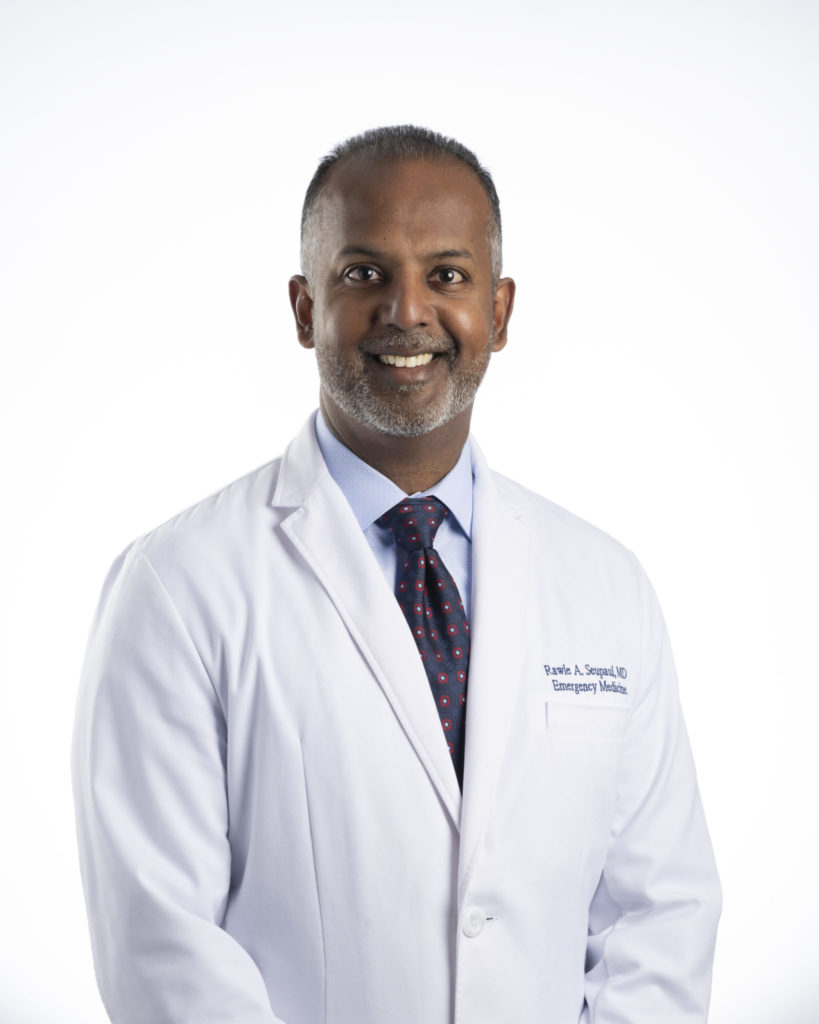
Conversation with Dr. Rawle “Tony” Seupaul

Interview by M. Paige Plumley and Jace C. Bradshaw

Please note: As you will soon see, our interview with Dr. Seupaul occurred prior to many recent events, including the Novel Coronavirus pandemic and the recent attention given to the Black Lives Matter movement. We, the interviewers, are fully aware of these changes to our social environment, and we know that Dr. Seupaul is, too. Perhaps we all can find messages appropriate to these challenging times in Dr. Seupaul’s story: although we cannot anticipate the future, as much as we would like to, the greater skill lies in being able to adapt to the situation at hand. It is important for all of us to nurture our own resiliency in the face of adversity, just as it is important for us to help in nurturing the resiliency of those among us, including members of our families, friends, students, colleagues, and all those who seek our care as health professionals. In Dr. Seupaul’s own words, “We control our own destiny. If we work together, we will not only overcome our current challenges, we will be stronger as an institution and as a country.”

Tell us about yourself.

Tony Seupaul, M.D.

I love this question. Everyone has a story! That’s the most important part of getting to understand an individual. Let me tell you my story. 

First off, family is the most important thing. I’ll tell you about my wife first. She was my high school sweetheart. We have known each other since 7th grade. We were a couple back then, which meant that as soon as we saw each other, we ran to opposite sides of the school. We reconnected between the summer of 11th and 12th grade.

She stayed in Florida after high school, and I went to Northwestern [in Chicago, Illinois]. We were long distance for seven years. Since I couldn’t get rid of her, I figured I would just marry her. Just kidding! I got married in my fourth year of medical school just before I graduated, and we have been married now for more than 22 years. We have two girls. My oldest daughter is at the University of Arkansas in Fayetteville and is taking her MCAT. My youngest daughter is graduating from Central High School this year.

My family is originally from Trinidad and Tobago, a small island in the Caribbean. It is the southernmost island in the Caribbean right off the coast of Venezuela. Both my mom and dad immigrated to Toronto, where they met and decided to get married. Growing up, I lived in several parts of Canada and multiple places across the US, but I mainly grew up in Miami, Florida. 

I also lived in Trinidad for a while and went to school there. My grandfather was the headmaster of the school, and he was revered and feared—no one messed with the headmaster. It was a very parochial, based on a British system of education. Wherever I lived, though, when I was at home, it was very much a Trinidadian household. That is the culture that I grew up with.

When I graduated high school in Miami, I knew that I had to get the heck out of there. I knew that if I went to the University of Miami or the University of Florida, it would be just like going to high school again. I was a very competitive speech guy in high school, and my debate partner and I both got into Harvard. We were going to go there and do the whole speech and debate thing. But then I got the offer to complete the 7-year medical program at Northwestern, and I just couldn’t turn down an opportunity like that. That turned out to be a really important decision in my life because, for the first time in my life, I was academically challenged. That changed me and humbled me.

How did you end up in the field of Emergency Medicine?

At Northwestern, Emergency Medicine (EM) wasn’t a “thing.” I did my EM rotation there and did not like it. I also did an away rotation in Miami at Jackson Memorial Hospital that was horrible. Still, I was convinced that EM was the career path I wanted. EM was one of those fields where I felt like I could get a little bit of everything. You get to do the hands-on procedures and traumas, and then there are the added bonuses of never being on call and not having to be in the clinic. I love my patients, but I don’t want to deal with their diabetes every day. I would much rather just take care of it that one time. That is how I am built. I think the “personality” of EM is one that fits me very well. I matched at the place that I wanted to go, which was Carolinas Medical Center in Charlotte, NC. It was my dream residency.

My first year, I won the intern of the year award. This was an honor because it was voted on by the entire institution, not just Emergency Medicine. As I would find out, EM was quite beloved even on the other services, which is part of what made that place so great. We felt special. My last year, I was a chief resident and felt very grateful and validated in my career choice.

What led you to a career in Academic Medicine?

I had some phenomenal faculty at Carolinas. They pointed me in the direction of academic medicine. I ended up getting offers from Indiana University and Carolinas. I wanted to be at Carolinas, but I ended up turning it down because of some advice that my mentor gave me. Had I stayed there, it would have been a very easy transition. Everyone would have known me, and I wouldn’t have had to prove myself. Only I might have been viewed as sort of a “super resident.” My mentor challenged me to go to a different system and prove myself with individuals who don’t know me at all. If I truly had the potential for greatness, I would flourish. Great advice, the execution of which is very difficult, as I quickly learned.

I went to Indiana University. It was a completely foreign place; I knew no one. To say my career at IU was rocky to start would be an understatement. I hated it. It was bad. Technically, I quit after two years. I rapidly realized the error in my ways. That’s just not how you handle a situation like that. I asked for forgiveness and discussed how to rehabilitate my career with my department chair. We tried to align the things I hold true in my core values, which meant I had to ignore some other issues. 

I took a lot on myself, and I flourished. I taught myself how to write, how to publish, and how to perform and conduct research trials. I built my niche around evidence-based medicine and education. I stuck to my niche and eventually got good at it. Then, after thirteen years, I got to a point in my career when I realized that I was ready for a new challenge in my life. When the opportunity to become Chair here at UAMS became available, I took it. It was the next big step in my career, one I will never regret.

For students who are considering their career path in medicine, what do you wish that you had known before you started?

Number one: Stick to your guns. Like I said before, at Northwestern, Emergency Medicine just wasn’t a priority field. It just wasn’t important. But I stuck to my guns. I did thorough research to test myself on what career I thought would be the best fit for me. I challenge medical students to do the same.

Number two: I think if you have a lot of happiness in your personal life, that will spill over into your professional life and vice versa. If you are miserable in your job, it’s going to affect your personal life. Either you align yourself in a field that you truly are passionate about, or you will not be successful in medicine. Call it burnout or career mismatch or whatever you want, but as someone who has been in academic medicine for 20 years now, if you don’t choose a career that you are passionate about, you will not have a long career.

You mentioned burnout. How do you avoid burnout in your own life?

Burnout is real. Still, we have to be very careful how we focus on burnout because to a certain degree, focusing on burnout sort of creates burnout. Like with a lot of things in life, it becomes reactionary, and the pendulum swings too far to the other side. We have to find that happy medium on things. There is not a one size fits all when it comes to wellness. I think wellness has to be tailored to each individual, although there are things we can do that cut across to everyone. It’s not all about money It’s about recognition and making people feel good about the great things that they do. That is something that we sometimes forget.

One of the things I have noticed from a wellness standpoint, and medicine sets us up for this, is that if you think about what it takes to be a physician, you have to be the best of the best. Right? So by the time you get to the end of the road, you are kind of the 1% of the 1%. Most of that is because you are driven, committed, and innately intelligent. That same drive can be the detriment to wellness. We are our own worst enemies. We are never good enough, which is what created this drive in the first place. It is a good thing until it becomes a bad thing.

One thing I think is 100% true about physicians, in any discipline, is that we all have some spectrum of imposter syndrome. We are always afraid that we are going to be found out, and someday someone is going to come up and say, “You are a fraud. You are not good enough. You don’t know what you’re talking about.” I have had these same fears. They can be motivating, but they can also be destructive. I firmly believe that on an institutional level, we need to take wellness seriously. 

For me, my wife has supported me through every step of my career. She has always been my foundation and my support. My wellness is tied to my family, and I love spending as much time as I can with them. My wife, my children, and I have this working understanding of what that means and what that looks like for us. I also love sports and am a big college football fan. I love to travel. I have known my five best friends for 30 years now.  We have an annual trip during which we tell the same stories, eat great food, and just have a great time together. That is my wellness. I indulge in those things that I enjoy and don’t sacrifice them. I think that I have figured out what is important to me, and that’s what I invest my non-work time in.

What was the last book you read?

It is right here on my shelf: Drive by Daniel Pink—a fascinating book. It’s about what drives human behavior. It gives a brief history of the cavemen and how they were driven by survival. Then the industrial revolution was essentially people working hard to get ahead and make more money. Pink then delves into what it takes for individuals to be productive in a modern setting. It turns out that the traditional methods of employment don’t work that well these days. As we move into today, it’s not about working harder. It’s about working smarter.


M. Paige Plumley and Jace C. Bradshaw are both medical students at UAMS.

Filed Under: 2 - Conversations at UAMS

Our Best Selves

A pandemic brings out the truth of people.
At first, toilet paper was hoarded and nobody cared about each other,
But once times got tough, our humanity truly showed itself.
Donations poured in and volunteers were in excess.
Support small business was the community motto.
When others are in need, we become our best selves.​


Hunter Augustus Ramey is a medical student at UAMS.

Filed Under: 55 Words

Season of Guilt

I sit by my window peering down and smiling upon the empty streets.

Springtime blooms are dancing, uncorrupted by the usual artificial noise, pollution, and commuters. 

How can I lounge about and admire the scenery from my high castle knowing others gasp and gargle in isolation?

Still, the neighborhood is beautiful this time of year.


Tyler Christian Thompson is a medical student at UAMS.

Filed Under: 55 Words

United We Stand, Divided We Fall

Panic breaks loose. Fear sets in. What am I to do???

Frustration swells. Patience is lost with all. This is just one big overreaction!!!

Flip a coin and see which team you will join.

OR

Take a step back, 6 feet or so, and meditate. Join hearts, not hands, with your community. We are one.


Erica Olson is a medical student at UAMS.

Filed Under: 55 Words

The Birds

I do not want to forget this moment,    
the taste of close uncertainty,    
the clarity of mortality
the weeping and weariness of the world.        

The sacrifice of heroes,    
the generosity of communities,    
the depth of hope,
and of a calling realized,    
the joy in helping and of healing.        

The way the birds sing each morning.


Kaitlynn Butler is a medical student at UAMS.

Filed Under: 55 Words

  • «Previous Page
  • Page 1
  • Interim pages omitted …
  • Page 10
  • Page 11
  • Page 12
  • Page 13
  • Page 14
  • Interim pages omitted …
  • Page 16
  • Next Page»
University of Arkansas for Medical Sciences LogoUniversity of Arkansas for Medical SciencesUniversity of Arkansas for Medical Sciences
Mailing Address: 4301 West Markham Street, Little Rock, AR 72205
Phone: (501) 686-7000
  • Facebook
  • X
  • Instagram
  • YouTube
  • LinkedIn
  • Disclaimer
  • Terms of Use
  • Privacy Statement
  • Legal Notices

© 2026 University of Arkansas for Medical Sciences