• Skip to main content
  • Skip to main content
Choose which site to search.
University of Arkansas for Medical Sciences Logo University of Arkansas for Medical Sciences
Medicine and Meaning
  • UAMS Health
  • Jobs
  • Giving
  • About Us
    • Submission Guidelines
  • Issues
  • Fiction
  • Non-fiction
  • Poetry
  • Conversations
  • Images
  • 55-Word Stories
  • History of Medicine
  1. University of Arkansas for Medical Sciences
  2. Medicine and Meaning
  3. Author: Chris Lesher
  4. Page 19

Chris Lesher

After the Hospital

By Melanie Beehler

A week ago, you thought the next breath could be your last.
The family and friends were buzzing with worry
and all visited you in such a scurry.
The nurses and doctors fixed you—quite fast! 

Your lungs now clear and the discharge approved,
you smile and think that the hardest has passed.
The love you were surrounded with felt vast.
Your visitors went home, as they were soothed.

Now you are recovering at home alone.
The chores piled up and the bills began.
Worry was back although not part of the plan.
Your friends had jobs they could not postpone.

Who knew that the hardest part of a hospital visit
involved your own mind and the games it plays?
The loneliness and tears may lead you astray
but you must survive – and that is explicit. 


Melanie Beehler is a second-year medical student at UAMS. She previously attended Lyon College in Batesville, Arkansas with a major in chemistry and biology. She is originally from the small town of Pea Ridge in Northwest Arkansas. In her limited amount of free time, she enjoys spending time with her friends, drinking iced coffee, and petting every dog she sees.
Filed Under: 7 - Poetry

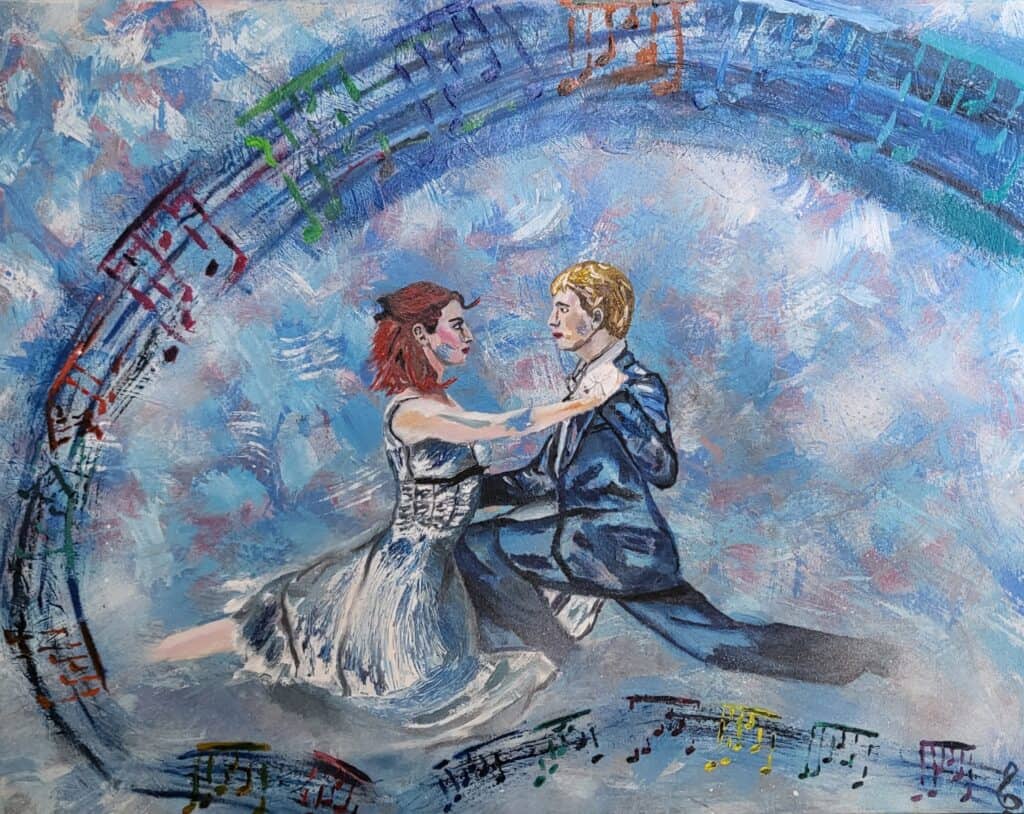
The Dancers

By Nathan Cook

Painting entitled The Dancers. A man and woman are caught in a dancing pose with a banner of music notation around them. The primary color of the painting is blue.

As an artist, much of my work is inspired by my everyday environment. This could range between items found around my home or current events, music, etc. I then attempt to translate those objects or ideals from my chosen media for a unique experience. 

It’s my goal, if only for a moment, that my artwork will give the viewer pause and allow the piece to provoke careful consideration. My art has a story to tell. And maybe the possibility to elicit an emotional response everyone can identify with awaiting beneath its surface. 

I was born in Arkansas, and later the U.S. Army took me to many places to encounter a plethora of experiences. UAMS was paramount in treating me and others in the post-war veteran community—which extends to their collaboration efforts with the Little Rock VA services. 

Reuniting with my family on my return to Arkansas in 2011 also initiated an inward journey reconnecting with my childhood. I came from a family of artists. Growing up, my grandmother and I would paint together. Her hand would clasp mine as a young child, directing brush strokes to provide a sense of visual development on canvas.  

As a child, I ventured through my grandparents’ house and looked at all the paintings. Some were by my grandmother or aunt or reprints from the Renaissance. I remembered the ambient sounds from outside making their way through the external walls as I studied those paintings; a random breeze would push against the house, and the jumbled melodies of wind chimes would dance in my ears, accompanied by the music of songbirds: nature and art. I wouldn’t know until later in life the impact art had on my life.In grade school, I was introduced to a new form of art: music. During my artistic journey, music played a profound role in finding inspiration. I began to look at music as if my ears were the paintbrush and my mind the canvas, slowly revealing a beautiful and intricate picture. I also learned to play three types of saxophones and the electric guitar. I attended every school competition and camp in Arkansas to be the best I could be. Later, an idea came to me. What if I could somehow translate emotions and images that came to mind when listening to music into a painting?

I pursued art professionally in 2018. My grandmother, my inspiration for artistic endeavors, has since developed dementia. My family and I confidently chose UAMS to play a role in my grandmother’s healthcare. In one of her brief states of cognition, she gifted me all of her art supplies. The brush hairs from some of the paint brushes were falling out, attributed to the passage of time and those invaluable moments together as grandmother and grandson. Armed with her tools and music, I got to work.

People may not know that all art forms create inspiration and influence other artists. This can be in literature, music, or something visual. I consider this a form of feedback loop, if you will. In 2018, I found myself enraptured by the music Airborne Dances by symphonic composer Oliver Davis. I was so captivated that it inspired me to paint, Airborne, an attempt to capture the musical movements of the concerto.

I wrote Davis to extend gratitude which led to a professional acquaintanceship. The visual sense joins the auditory sense. Oliver Davis’ future musical works would continue to play a role in inspiring my art. 

In 2020, the COVID-19 pandemic was in full swing and had a devastating death toll. Despite the virus on the rise, it didn’t deter Davis from composing a new album. He embarked on a task to record the album, Solace. He assembled musicians worldwide, aided by remote technology, to complete the necessary recordings for his new album.

Like those in the medical professions tirelessly working to aid those with the Coronavirus, the international artistic community did its part to combat mass depression thriving in the wake of the virus by creating music. The term ‘solace’ means to comfort or console in a time of sadness or distress. After listening to the new album, I felt driven to create a painting that portrayed happiness.With this in mind, I painted The Dancers. It was later nicknamed Ghosts Dancing amongst some viewers, as it was noted that the dancers seemed to develop from the background. The painting represents happiness in an era of despair during COVID and the Russo-Ukrainian War. Where something as simple as human touch was now considered forbidden, I placed my thumbprint into the oil paint, where the dancer’s hands joined, emphasizing human touch. Sometimes we need a reminder to be thankful for those happy moments when we danced, rejoiced, and touched; tomorrow, we know not what awaits us. The painting found a home with Oliver Davis in the U.K.

Filed Under: 7 - Images

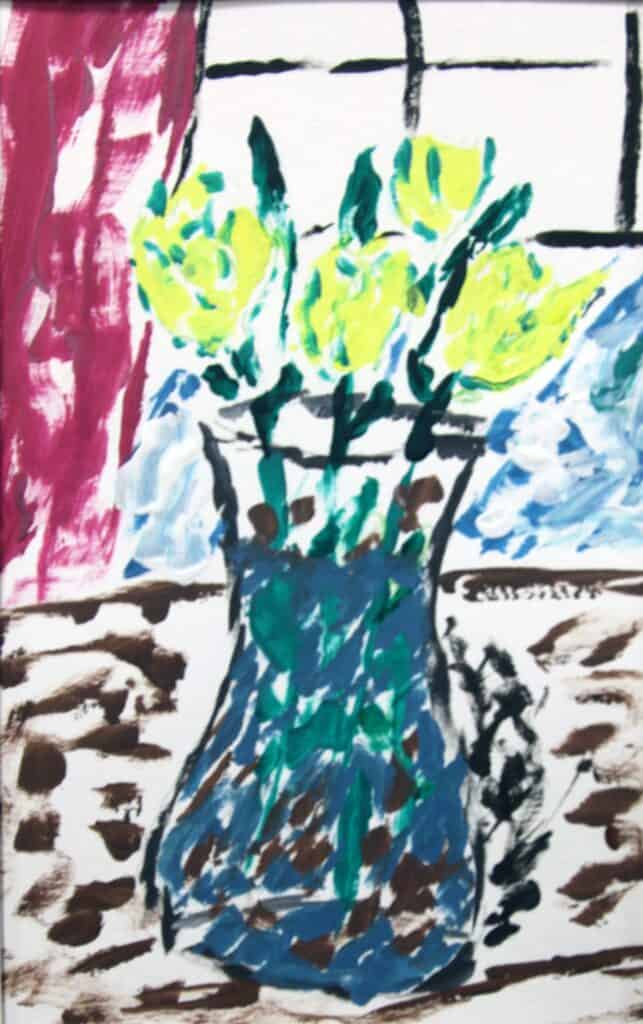
Vase with Flowers

By Robert Gay

Painting of yellow flowers in a clear vase. You can see the green stems in blue water. There is a red curtain in the background.

I have really enjoyed the painting class over the last several months [at UAMS]. The instructor is very helpful and innovative in teaching the various types of paintings and methods available. I am doing something I never believed I could do and enjoy.

Filed Under: 7 - Images

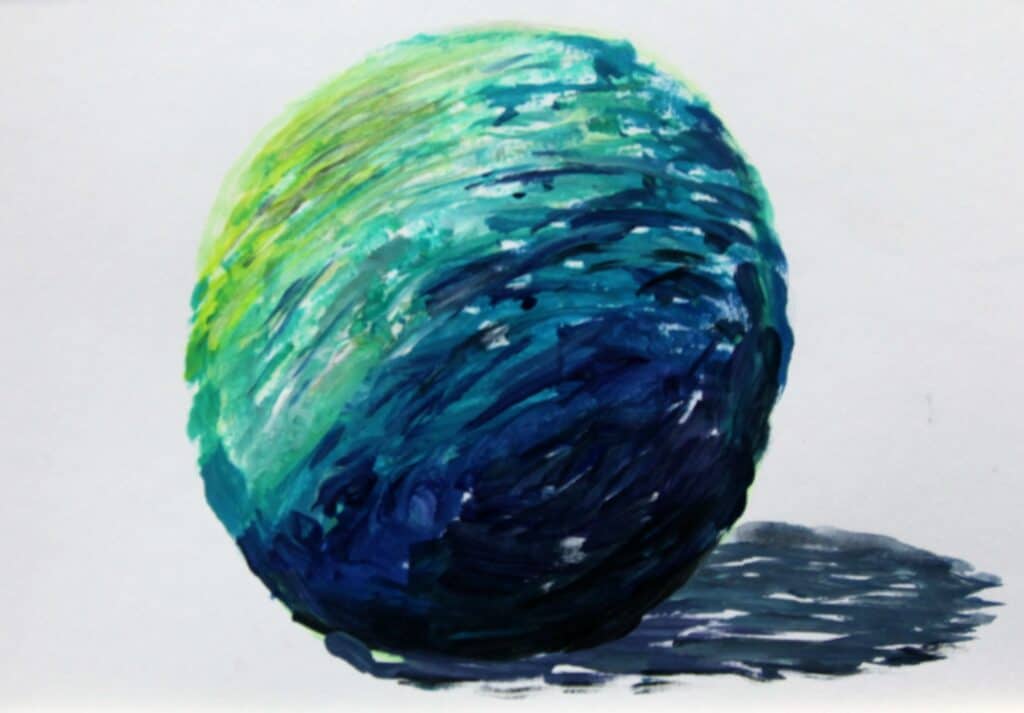
Green and Blue Ball

By Susan Santa Cruz

Painting of a ball, green on one side and blue on the other

I graduated from the UAMS College of Medicine in 1979. I had a primary care Internal Medicine practice for many years, followed by over ten years working as a hospice physician. In retirement, I enjoy pickleball, bridge, and painting. This painting was part of an exercise on light and shadow. We were asked to determine an imaginary light source and paint the appropriate shadow that would be cast. 

Filed Under: 7 - Images

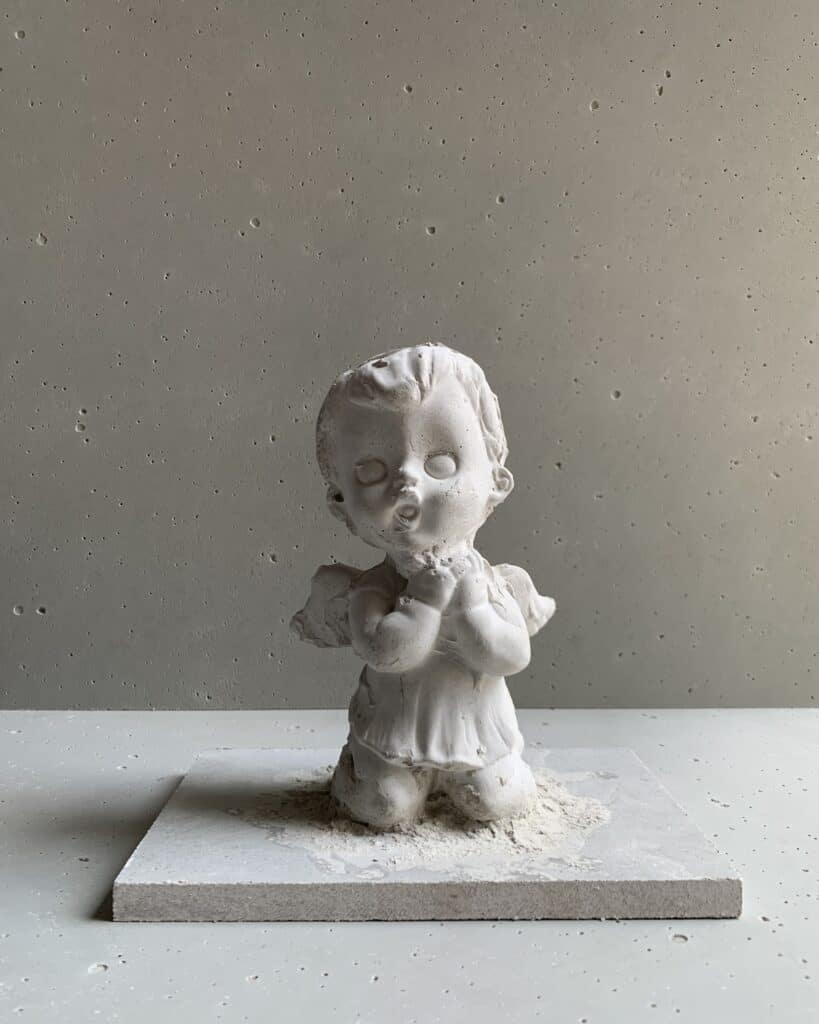
Angel

By Mario Loprete

Concrete state of a child-like cherub

I created this sculpture using as a model my first toy that was given to me by my parents when I was a baby. An angel who accompanied me in life, helping me in difficulties and guiding me towards God. He stayed by her side and helped me face the most complex and difficult moments.

Painting for me is my first love. An important, pure love. Creating a painting, starting from the spasmodic research of a concept with which I want to transmit my message this is the foundation of painting for me. The sculpture is my lover, my artistic betrayal to the painting that voluptuous and sensual lover that inspires different emotions which strike prohibited chords. 

For my concrete sculptures, I use my personal clothing. Through my artistic process in which I use plaster, resin and cement, I transform these articles of clothing into artworks to hang. The intended effect is that my DNA and my memory remain inside the concrete, so that the person who looks at these sculptures is transformed into a type of postmodern archeologist, studying my work as urban artefacts. 

I like to think that those who look at my sculptures created in 2020/2022 will be able to perceive the anguish, the vulnerability, the fear that each of us has felt in front of a planetary problem that was Covid-19 … under a layer of cement there are my clothes with which I lived this nefarious period. Clothes that survived Covid-19, very similar to what survived after the 2,000-year-old catastrophic eruption of Pompeii, capable of recounting man’s inability to face the tragedy of broken lives and destroyed economies.

Filed Under: 7 - Images

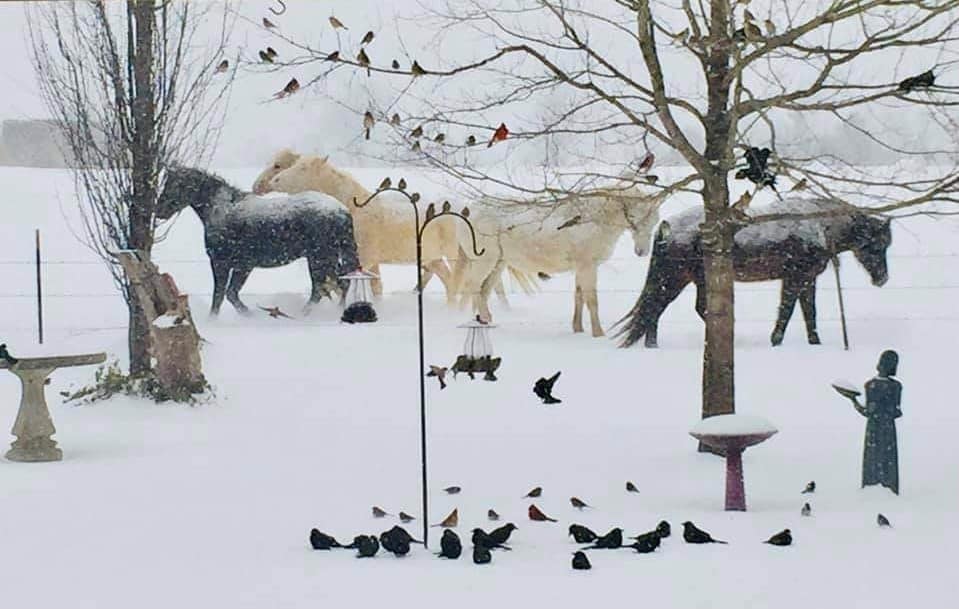
Breakfast on a Snowy Morning

Horses standing in a snowy field. Birds of various types adorn the branches of trees and the ground.

David Goff is a retired teacher and financial aid director of a small college in Paragould, Arkansas. He loves canoeing, backpacking, and feeding the horses over his backyard fence.

Filed Under: 7 - Images

OSCE

By Olivia Brown

Smile and knock — enter when permitted.

Shaky and washing my hands.

“What brings you in today?”

Loud enough for the cameras to pick up – empathy.

Interview progresses, grades hopeful.

Past medical history ending, home stretch.

“And when was your last period?”

Gentle smile.

“Menopause for ten years.”

Note to self — check patient’s age before entering.


Olivia Brown is a third-year medical student who wrote this piece to reveal that humor can often be found inside the practice of medicine

Filed Under: 7 - 55 Words

Just Fine

By Stephanie Gardner

I worried…. despite her insistence that she was “just fine.” And now my heart aches with things unsaid.  Questions unasked, sentiments not shared. Yet, as I reread her last email, I once again marvel at her fortitude, brilliance, determination, and unbridled passion.  And I conclude….she was right.  She was “just fine.” Unmistakably, exquisitely, fine.


Stephanie Gardner, Pharm.D., Ed.D., is Provost and a professor in the UAMS College of Pharmacy. She is an avid reader and passionate about promoting the arts on our campus.

Filed Under: 7 - 55 Words

Dependable, Like the Tides

By Stephen Phillip Johnson

They come, in shifts— through side entrances, private doors…. most

wearing comfortable, expensive shoes, color-matched pants and tops

squeezing-in last minute family talk, world business…. on cell phones.

Somewhere in this sanctum cube (say, Room 416), a bed-bound soul alerts

to the Change, hopefulness warming; the One with the soft touch is near!


Stephen Phillip Johnson is a Mountain Home carpenter. Writing is his itch. Within the halls of medicine, where he’s been (repeatedly) healed, reside flocks of muses.

Filed Under: 7 - 55 Words

Appalachian Apathy

By Collie Mason Shaw

“What will it do, kill me?”  

Said a wearied coal miner 

Who caught me eyeing the tobacco smoke 

Pouring from his tracheostomy. 

“I don’t want to live forever, just long enough,”  

As he lit another spliff 

Half jaw working hard verbalizing regret 

“Just three months to turn my life around, I don’t want a miracle.”


Collie Shaw graduated from the UAMS College of Medicine. She is currently an intern at Unity Health in Searcy, Arkansas and wrote this to emphasize the heartfelt emotions of end of life and goals of care.

Filed Under: 7 - 55 Words

  • «Previous Page
  • Page 1
  • Interim pages omitted …
  • Page 17
  • Page 18
  • Page 19
  • Page 20
  • Page 21
  • Interim pages omitted …
  • Page 30
  • Next Page»
University of Arkansas for Medical Sciences LogoUniversity of Arkansas for Medical SciencesUniversity of Arkansas for Medical Sciences
Mailing Address: 4301 West Markham Street, Little Rock, AR 72205
Phone: (501) 686-7000
  • Facebook
  • X
  • Instagram
  • YouTube
  • LinkedIn
  • Disclaimer
  • Terms of Use
  • Privacy Statement
  • Legal Notices

© 2026 University of Arkansas for Medical Sciences