• Skip to main content
  • Skip to main content
Choose which site to search.
University of Arkansas for Medical Sciences Logo University of Arkansas for Medical Sciences
Medicine and Meaning
  • UAMS Health
  • Jobs
  • Giving
  • About Us
    • Submission Guidelines
  • Issues
  • Fiction
  • Non-fiction
  • Poetry
  • Conversations
  • Images
  • 55-Word Stories
  • History of Medicine
  1. University of Arkansas for Medical Sciences
  2. Medicine and Meaning
  3. Author: Chris Lesher
  4. Page 14

Chris Lesher

Hey Doc!

By Humaira Khan

Back stooped, feet shuffling. Hands trembling, rolling imaginary pills. 

His wife follows, smaller at each visit, struggling. 

“Hey Doc!” he says. 

I look up smiling, thinking he means me, but find him grinning at an empty chair. His wife’s sad eyes speak volumes. I remember then: “Doc” is the person no one sees but him. 


Humaira Khan, M.D., is a neurologist, mother, nature-lover, and amateur photographer with a life-long passion for the written word. She has a Diploma in Freelance and Writing from the London School of Journalism and her work has been published in Intima as well as in Lifestyle and Consumer magazines, both online and in print.
Filed Under: 8 - 55 Words

Circling the Drain

By Catherine Corless

You’re circling the drain.

You know you are.

A slow death.

Stop talking to yourself – do something about it.

Just stop drinking.

You are circling the drain.

Today will be different.

Don’t drink today. Or, just not so much. 

Just two drinks at dinner.

Just three…

Maybe tomorrow.

You’re circling the drain.

Until – you aren’t.


Catherine Corless, J.D., has been practicing law for 20 years and writes what she knows.

Filed Under: 8 - 55 Words

Backyard Backstory

By Aditi Pant

When we finally had a backyard there was no time to watch the stars at night. The day ran fast tiring us and the night dropped quickly. Then, one early morning, for few precious moments, he made me look up. Some stars remained twinkling in the darkling dawn. When you make space, the universe adjusts. 


Aditi Pant is an educator and writer in Houston and words are her solace, strength and sanctuary. 

Filed Under: 8 - 55 Words

The AIDS Quilt

By Bree LeMaire 

The AIDS quilt panels spread out over a quarter mile in Washington, D.C., on the National Mall. People slowly, reverently, walk looking down, taking in endless panels. The reality of it all jolted me. I knew there were deaths, but I never dreamed they were of this magnitude. One panel had an appliquéd photo of a man floating on clouds surrounded by signatures. Another had a tree with a name on each branch and then further another extended section with kids having hemophilia, mostly boys, so very young. Another panel showed a bouquet of multicolored balloons and below them a name with the lifespan date. Next was a flag full of stars across a gay rainbow and a short poem with a name. Then came a Spanish saying mentioning discrimination with the victim’s picture and the word “non.” One after another of clouds, balloons, quotes, sayings, and special messages. With a full heart I realized they all spoke of a special individual loved enough for another to take their time to construct a quilt. I joined the slow parade, walking, in my own solitude, reading, digesting, taking it all in. 

I was two years into my work as an AIDS research nurse at UCLA, and had gone home to visit my folks in Delaware.  Only a short train ride to check out the quilt, this experience was a break from family intensity. 

Strategically dressed in white and walking between the panels were grief volunteers. It was late afternoon. Some spoke quietly with the strolling visitors, while another put their arm around an older man and offered a tissue. At one point I watched a conga line of those white-clothed people holding hands and quietly dancing by. There in the middle of the line was Richard, a handsome man with light brown, curly hair and deep blue eyes, a friend. Here was a familiar, understanding person to connect with, one of the subjects in my study. Neither of us had talked of going back East, and there he was, standing with his arms open for me to walkinto.

“I can’t believe all this. How does a person take it all in, so many?” I mumbled. 

Once we recounted our surprise at meeting one another so far from Los Angeles, Richard led me to a nearby bench. I cried while he supported me for at least an hour. Then a far-off bugle began playing taps. The white-clothed volunteers began to form a circle around each quilt, and slowly began a silent folding ceremony. Each piece was taken, stacked, and stored for the next day. 

“The damp comes in at night and seeps in if we don’t put them in dry storage,” Richard explained.

As the guardians put the panels away, I hugged Richard and said goodbye. We promised to reconnect, and I headed back to Delaware, a million miles from all the sadness. A month later, I heard from Richard. He said he’d been dealing with mycobacterium avium complex and cytomegalovirus, both normal bacteria and viruses we carry every day, but immuno- compromised people cannot fight them off. 

“I was responding to treatment,” he said, “but we all know there is no cure.” When he felt better, I saw him for a home visit. This included a lunch his home health aide prepared. Richard lived in a beautiful West Hollywood house, bright and sunny with lots of windows, flowers, and white curtains. There were newly planted pansies, begonias, and white daisies along the entry walk. We enjoyed the sunshine from his kitchen window. He said, “I used to own eighteen houses in Los Angeles. I invested in real estate, and now I’m losing them all as I can’t make the payments.” It was his way of telling me how successful he had been, a counterpunch to his illness.

When I next called Richard, his roommate said he’d moved, which didn’t make sense, as he had seemed settled in at home with his aide. Then I heard from his aide. Richard had died. Six months later, I read his obituary in the L.A. Times. He’d died in a local hospice. I realized his desire to be seen as a successful real estate investor, not a debilitated victim in an AIDS hospice. Once more I knew the emptiness of separation during Richard’s final days and felt sad, as I was never offered the opportunity to say “Goodbye.” Even so, I cherish the sunny Washington afternoon when he emerged from a conga line and welcomed me into his loving embrace.


Bree LeMaire, RN, M.S., worked in HIV research for ten years. At forty-eight, she was happy to find a research job at UCLA, even though HIV was something health care workers avoided. Her focus would be on research, never thinking the patients would become dear friends who became sick and died. Writing was her method for coping with so many deaths.

Filed Under: 8 – Non-fiction

The Clang of Distracting Thoughts 

By Eli Daniel Ehrenpreis

“Who will ask me for medical advice at this wedding?”

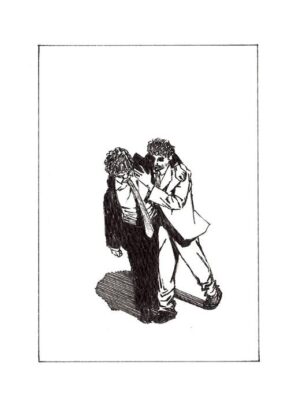
illustration of one man holding another
Untitled (two and a half), by Jean Lemonnier

The music wasn’t banging loudly, so this time, sitting alone and having a drink, I am able to internalize my thoughts without interruption. I want to solve their medical problems. I want to have a perfect memory. 

The exercises start: Reasoning, remembering, synthesizing…. all are functioning well. Guidelines, diagnostic hints, eponyms, treatments, adverse effects, CAM, data analysis…all there. There are the concepts that I can reach directly from inside of my head; there are the memories that are tucked away that I can rapidly retrieve. If I think for instance of the names of the wrist bones-scaphoid, lunate, trapezius, trapezoid, hamate, capitate from the mnemonic SLT your wrist-that I memorized forty years ago-they materialize when summoned. The causes of anion gap acidosis-SKUMPILE. The Chief of Medicine ranting about high output cardiac failure and destroying you if you treat it with Lasix.

Sometimes it’s hard to relax.

The regs at work don’t do this. They find me and my thoughts too distracting. Gargoyles still stare down from old buildings at me as I walk along the quad.

I once piped up that “fenugreek makes your urine smell like maple syrup” during one of those dog and pony shows for doctors; an academic type giving a lecture trashing alternative medicine; the audience eating their steaks and drinking their wine. So, when I mentioned the maple syrup, one of the regs whistled in that “anyone can look up facts like that on their phones” …and I decided not to defend myself. 

I see that this same guy is at the wedding.

After dinner, an acquaintance and I are discussing his prostate cancer, when a millennial runs into the reception hall looking for my help, because an elderly guy is standing by the bathroom saying that he isn’t feeling well.  I go to check. He’s just a drunk old doc who overdid it at the open bar. I send him home after coffee and some psychotherapy. 

In the meantime, I notice that the reg doctor from the meeting is walking away in the opposite direction so he can avoid the situation near the bathroom. 

The acquaintance with cancer sees it all. And he says to me, “That’s why people ask you for medical advice at weddings. Not him.”


Eli Daniel Ehrenpreis, M.D., started life as a musician then became a physician, educator, writer, and inventor. He stopped seeing patients due to disability. His latest book, The Mesentery in Health and Disease, was published by Springer International. His prose and poetry writing often focuses on his own experiences. He has three adult children and lives with his wife Ana and two small dogs in Skokie, Illinois.

Jean Lemonnier was born in July 1999 in Bayonne, France. Interested in notions of sciences and spirituality like the void or the inner infinity of moments in suspension, Jean aims to create fictions of alternative permanences through different mediums. In 2021, Jean degreed from the MO.CO. ESBA fine arts school based in Montpellier, France, where his practice was based on drawing, engraving, video, volume with wood and metal. He’s currently living and working in Ibaraki, Japan, where he continues his studies on the master Global Art Practice of the Tokyo University of the Arts.

Filed Under: 8 – Poetry

Happy Birthday, Dr. Napier

By M.N. Wiggins

Without remorse, Melvin’s alarm announced the arrival of seven a.m. Seven would have been sleeping–in three years ago. Three years ago, he’d lived in Maumelle, a 20 to 30-minute drive to his practice in downtown Little Rock, depending on traffic. But now, living in a loft directly over his clinic, seven arrived earlier each day. The seven & sevens he’d knocked back at McKeen’s last night weren’t making it any rosier. He flopped an arm to the other half of the bed without opening his eyes. It returned the same report it’d given the day before and the day before that—no Alexis.

Melvin stood groggy-eyed in his bathroom, replenishing the Earth with last night’s fluid intake, his recycling effort on the day. He zombie-walked into the loft’s tiny living room/kitchen to make himself a Dolly Parton Nine-to-Five cup of ambition and burned his finger on a match as he lit the gas stove. With coffee going, he spied the Sugarfield Sugar Cookie box on the counter. He raised an eyebrow’s worth of breakfast hope. Unrewarded, he chunked the box, knocking over the trashcan and giving his floor a decorative mosaic of beer cans, banana peels, and coffee grinds. With less hope than he’d held for the box of cookies, he opened the kitchen cabinet. Only two occupants peered back: a dented can of hominy, whatever the heck that was, and a red and blue cardboard cylinder with a picture of a Quaker smiling much too happily at this forsaken hour. 

Melvin checked the fridge. A half-eaten lemon-glazed bundt cake sat on the rack below the bottle of spoiled milk. “Winner-winner,” he mumbled. He grabbed a dirty fork out of the sink and gave it a cursory rinse under the faucet, or at least he thought he did—last night’s haze was doing an encore. Sitting at his tiny table, he examined the encrusted remnants on his fork, working to recall what he could’ve eaten that was orange. Shrugging, he wiped it on his BVDs and plunged it into his breakfast, creating a crispier sound than you’d want from a bundt cake. His eyes narrowed as he picked at the green splotches. Melvin muttered something about beggars and choosers and dunked a piece into his coffee to soften.

He chucked the rest into his resurrected trashcan and stood at the window, sipping soggy-crumb coffee and stared at the April morning. 1952 Little Rock stared back. 

Melvin glanced at the table. There’d be no birthday cake when he climbed the stairs after work, no one to light candles, no one to sing, no wife to kiss, no young sons to greet him, excited that Daddy was home. He’d had none of those things last year or the year before—not since his arrival. 

Freshly showered and in coat and tie, Melvin opened the front door and stepped onto the landing that overlooked the clinic below. He heard patients checking in downstairs, a full day’s work ahead. His gaze turned to the loft door opposite his. A wave of nausea washed over, just as it had every morning since Sally had left. He closed his eyes and inhaled, but after four months, the lingering combination of cigarettes and perfume emanating from her loft had vanished, just as she had. 

Melvin rubbed his temples, reliving the shouting match, this woman who’d gone out of her way to make him feel welcome, not just as his clinic receptionist, but as his best friend since landing here in 1950. She’d wanted more from the get-go, but he’d pushed her into the friend zone. Like everyone else in this decade, Sally had no idea Melvin had a wife, two kids, and a laminated Blockbuster card dated 2004. 

Secrecy was a solid strategy. Thrust over half a century into the past without friends, family, or cash, the less you revealed, the better. How he’d gotten here, how they’d met, and how he’d been able to practice without a license was a long story, a novel unto itself. None of that mattered today. Today, everything was lost—his family back in 2004, Sally to parts unknown, and recently, his last-ditch effort to travel home had spiraled down the toilet. Nothing to do now but soldier on. Go see patients. Another joyous day of figuring out how to be a 1950’s ophthalmologist without topical antibiotics, steroids, lasers, ultrasound, or anything remotely useful. Head hung low, Melvin descended the black iron spiral staircase, turn by turn, into the circular depths of the inferno. If he’d read Dante back in college instead of putting moves on his girlfriend’s roommate, he’d have gotten the metaphor.

A pot-bellied forty-two-year-old met him with a grin at the bottom. “You look like death warmed over.” He handed Melvin two aspirin and a glass of water.

“Shut up, Ronny.” Melvin downed the pills, followed by the chaser. “Thanks for the cure-alls.” Melvin rubbed his head. “I’d kill for a mocha and Pop-Tart right now, and it’d be justifiable homicide.”

Ronny squinted. “What the heck’s a Pop-Tart?”

“Pure Heaven in tinfoil.”

Ronny shook his head. “Canadians are weird. By the way, happy birthday. How old are you, anyway?”

Melvin shrugged. “Negative 19.” He rubbed his head again. The truth hurt as much as the math.

Ronny’s eyes lit up. “Hey, man, check this out.”

Melvin held up a hand. “Dude, I told you, no more pictures of your dog. Don’t care that your momma knitted you guys matching sweaters.”

Ronny huffed, “That wasn’t it, smart guy.” He half-turned and pushed photos back into his hip pocket. “Check out the dude across the street.”

Melvin closed his eyes and massaged his temples. “Leave me alone, man. I’ve got patients to disappoint.”

Ronny smirked. “Yeah, like that’s possible.”

“What do you mean?” 

Ronny nodded toward the waiting room. “Way I hear it, your clinic is packed with unmarried socialites dressed to the nines, and they ain’t here for glasses.” Ronny tapped his left ring finger.

“That was all in Sally’s mind. She thought every lady in my clinic had some ulterior motive. Not true.”

“What about the desserts they bring you?”

“It’s the South, dude. People are nice.”

“I’ve seen you with icebox cookies, lemon chiffon pie, cupcakes, tea cakes, brownies. And remember when that Marci girl tried to make you bananas foster here in clinic? Darn near burned the place down. Arkansans are nice, but we ain’t that nice.” 

“What’s your point? I’ve got a full day’s work and a massive hangover.”

“My point is, you’ve moped around for the last two years, man. You haven’t been on a single date, except with Sally, and we both know those weren’t date-dates.”

Melvin’s eyes brightened. “Have you heard from her?”

Ronny shook his head. “She’s gone, dude. You need to move on and get out there.”

“Leave me alone.” Melvin turned, but Ronny grabbed his arm and pointed to the window.

“Seriously, check out the guy in the dark green sedan. I swear he was there yesterday, too. And look at the butts below his car. He’s gone through a pack and a half.”

Melvin squinted, recalling his run-ins with the Arkansas Medical Licensing Committee and the Detroit Mafia—one of which gave him grave concern. “Who do you think he is?”

“Dunno, but I don’t like it. I’m going to ask him.” 

Melvin planted a hand on his chest. “Hold up. Have you never heard a Jim Croce song?”

Ronny pushed his hand away. “Who?”

“The guy who preaches not to mess with strangers. Let it go. Besides, don’t you have work to do, fitting glasses, convincing customers they look great in overpriced frames?”

“If a doctor I know would prescribe a pair every once in a while, then yeah, I would.”

Around eleven, Melvin pulled a new chart—a work-in. He’d lost count of how many patients he’d seen so far but recalled several offers to brunch, church, and mentions of granddaughters allegedly available this weekend. A freshly baked, lemon-glazed bundt cake now sat in his office. Maybe Ronny had a point.

Melvin knocked as he opened the exam room door and stopped. There was a man in the exam chair. “I’m sorry. Are you here for Dr. Thomas?”

“I’m here for Napier.”

Melvin smiled and shook a scarred, calloused hand. “Then you’re in the right place. What can I do for you?”

The man folded a leg across his lap, wrinkling his worn brown suit, a suit not too flashy and not too cheap, one that could disappear in a crowd, the white Honda Accord of 1950s men’s apparel. “Just a check-up. Worked here long?”

“No, not really.”  Seems friendly enough. But there was something off-putting. Melvin noted nicotine stains. Nothing strange about that here. Maybe it was a smell, but after two years in the ‘50s, Melvin was nose blind. “What kind of work do you do, Mister”—he scanned the one-page chart—“John Smith?”

“What’s that got to do with an eye exam?” Smith asked with a thin smile.

Melvin shrugged. “A man’s work affects the body. Body affects the eyes.”

Smith gave a cold, hard stare. “I do a little of this, a little of that. You’ve got a new receptionist.”

“That’s true.” Melvin checked his vision.

Smith’s eyes trained on Melvin’s hands as he reached behind the exam chair and tilted Smith back. Melvin grabbed something from his desk and hovered over Smith. “Just going to give you a little—”

Smith clamped his arm. “What’s that?”

Melvin showed him the bottle. “It’s 4% cocaine. It’ll numb your eye for this test. Trust me, you want it.”

Smith released his grip and settled back into the chair. “A little coke? Sure. If you’ve got leftovers when we’re done, let me know.”

Melvin pulled a shiny silver Schiotz tonometer from a small rectangular box and placed it on each eye, adding tiny weights and jotting the intraocular pressure in Smith’s chart. He tilted Smith up. “15 & 15, not bad.” Melvin scooted on his rolling stool and wheeled the slit lamp table to Smith. “How did you know about the receptionist? Isn’t this your first time here?”

Smith flashed a grin of dentures, a grin not old enough for loss from tooth decay. “Brought my mom here a while back. Your last receptionist was hard to forget. Was she your girl?”

Melvin chuckled. “No. Place your chin in here, please. Thank you. Let your forehead push all the way into the strap. Great. Just look straight ahead.” Melvin fine-tuned the slit lamp with the joystick. When it focused, he shuddered as if stepping out into a cold winter’s day. What stared back was nothing—a dead eye drenched in darkness. The pupil had taken a beating: misshapen, immobile. With no diagnostic lenses in 1952, Melvin stacked trial lenses together to examine the retina. His slit beam illuminated inside Smith’s eye but couldn’t erase the shadowy ooze pouring through the scope.

Swinging over to the left eye, it confirmed a picture of trauma. How he’d read 20/20 was anyone’s guess. Like the right, the cavern inside Smith’s eye reflected back a bored predator’s soul, an absence mixed with a craving for—something. Melvin pulled away from the slit lamp as quickly as he could.

“Any idea where she ended up?” Smith asked, leaning back.

“Who?” Melvin placed one hand on top of the other to hide the shaking.

“Your receptionist, the one who left.”

“Sally?” He blinked a couple of times. “Really couldn’t say.”

Smith’s dead eyes narrowed. “That so? Hard to believe she wasn’t your girl. A man in your position and a girl like that.”

Melvin’s trembling ceased. He leaned back on his stool and folded his arms. “A girl like what?”

Smith shrugged. “Come on, doc, pretty little blonde number with plenty up top? Kind that could rev you up without trying?” He winked. “I like that, and I’m betting you did, too.” He picked at the dirt under his fingernails. “Maybe I ought to look her up. She feisty, doc? Cause I like feisty. Sally, right?” Smith’s dentured grin spread as he watched Melvin’s ears burn red. “Sure she’s not your girl?”

Melvin stood and opened the door. “We’re done here. Don’t think I can help you, Mr. Smith.”

Smith nodded as he walked out. “People do say that. Usually turns out not to be the case. See you around, doctor.”

Melvin trudged his cake upstairs after the last patient of the day. He unlocked his door and paused. Sally’s door looked different. That could only mean . . . 

Melvin’s heart raced as he tossed the cake into the fridge for roach protection and zipped to her door. “Sally?” He turned the doorknob. It opened. “Sally?” He stopped. The couch was flipped, cushions strewn, drawers and closet ransacked, and a broken picture frame lay on an ironing board on the living room floor. Melvin found the same treatment in her bedroom: drawers rifled, clothes on the floor, and another empty, broken picture frame. He picked up the phone and put it back down. This wasn’t the Arkansas Medical Licensing Committee.

He straightened her loft, stole a bottle of her bourbon, and returned across the landing. At his table, he poured a drink and stared at it. Bet Smith didn’t find what he was after. Melvin crept downstairs and peeked out the window. No dark green sedan. No smoking man in a brown suit.

Melvin sat on his couch and stared at the bourbon he’d yet to drink. His head jerked toward the sound of a passing car and back to the click of the fridge motor. If he’d felt alone earlier, he didn’t now. Melvin grabbed his keys.

Staying in the streetlamp light and peering into passing alleys, Melvin boogied on down to McKeen’s. Whether well-loved, a terrible alcoholic, or both, Melvin entered to fanfare reserved for Norm at Cheers.

Walter McKeen, owner of the establishment that bore his name, rang the brass bell. “Happy birthday, Melvin! My adopted Canadian son.” He waved a miniature maple leaf flag planted on the register after Melvin performed his cataract surgery two years ago. “Everybody sing,” Walter pointed. “You, too, Eddy.”

Melvin blushed and took his usual barstool. “You didn’t have to do that, Walter.”

“You’re family—at least to us. We sing for family. Whatever you want tonight, it’s on the house.”

Several patrons slapped his back, inquired if everyone’s drinks were free tonight, and left disgusted. Melvin sighed and rotated the beer he hadn’t touched.

Walter nodded. “I miss her, too, son. Sally was like a daughter. And good for business. That girl drank like a fish.” He shook his head. “You should’ve put a ring on that finger. I don’t understand your generation. You kids expect everything on a silver platter.”

“You realize this is 1952, right?”

Walter cut his eyes. “Yeah, yeah—modern times. My generation had to work for everything. And when we found the right girl, we didn’t fool around . . . okay, we fooled around, but then we married—none of this hem-hawing. That girl loved you like crazy. Why didn’t you marry her?”

Melvin closed his eyes. “I had my reasons.”

“I can think of one. You’re a . . . It’s your birthday. I’ll wait till tomorrow to call you an idiot.”

“Much obliged.”

Walter leaned on the bar. “Look, kid, relationships are like beer. You can have one or choose not to. But if you have one and don’t drink it, sooner or later, it goes stale.” He sighed. “Lots of other nice girls out there. Maybe not her, but maybe even better.”

Melvin wiped his nose. “Doubt it. Hey, a guy in a brown suit was asking questions about her today. Anyone like that come in here? Drives a green sedan?”

Walter’s eyes narrowed. “Questions about my Sally? Who was he? She in some kind of trouble?”

“Wish I knew.”

Walter patted Melvin’s arm. “A while back, you talked about another girl. What was her name . . . Alexis? Maybe she could work out.”

Melvin stared at the beer. “I’ve tried to reach her—every way I know how. It’s never going to happen.”

“Not with that attitude.” Walter pulled an empty tap. “Keg’s dead. Be right back.”

Melvin stood. “I’ll go down after it.”

Walter waved him off. “It’s your birthday. Stay and not drink the beer I gave you. I love it when people come to my bar not to drink.”

Melvin grinned. “You’re the only one working, and these yahoos hit the tap when your back’s turned.”

Walter clutched his chest. “These saints? Say it ain’t so.” He nodded toward the cellar. “You’re a good son.”

Melvin walked down the ramp into the darkness and groped the chain to the hanging bulb overhead. The temperature plunge rippled gooseflesh up his arm. He tipped the keg and slid the handcart underneath. It came down with a thud, followed by another sound—a fainter one, but one too many. Melvin turned to see the light from the hanging bulb gleam off John Smith’s dentured grin. 

“Hello, doc. Saw you come in. Was just on my way up to see you.”

Melvin struggled to inhale. “Mr. Smith. How did . . . ? ” He managed a second breath. “What are you . . . ?”

Smith shrugged as if bumping into him at a grocery store. “Need a second opinion.”

Melvin nodded. “Nine-thirty tomorrow?”

Smith’s toothy grin broadened. “I was thinking now.” He pulled a jackknife and motioned Melvin to the far back wall. 

Eyes wide, Melvin felt the coolness of the old brick on his back as a bead of sweat slalomed down his vertebrae.

Smith’s expression lightened as he folded and tucked away the knife. “Sorry about that. I’m not here to hurt you. Just needed your full attention. I apologize for razing you earlier about the girl. I wanted a read on you, that’s all. I’m not after her.”

Melvin took a breath. “What do you want?”

“I have to find her father, pronto. I’ve got critical information he needs before… the wrong people get there. Sally’s my only lead. I only hope that wherever she is, he’s there, too. Melvin, I need your help to save them.”

Melvin nodded. Sally’s in danger? I misjudged this guy. Maybe together we can . . . Consciously or not, Melvin’s eyes drifted and locked with Smith’s, still dead, still a void of hopeless boredom. No matter how hard Smith tried, those eyes didn’t match the facial expression he’d slipped on for his intended audience of one. 

But Melvin saw more, a familiarity, and he trembled as if hordes of infant spiders crawled up his legs. After two years of waking each day to the task of getting back to his family, and going to bed each night a failure, Melvin had discovered those eyes in his mirror—hope melting, mundaneness spreading, joy no longer found without or within. Albeit an early manifestation of the diseased eyes before him now, his were undoubtedly on the spectrum.

Trusting his soul still had enough breath to blow a second wind, Melvin dug deep. “I wish I could help. Truth is, I barely knew her.”

Smith nodded as if pleased with the response. He reached inside his jacket. Melvin’s eyes widened as Smith pulled out not a pistol but something equally life-threatening. 

Melvin held up his hands at the photo from Sally’s living room. “I know how it looks, but that was a company picnic. They asked us to pose together for the photo, that’s all.”

Smith tossed it at him and pulled another. “Found this one in her bedroom. What does that say right there? Dr. and Mrs. Napier?”

Melvin blinked twice. “Granted, that looks bad. It was a joke. Obviously, we’re not married. We went to Eureka Springs one weekend because her grand— ” Melvin’s mouth slammed shut as the dots connected. Sally’s grandparents lived in Eureka Springs. Her parents owned a cabin there. If she was anywhere, that’s where she’d be. He locked eyes with Smith and saw dots connecting there as well.

The cellar’s single hanging lightbulb highlighted Smith’s head as his fake toothy grin crawled out again, the grin of a man who’d gotten what he was after. Now, Melvin noted something new. Smith’s dead eyes had a hint of giddiness, the tiniest spark of life. Whatever they had craved, dinner was about to be served.

Smith pulled a long, double-edged knife from inside his jacket. “Tell me, is Eureka Springs far?”

Melvin swallowed hard and shook his head.

Smith shrugged. “Guess nowadays, nothing’s that far. Everything’s just a phone call away.”

“I won’t say a word.”

Smith nodded. “I know. Ever seen one of these? Called an M3 trench knife.” Smith’s eyes now had a full-on twinkle.

“Ever see one of these?” Walter pushed twin steel barrels into the small of Smith’s back. “Called a scattergun. Others would call it a deus ex machina—whatever that is.”  

The cocking of the double hammers echoed around the cellar walls.

Melvin exhaled. “I may not have a knife, Mr. Smith, but I do have family.” Melvin slid around and stood behind Walter.

Smith dropped his knife and stared at the bare wall with his dead eyes and the expression of a man who’d been to this rodeo countless times, a man who knew what to do and how it would play out, the way it always had. The only thing that ever changed was the face of the man on the other end of the gun, an irrelevant variable. Smith knew that face belonged to a man with a moral line in the sand. Veteran? Maybe. But this wasn’t a war, and the man with the gun wasn’t under orders. 

This man had likely never shot a man in the back, not an unarmed one, anyway. This man would know that, if he did, he’d have to live with it. Odds were, this man didn’t want to be here. He’d just as soon drop that gun and go have a beer with his loser buddies upstairs if given half a chance. Sure, he’d probably already told himself he’d pull if threatened, if no other choice. But it takes a moment to decide you’re truly in mortal danger and another to convince yourself it’s okay to cross that moral line. But in that time, Smith knew he could spin into the man, pushing the barrel away. The swiftness would surprise the man, causing him to loosen his grip. Taking it would be all the easier. 

In less than a breath, experience with an economy of movement would have the gun in Smith’s hands, with no line to cross, no hesitation. Unloading one barrel into the man’s chest, he’d turn the other on the doctor, no doubt fleeing for the cellar door. If both barrels were spent in the struggle, it was just a matter of lifting his right knee to bring an ankle holster into play. His beloved .32 would finish the job. There wouldn’t be the satisfaction of gutting Napier, watching his eyes as he realized he was dying. Smith had salivated over that for the last few hours. But he was a pragmatist and told himself beggars could not be choosers—a prevailing philosophy amongst killers and hungover bundt cake eaters alike. 

The drunks upstairs would hear gunshots and be tempted to come see. But the desire for self-preservation would prevent it. Even if they did, Smith would be long gone through the Prohibition tunnel he’d used to slip in. Coming up in Detroit, he’d developed a reputation of getting in or out of anywhere that suited him, a skill that had donned him, The Roach, a name he relished as a point of pride.

He knew all this would come to pass. All The Roach needed was a moment’s hesitation, a moment garnered by reminding the man of the depth of his line in the sand.

The Roach raised his arms halfway. His toothy grin returned. 

“Look, pal, you don’t want to shoot an unarmed man in the—” 

B-BAM!

Melvin stared at the new mosaic on the old brick wall, the scattergun living up to its name. Walter pushed the lever to break open the shotgun and popped out the smoking shells. He tossed them on the body with no more care than a man tossing an empty box of Sugarfield Sugar Cookies. He turned to Melvin with soft eyes. “Need help with that keg?”

Melvin shook his head with wide eyes. “No, sir. I got it.”

Walter smiled and patted his back. “Good boy.” Shotgun over his shoulder, he headed up the ramp.

“Uh, Walter? What will they say upstairs?”

Walter turned around. “You mean in Heaven? I doubt that guy’s an issue.”

“No, the people in the bar.”

“The drunks?” He smiled. “All regulars tonight. A round on the house, and it’s c’est la vie.”

“But what about”—Melvin pointed—“the . . . you know.”

Walter shook his head. “The missus and I will handle it tomorrow.” He shrugged. “Wouldn’t be the first time. Now, come on, let’s celebrate your special day and talk about finding this Alexis.”

Melvin pushed the handcart to the ramp and grabbed the chain to the light. Before pulling, he glanced back at the remains of The Roach. “That guy would’ve . . . Wow.” He pushed up the ramp. “Happy birthday to me.”


Dr. Wiggins is an ophthalmologist currently residing in Florida where he serves as a glaucoma specialist with the Department of Veterans Affairs and is a Courtesy Professor of Ophthalmology at the University of Florida. He has previously worked at the Jones Eye Institute as an Associate Professor of Ophthalmology and was the founding Editor-in-Chief of the Journal or Ophthalmic Medical Technology during his time as Medical Director of the OMT program. This story is written as a day in the life of Dr. Melvin Napier, a character from the author’s recent novel, Letters of the Arkansas Traveler (Davis Street Publishing 2023: davisstreetpublishing.com), which is about a modern ophthalmologist trapped in 1950s Little Rock. He is a member of the Author’s Guild and of Pegasus Physician Writers of Stanford. His other novels are The Sugarfield Sugar Cookie: Sweet Southern Drama and Magical Arkansas Tales (Children’s short stories) both published by Davis Street Publishing in 2022. He is also the author of textbooks for ophthalmology including Clinical Optics Made Easy: The Fabled Second edition (Davis Street Publishing 2023) and Clinical Optics Made Easy (Crimson House Publishing, 2018). 

Filed Under: 8 – Fiction

Meaning Beyond Medicine or Death?

By Arno Bohlmeijer

“The best stories should be
about the world of a child.”
G.F. Green

“Seen through grown eyes.”
Arno

His hair is long and thick, shining, and curly. But at school, some kids tease him, “You look like a girl! What about braids?”

At first Rick thought: who cares, tough guys have long hair with tails or buns. But after a bad night, he tells his parents, “I want a change. I’ll have my hair cut.”

At the salon he keeps his eyes closed. Most chunks of hair go neatly into a box. Looking in the mirror later, he hardly recognizes himself. He blows a loose hair away and smiles.

Back on his bike, his scalp feels the wind. Is it cold or nice and fresh?
He crosses the park. By the pond, there’s a white heron, so still, as if waiting for someone. Rick had better look in front of him, though, or else he’ll begin to sway and will end up in the lake or swerve into the geese that have gathered on the bike track.

Just ahead, two young people are sitting on a bench. He doesn’t know them, but something makes him stop. One of them, the girl, is bald.

The boy next to her watches Rick stop and calls out, “What are you gawking at, do you need binoculars?”

Rick goes numb. “Sorry?” he mumbles.

The boy chuckles, “Wanna see up close? She’s as bald as a soccer ball!”
Rick’s legs almost give way, and his bike falls on the grass.

“Never mind, man, I was joking,” the boy says.

“We often make jokes, clever or silly,” says the girl. “Sometimes that helps when we’re scared or angry. It’s the cancer in me, and people staring at me as if I’m a freak.” She pauses. “But you were not leering, were you? You stood there and looked at me square! Do you always smash your bike like that?”

“Sorry,” he mutters.

“No worries. I’m Vivi. And you?”
“Rick.”
“And my name is Lee,” the boy says.

Vivi wipes her forehead. “And this bitch is called leukemia. Cute name for a blood disease, right?”

Uneasy, Rick watches a gull fly overhead, shrieking when geese are given bread.

“Come and sit, Rick,” Vivi says.

As she doesn’t move to make space for him, he can’t but sit close, while she says, “You won’t get cancer from me. It’s not contagious.”

Rick tries to look at her in the eye. “Can you not get new blood?”

“Yes, a transfusion. And surgery.”

“Will you get better, then?”

“Maybe. It doesn’t always help for leukemia.”

“What if it won’t help?”

“Then I’ll die. It’s okay, I’m used to the shock that people feel when I say it like that.”

Rick swallows. “Aren’t you scared?”

“Well, I was so scared that I froze, as if my blood became ice. And when it melted, I was a waterfall.”

“Me too,” Lee says, “just a flood of tears.”

Rick thinks the wind is picking up. He looks at the oak tree, but its leaves are rustling gently.

“And then?” he asks.

Vivi reaches and catches a floating leaf. “I asked around, and I heard, learned, and felt all sorts of things. Now I know that death itself is nothing, I mean, literally, it’s nothing. What comes after, must be much bigger. Look, I’m like dead already, or have been, really, and yet you’re here with me. Now I know you. That’s how it will be later, on a larger scale – as large as life. After death it must all be new.”

“How can you tell?”

“Well, the blood and heart and brain die, but there’s no end to feeling, right? No limit, no end. Feeling is not even visible, not as such, so how can it die?!”
“Beats me,” Rick says.

“Exactly, I wouldn’t know either. It’s too good to be untrue, or to disappear. So, I’m curious to know what’s going to be new – for good. I feel ‘nearly new’ already, because I’ll know a heap more about what’s next.”

“You’ll just find out sooner than we will,” says Lee.

“Yeah, sorry,” Vivi says, “whenever I’ll be dead, I won’t miss people anymore, so for you it’s tougher, because you will be left behind.”

“Alright, Viv, when or if you’re first, I hope you’ll send us a message.”
The three of them ponder that for a moment, wondering what ‘message from heaven’ could be real? What kind of sign could it be?

“In any case,” Vivi says, “it will be something uplifting. And no coincidence. Or…” she ponders that point a bit more, “Sometimes a coincidence is so striking it’s more like a token.”

A man walks by, turning to stare at Vivi. When she waves at him, he hurries on.
“I can’t stand that,” she says. “It’s normal for people to look, we all do, but why not say Hi, shake hands, or smile, or cry, or even give a wink! Next time when somebody gawks at me, they’ll trip over your bike, Rick.”

“Oh no…” Rick stands up. “How long have I been here? My family must be worried about me.”

He makes for his bike but hesitates, turns around and asks Vivi, “Don’t you want a wig?”

“Sometimes, yeah,” she says, “but it can itch or tickle, or look phoney, so it needs to be cool.”

“Sure. Like a wicked Rick-wig, made from real hair?”

“Wow, that sounds blitz, especially for the outdoors. Nice and warm in winter. And I love dressing up!”

“Okay,” Rick says, “I’ll get you one. Bye!”

“Good,” Vivi says, “I’ll book this bench for ever. But when the beech tree turns all yellow-goldish-orange, overnight, I’ll be somewhere else, or everywhere.”
After a second, Rick says, “I’ll remember, so you’ll be with me too.”

“Yes, please. And if a tree stays yellow-goldish-orange, then you’ll need glasses.”

“Terrific,” Lee calls out, “mysterious and beautiful! We won’t get glasses but leave it that way.”

With a smile, Rick picks up his bike, rides and waves, almost losing his balance.

“Hey, stay on your feet, or wheels,” Vivi says. “And mind that goose! Tonight, go to sleep late and watch the moon; it’s new too.”

The end,
or is it?


Arno Bohlmeijer is the winner of a PEN America Grant 2021, a novelist and poet, writing in English and Dutch, published in six countries (US: Houghton Mifflin) in two dozen renowned journals and reviews, 2019 – 2023, and in Universal Oneness: Anthology of Magnum Opus Poems from around the World, 2019.

Filed Under: 8 – Fiction

Second Life

by Terry Sanville

He opened his eyes and found himself strapped to a gurney, in a swaying vehicle, a siren screaming. A masked person, probably a woman, stared down at him, pressed a stethoscope to his chest, and took his vitals. A plastic mask covered his mouth and nose. He pawed at it; his arm trailed a clear tube that dripped fluid into a vein.

“He’s back,” the woman said.

“Good,” said her partner. “Keep him on oxygen and check his blood glucose.”

“Got it.”

He continued to finger the plastic mask. “What . . . what happened?”

“We don’t know,” she replied. “They’ll tell you more at the hospital.”

“Hospital?”

“Yes, Cottage Hospital.”

“Where . . . where’s that?”

The woman glanced at her partner. “Just lay back and breathe easy, Mr. Delmar.”

“Who’s Delmar?”

The paramedics stared at each other. “That’s you . . . Mark Delmar.”

“Me?”

The ambulance came to a stop, its back doors flew open, and they hauled him out. Others came running. They rolled him through an automatic door signed “Emergency,” into a curtained-off stall and shifted him onto a new bed. A nurse dressed in teal scrubs transferred his IV bag to a stand and took his vitals.

“Do you know where you are, Mr. Delmar?”

“No . . . and I don’t know this Delmar fellow.”

“Do you know why you’re here?”

“No.”

“What do you remember?”

“Only waking in the ambulance.”

“You’re lucky. Your fiancée asked the police to do a welfare check at your house. They found you unconscious.”

“My fiancée?”

The nurse stopped and stared at him for a moment. She continued to type into the computer, adding notes. “Do you know where you are?”

“In a hospital?”

“Yes, but where? What city?”

“I don’t know.”

“Do you know what state you’re in?”

“A confused one,” he said and tried to grin.

“Who is the President?”

“President? I . . . I don’t remember.”

Nurses came and went, drew blood, and wheeled him down a long corridor for some type of scan – a huge machine that clicked and buzzed and drew him partway into a claustrophobic tunnel. Gradually the fringe of fog that encased all things around him faded and he could see more clearly.

He lay quietly and stared at the wall clock, not sure if it was day or night. Reaching for the carafe, he poured a glass full of ice water and gulped it down, drinking it so fast that his throat and chest ached. Outside his curtained stall, mumbled conversations:

“. . . Tox screens were clear . . . need more specialied tests . . .”
“. . . CAT scan showed nothing . . .”
“. . . need an MRI to really see what’s . . .”
“. . . severe retrograde amnesia . . .”
“. . . yeah, like somebody deleted his files . . .”
“. . . keep him for a few days then refer him to UCLA . . .”
“. . . the fiancé is really upset. Should we . . .”
“. . . not yet . . .”

Time passed slowly. He wanted something to read but couldn’t remember what he liked. His hunger grew and he pressed the call button over and over, but nobody came. Finally, a guy dressed in gray scrubs pushed back the curtain and emptied the trash.

“Could you have the nurse come see me?” he asked.

The guy looked at him blankly. “I sorry. No speak English.”

Finally, a portly man in a white lab coat entered his space, sat on a stool next to the bed, and adjusted his glasses. He smelled of cigarettes and Old Spice.

“Mr. Delmar, I’m Dr. Norris. I’m a hospitalist here at Cottage. How are you feeling?”

“Hungry.”

“Yes, yes, we’ll get to that.”

“Why does everyone call me Mr. Delmar?”

“Because that’s what it says on your driver’s license.”

“Really?

Dr. Norris handed him the plastic card. Mark studied the photo of a stranger who was born in 1990 and lived somewhere in Santa Barbara, California, wherever that was, was six foot tall with blue eyes, brown hair, and weighed 190 pounds.

“We’ve noticed that your memory has taken a vacation. But close your eyes and think back. What do you remember about yesterday?”

“Nothing really.”

“Have you taken any drugs that we should know about?”

“I don’t think so.”

“Have you had any problems at work or with your fiancée?”

“I don’t remember anything or anyone,” he said, starting to get troubled and very worried.

“Do any of these people look familiar?” Dr. Norris held up a photograph of a small group of smiling adults.

“No. Should I know them?”

“Does the man on the right end look familiar?”

“Hey, I already said no.”

“That’s you, Mr. Delmar, a bit younger but you.” Dr. Norris scribbled in a small notebook.

“Look, Dr. Norris. I am drawing a blank. How I got here or what happened before I don’t know.”

Norris stood and closed his notebook. “We’re going to take some more blood to test for specific chemical poisoning. And the neurologist has ordered an MRI scan. We want to keep you here until our staff evaluates the results of these tests.

“How long will that take?”

“Could be three days. But within a day we should know if your amnesia is transient, and you begin to regain your memory.”

“I hope so. But can I get something to eat now? I’m starving!”

“You’ll be moved to a ward in a little while. They’ll provide food. I’ll check in on you tomorrow. Sleep well tonight.”

Mark Delmar closed his eyes. His thoughts wandered back to his time spent in the ambulance, the sounds, the sights, the smell of rubbing alcohol, and the sting of the IV needle. Beyond that hung a thick black curtain, an abyss devoid of people, places, or things, ideas, or mental images that might trigger the senses. It was like the time before the Big Bang when there was no time. Only God’s time. And how the hell could he know about the Big Bang but not remember yesterday? He fell asleep wondering if he could survive a future without a past.


Time passed like viscous lava creeping across a flat plain. Once or twice each day a Physician’s Assistant administered a memory test, getting the same results. On the third day after lunch, a trio of doctors entered his room and gathered around the bed. Mark clicked off the TV and pulled himself upright. The doctors introduced themselves: a hematologist, a neurologist, and Dr. Norris who took the lead.

“Good afternoon, Mark. We’ve completed our analysis of your blood work and imaging.”

The hematologist stared at his notes and spat out words like a machine gun, rattling on and on about what tests were conducted and the purpose and accuracy of each. Finally, he concluded, “Your blood panels came back normal, everything within range. The toxicology analysis didn’t show anything harmful. But there are more specialized tests that should be run.”

Mark frowned. “So, I’m healthy?”

“From my perspective, apparently so.”

“Did the scan show—?”

“The MRI provided excellent images,” the neurologist said. “My colleagues and I studied them closely, focusing on the hippocampus and other related structures in the temporal lobe. We didn’t detect any growths or trauma.”

“So, what does all this mean?”

Dr. Norris cleared his throat. “It means that we don’t know what is causing your amnesia. But we have suspicions.”

“Like what?” Mark snapped. He felt the doctors hid behind the technical trappings of their profession when all he wanted was an answer, and more importantly, a cure. Were they scared to cut to the chase? Did more words somehow soften his problem and the lack of a fix?

“We think you were poisoned by the ingredients in the flea bombs you placed in your house.”

Mark sat up. “What the hell are you talking about?”

“Your fiancée told us that your dog has fleas and that you activated several flea bombs to take care of the problem.”

He stared at them.

“Don’t worry, your dog is fine,” said Dr. Norris.

“I don’t remember having a dog . . . or a fiancée.”

“Yes, yes. Well, we researched the effects of the chemicals in the flea bomb on humans. Not much there, most of it involves short-term localized impairments and nothing that would explain amnesia.”

“So . . .I’m pretty much screwed?”

After a long pause, Dr. Norris said, “Not necessarily. Your memory could return at any time – in bits and pieces or all at once. But we believe that you should be referred to UCLA Medical Center for further evaluation and treatment.”

“How long will that take?”

They explained the process.

Mark sat stunned, with the phrases, health insurance, if they accept, and several weeks tumbling around his mind. “So . . . what’s next?”

Dr. Norris stepped forward. “We can arrange for transitional care, subject to insurance coverage, or . . . your fiancée has said that you can live with her until UCLA opens up.”

Mark stared into space, not knowing what to do.

“You don’t have to give us an answer right now. Your fiancée will be in to visit you this afternoon. You can decide after that.”

Mark nodded. The doctors hurried out. He lay back and rubbed his eyes and thought about his so-called fiancée. She’ll be a total stranger to me. She’ll expect me to know her. What if she’s ugly? What if I don’t like her? What if she’s scared, doesn’t like me . . . whoever that is?

He felt exhausted and drifted off to sleep as the TV blasted forth with an episode of Castle.


Mark sat in a wheelchair, clutched his discharge papers and waited. He’d decided that staying with a stranger was better than one more night on the ward or in some rest home. Hannah entered with Dr. Norris. She rushed to his side and stroked his cheek. He flinched. She was tall, beautiful and spoke to Norris in a strong voice.

“Is he alright? Can I take him home?”

“Yes. Except for the memory loss we talked about, so far we haven’t found other problems.”

Hannah nodded, moved behind the wheelchair and pushed Mark down the hall, into the elevator, then out the hospital’s doors into the blinding sunlight and to her car.

Traffic crowded the city’s streets. Hannah drove the Prius expertly, changing lanes and leaning on the horn at just the right moments. They motored northward toward the mountains then turned and cut across the intervening foothills covered with housing. She finally pulled into the driveway of a Spanish-style house, perched high on the slopes overlooking Santa Barbara and the Pacific. The house looked old, its orange roof tiles askew and covered in lichen, the front yard’s cactus garden gone amok.

“Yeah, this place was my grandparents’,” Hannah said. “They came here from Chicago right after World War II. I’ve only been here about five years.”

Mark nodded even though the words Chicago and World War II meant nothing to him. While in the hospital he realized that he could speak, read, and understand the names and functions of objects. But historical places, events, and context lay beyond that black curtain.

Heavy dark furniture filled the inside of Hannah’s house. Paintings and photographs of ranchlands covered the walls. In the living room, a blackened fireplace occupied one wall. A classical guitar rested in a far corner next to a huge piano. Hannah left him there and disappeared for a moment with the suitcase filled with his clothing and personal items.

“Do you want some iced tea?” she asked. “Today’s been a scorcher.”

“Yes, that’d be great.”

“Two sugars, right?”

“You clearly know me well!”

They sat on an overstuffed sofa and gazed out a picture window at sailboats dotting the gray-green Santa Barbara Channel.

“I’m so sorry that I didn’t get to you sooner,” Hannah said. “But you were busy with the Stempson House, and I thought you’d just turned off your cell.”

Mark nodded, not knowing what the hell she was talking about. He figured he’d be doing a lot of that over the next few days. Weeks? Months?

“This is so weird, don’t you think?” she said.

“God, yeah. I’m not sure what I should do. They told me nothing at the hospital, just to wait until they get word from UCLA.”

“Yeah, I know. Dr. Norris told me as much about your case as he could.”
Mark leaned back into the cushions and sighed. “So, what do we do now?”

“Why don’t I tell you about you, then about me, then about us.”

“This just gets weirder and weirder.”

Mark gulped his iced tea, closed his eyes, and wondered if he opened them again would he be back at his own house, wherever that might be. He listened intently as Hannah rattled off what she knew about him: Catholic, licensed architect with his own practice (mostly residential), male Australian Shepherd named Socks, parents dead, no siblings, divorced, chess player, non-athletic, wine connoisseur, Lotus driver, great lover with training still required.

Hannah’s story seemed more interesting: Jewish, USC grad in Music (classical piano), three cats (Magic Man, Cinnamon Girl, and Elise), parents alive and well in Pasadena, two brothers, never married, chess player (usually beats him), reader, athletic (runs five miles a day), wine connoisseur, Toyota driver, great lover, and coach.

Mark opened his eyes and smiled at Hannah. “Thank you. That’s great. I’ve narrowed my questions down to the top one thousand. So . . . tell me about us.”

“Okay. Well, we met about a year and a half ago at PetSmart. You were buying doggie kibble and flirting with the clerk.”

“I flirt?”

“Oh yeah, big time.” Hannah chuckled. “I was standing right there, and you hardly noticed me.”

“How could I not notice?”

“See, you’re doing it right now.”

“Sorry.”

“No, keep going. Anyway, I followed you out. You turned around right before me; both arms were full of pet food. You eyed the cat food bags and said something about your dog loving cats. I said my cats never knew a dog. And that was that.”

“So . . . how well did I know you? I guess if we’re engaged, well.”

Hannah grinned. “Well . . . if you mean in a biblical sense, ever since our fourth time together.”

“You certainly are . . . desirable.”

“There’s that flirting again.”

“Oops.”

They talked for what seemed like hours, Hannah telling stories about her youth or recounting the past year and things they had done together. To Mark, it sounded like a full life, one without much threat or fear. She showed him cell phone images of them at various places, taking selfies, always smiling.
He looked, amazed at how nothing rang a bell. Nothing.

“So . . . do you remember anything at all before you passed out? Has that changed at all?”

“I don’t remember anything.”

“Oh, crap! I almost forgot.”

Hannah bolted from her seat and disappeared into the adjoining kitchen. A door opened and closed. The clatter of paws on kitchen tiles sounded. An Australian Shepherd burst into the living room and charged toward Mark, its bushy tail frantically beating the air. He bent forward and grabbed the dog by its shoulders before it could climb into his lap, scratched it behind the ears, and rubbed its belly, the pooch whining and barking the entire time.

“Ah, so, this is Socks,” Mark said, laughing.

“Yep, definitely happy to see you.”

“But you have cats. How do they . . .”

“You’ll see later after he calms down.”

In a few minutes, Socks scratched himself, turned a few circles on the carpet then slumped across Mark’s feet and pretended to sleep.

They continued talking. Mark didn’t notice that the sun had disappeared into the sea until Hannah turned on a light. Somehow two bottles of wonderful cabernet had emptied themselves and stood guard on the coffee table strewn with magazines about the pop music scene. Evidently, Hannah did studio work when not giving private lessons and teaching at the community college. He silently congratulated himself on his decision to stay with her ¬– she seemed delightful, smart, educated, and sexy as hell. And it was clear to Mark that she loved him.

He excused himself and asked for directions to the bathroom. Once inside, he stared into the mirror over the sink. The dark three-day beard and his over-the-ears unruly hair made him look like a coal miner, home after a hard day’s work. He pushed his hair into place and rejoined Hannah, nervous about what might happen next.

He found her seated at the piano, concentrating, playing something slow and dramatic. He waited until she finished before speaking.

“That was beautiful. You certainly are accomplished.”

“Pull up a chair.” She pointed, not taking her eyes off the keyboard, and dove into another piece.

Mark found a wooden folding chair leaning against the wall and pulled it up close.

“Grab that guitar.”

“You play the guitar too?”

“Hell no. But you do . . . rather well.”

He retrieved the instrument from the corner.

“Go ahead and tune it. You have perfect pitch, you know.”

“No, I don’t know.”

“Just close your eyes and work the tuners.”

He closed his eyes and gently plucked the strings. It felt familiar.

“How’s that?” he asked, as sounds filtered through.

“Perfect. Now keep your eyes closed and play.”

“I can’t remember.”

“You may have muscle memory and know how to do it.”

“Just try.”

Mark began to play. His hands and fingers seemed to move on their own accord. He opened his eyes and watched, as if from a distance. Notes poured from the instrument’s sound hole as his fingers danced across the fretboard. Whatever it was he played came to an end. He stared at Hannah, open-mouthed.

She smiled at him and touched his face, her fingers warm and soothing. “See, muscle memory.”

Mark shivered. “Yeah, that was something. I wonder what else I remember?”
She stood and moved away from the piano. She pulled him closer. There is more muscle memory there, she smiled coyly at him.

He followed her as she sashayed toward the back of the house, to the bedroom to start his second life.

He woke to sunlight pouring through an open window, curtains thrown back to expose the city, sea, and sky. For the first time, he thought about his future, something he’d been avoiding. And the more he thought about it the more he felt that UCLA could wait. His future could be a grand adventure, something the Discovery Channel would be proud of.

Hannah called out to him from the kitchen. He pushed himself up. Socks lay stretched out on his side at the foot of the bed. Three huge cats curled up against his belly. All four snored softly. Mark slipped from the bed and padded across the floor toward the aroma of something delicious baking, eager to start another life with Hannah.


Terry Sanville lives in San Luis Obispo, California with his artist-poet wife (his in-house editor) and two plump cats (his in-house critics). He writes full time, producing short stories, essays, and novels. His short stories have been accepted more than 500 times by journals, magazines, and anthologies including The American Writers Review, The Bryant Literary Review, and Shenandoah. He was nominated three times for Pushcart Prizes and once for inclusion in Best of the Net anthology. Terry is a retired urban planner and an accomplished jazz and blues guitarist – who once played with a symphony orchestra backing up jazz legend George Shearing. 

Filed Under: 8 – Fiction

I Am the Age of My Cadaver

By Carolyn Roy-Bornstein 

Decades ago, I stood before her, scalpel in hand, a shy young medical student, awestruck and trembling. Now I am 65, the age of my cadaver.

Four students were assigned to each donor body. We took turns with forceps and saws – cutting through layers of skin, fat and fascia. We teased apart networks of nerves, arteries and veins. We weighed airless lungs on hanging scales. We worked methodically in sections —limbs, pelvis, thorax — exposing only those areas critical to the day’s work, with the rest of the body kept wrapped in white sheets and clear plastic. Lastly, we unveiled the face. What could our professors have been shielding us from with this practice? Surely not death itself. By the time we viewed our cadaver’s face, we had held her non-beating heart in our hands, our knife edges placed across her cold still chest.     

I believe our mentors were trying to save us from our emotions. The message we received was to detach ourselves from this patient, essentially our first one. If we gazed into this person’s eyes, perhaps we would be unable to complete the tasks required of us. The precise incisions, the delicate separation of tissue, might be rendered impossible were we too attached to this figure on our table.  

This was the hidden curriculum in medicine, the seemingly agreed-upon agenda. Keep a professional distance between you and your patient. Don’t get too familiar. You may ask personal questions of them – you’re the doctor, after all. You must. But don’t give out any details about yourself. Bonding too closely with your patients will make caring for them too difficult. It will cloud your judgment. 

But what if it turns out that the opposite is true? What if the care our patients need is made clearer by listening intently to their story? By getting to know them not just through their symptoms but by how they came to be here—in your office, sitting across from you? Where they live and work, who their friends are? What their deepest secrets or worries might be? What if learning to listen in this way — paying radical attention to the other human being in the room —not only made us more empathetic physicians, but also created meaning in our professional lives? What if feelings were not something to be protected from, but rather something to be embraced and explored – something that could enrich our physician experience and make for purposeful work?

Since the early 1990s, narrative medicine has been studying this very possibility and coming to the heartening conclusion that yes, such deep-rooted human interaction can indeed deliver on each of these promises. As the writer-in-residence at a family medicine residency program, I have learned to use narrative medicine’s principles to create a safe space for young physicians to process their experiences with their patients through literature and gain perspective through reflective writing. We use close readings of poetry to enhance our powers of observation. We write reflectively together, releasing the suffering to which we bear witness every day. Sharing our work requires us to be brave and make ourselves vulnerable, but it strengthens our relationships with each other as colleagues and deepens our connection with our truest selves.

In a recent session, one of the residents wrote movingly about bearing witness to the death of her patient. 

 “How did it feel to write those words and to share them?” I asked.

“I guess I didn’t realize how much guilt I was carrying for not doing more for my patient at the end of his life,” she said quietly.

We noted the use of the past tense in her words, agreeing that in writing about the incident, she had not only identified the overarching emotion associated with the event, but also was able to release just a bit of it with her words.

Now finally, at the age of my cadaver, I think I understand what she was trying to teach me all those years ago.

Don’t be afraid, my dear. Come closer. Look me in the eye. You will suffer more by keeping your distance, by not allowing yourself to get close, to take chances, to feel. Remember: you will find your meaning once you open yourself, as you have opened me.


Carolyn Roy-Bornstein is a retired pediatrician and the writer-in-residence at the Lawrence Family Medicine Residency program. Her work has appeared in the Washington Post, the New York Times, the Boston Globe, JAMA, Poets & Writers, The Writer magazine, and many other venues. She lives and writes in Maine and Massachusetts.

Filed Under: 8 – Non-fiction

Drifting

By Christopher Fettes

All the world is on the wind:
Plants coming into bloom,
Distant fires burning forests and homes,
Smokestacks exhaling on the third shift,
Cities waking up and commuting,
Every scent drifts over time and space,
Heavy here in the cool, damp air of night
In the latter days of spring.

The wolfhound takes it all in,
Distracted from her purpose in the night.
I can but wonder what she perceives
Drifting through our small piece of the world,
Cutting through the heavy bouquet of honeysuckle
That predominates these few days
Before disappearing into green
In the keen light of summer.

All the world is on the wind,
Drifting past at all times,
All the while it goes unnoticed,
Perhaps merely marveled at,
This presence of imperceptible matter
Crossing great distances unseen
And unremarked upon
To find us where we are.


Christopher Fettes was born and raised in Little Rock, Arkansas, where he lives with his wife and their beloved pets. He earned both a B.A. and M.A. in English from the University of Central Arkansas. He writes poetry and fiction. He serves as Poetry Editor for Medicine & Meaning and is a reviewer for Slant. He is the author of a chapbook titled A Loneliness in the Distance Between.

Filed Under: 8 – Poetry

  • «Previous Page
  • Page 1
  • Interim pages omitted …
  • Page 12
  • Page 13
  • Page 14
  • Page 15
  • Page 16
  • Interim pages omitted …
  • Page 30
  • Next Page»
University of Arkansas for Medical Sciences LogoUniversity of Arkansas for Medical SciencesUniversity of Arkansas for Medical Sciences
Mailing Address: 4301 West Markham Street, Little Rock, AR 72205
Phone: (501) 686-7000
  • Facebook
  • X
  • Instagram
  • YouTube
  • LinkedIn
  • Disclaimer
  • Terms of Use
  • Privacy Statement
  • Legal Notices

© 2026 University of Arkansas for Medical Sciences