• Skip to main content
  • Skip to main content
Choose which site to search.
University of Arkansas for Medical Sciences Logo University of Arkansas for Medical Sciences
Medicine and Meaning
  • UAMS Health
  • Jobs
  • Giving
  • About Us
    • Submission Guidelines
  • Issues
  • Fiction
  • Non-fiction
  • Poetry
  • Conversations
  • Images
  • 55-Word Stories
  • History of Medicine
  1. University of Arkansas for Medical Sciences
  2. Medicine and Meaning
  3. Author: Chadley Uekman

Chadley Uekman

Cyclopia, 1979 

The mother was awake on the operating table, a green surgical drape tented to obstruct her view, husband seated by her head. 

Dr. Cagan sliced open the woman’s abdomen in one smooth horizontal sweep as if wielding a conductor’s bladed baton and released a ballooning layer of yellow fat. He dug through the tissue, suctioned and blotted, tugged and pulled on the abdominal incision, sawed through the rectus sheath and split the rectus abdominis along the grain. 

Thus, he exposed the uterus, a gleaming magenta bulge, and with a final transverse incision, slit the muscle open to a gush of green fluid and the hesitant bob of a tiny bald shoulder. 

The baby’s head was down, wedged low in the pelvis and Cagan had three minutes for an optimal outcome. He jammed his slick right hand into the maw, searched for a leg—one, two—grabbed, twisted, pulled, extracted, and hoisted the infant upside down into the air. A feeble cry from the dangling, gray-blue torso, glazed with vernix and gore and its own waste. 

“It’s a girl,” he called, clamped and cut the cord, and tossed the baby into the pediatrician’s draped arms. 

“A girl, a girl,” the parents chanted, as the pediatrician looked upon the misshapen face, the single eye below a tubular nose, not above but below, not two eyes, but one, not a girl, not a human, not viable, life and death and horror held together by a string of heartbeats. 

Cagan scooped out the placenta and slurped it into a waiting pan, suctioned and blotted, clamped needles and wielded sutures, stitching in and out, in and out, instruments twinkling under the lights. As if he had not seen, as if he did not know, as if the baby was a girl and the parents could bask in her future, and all he had to do for success was close the uterus in good time. Time for eggs and bacon on a bagel, a Turbo coffee with two shots, time for a waiting room full of fetal laden uteruses, odds of which none would be harboring a mutant. 

“We have a problem,” the pediatrician said, staring at Cagan. Then she flipped the drape over the newborn’s face, clutched the baby to her chest and walked past the parents, stating, “We’ll warm her up in the nursery and then we’ll talk.” 

And later, baby splayed on a radiant warmer, the father slid in and asked how long the infant would live.  

“Hours, days—no one knows,” the doctor said. “She does not have a fully functioning brain. I’m sorry.” 

The father closed his eyes, nodded once to his past, born and raised on a cattle ranch, and if the baby had been a calf, he knew they’d have dropped a rock on its head. 

“But,” he said, “what do you do with a daughter?” 

Background noise–the pulsed bleep of monitors, rush of running water, and lusty cries of hungry newborns swirled around them. The pediatrician placed a hand on the father’s shoulder. “Just be with her,” she said.  

The father stroked his silent baby’s belly, drew a calloused thumb down her leg, cradled her right foot and studied the pattern of lines and ridges on her sole. Then, between thumb and forefinger, he gently rolled and squeezed, kneading, as if savoring, each tiny flawless toe.  

SHORT BIO: Karen Laugel is a retired physician and emerging writer who lives on the Delaware coast with her kayaks. Her work has appeared in multiple publications including Gargoyle Magazine, Quartet (Editor’s Choice), and the Tipton Poetry Journal. She is a student of The NYC Writers Studio and is a member of the Rehoboth Beach Writers Guild and the Eastern Shore Writers Association. 

  

Filed Under: 13-non-fiction

Me and Melanoma 

Is That All There Is? 

I was diagnosed with melanoma two weeks after I had a stillbirth, on the same day as my mother’s birthday, my son’s initial due date (he came early), and my first date with my husband, who told me it had been love at first sight for him.  

On December 18, 1998, my dermatologist burst into the examining room in a Santa hat.  

“Merry Christmas! I have some bad news, but plenty of people survive this, and I have a great surgeon to recommend,” she said. Her elfin assistant handed me some leaflets. 

“You have melanoma,” she told me and waltzed out of the room. 

Christmas was between December 18 and the surgical date to remove skin from around the cancer to prevent its spread. January 12, 1999. My advice: Don’t go to any medical appointments a week before a holiday or a wedding. You’ll dampen the festive mood. Wait until December 26, or even January 2, when all the doctors return from the Caribbean.  

My son had turned 3 on December 6, so I told him my surgical site was a big boo boo. “It’s an awful big boo boo,” Sean replied.  

Christmas Day came too soon. We wrapped Santa gifts for Sean until 3 a.m. He woke us at 6. 

My husband had ordered me a one-of-a-kind sapphire bracelet when I lost the baby, and he put me on a treasure hunt to find it Christmas morning. I did not enjoy searching the home for my gift, especially when he’d hidden it inside the tree branches all along. I’m a non-athlete and non-gamer in a family of athletes and gamers. Nevertheless, I gasped when I opened the box. The bracelet was gorgeous and designed just for me. Brian had inserted a card reading, “Beautiful. Exactly like you.”  

But how much time would I enjoy wearing it? It seemed an extravagant material gesture, a Hail Mary at the end of our 12 years together. I wasn’t in a very healthy mental state, of course.  

I burst into tears. What did I need a bracelet for in heaven? If there was a heaven. 

 I’d convinced myself I was a goner who’d leave without publishing books, my dream, my mother’s dream deferred–passed on to me. I’d convinced myself I was not only leaving my spouse behind with a disorganized home and dirty laundry, but my son would grow up without a mother.  

I knew what that felt like. My mom’s Parkinsonian dementia began when my brother was born. I was 6. She stuck around in her body for 38 more years, but her mind was busy nurturing judgments, rigid ideas, and hallucinations instead of her kids. An entire fragile, brittle package tied up with a bow. 

I wanted my son’s life to be predictable and safe. 

With Mama, we never knew what to expect or when. An example? The day my preacher decided the theme of his sermon would be “Is That All There Is?” It was the first time I listened to a sermon from start to finish. His words made sense. His stance: We often ask for meaning in life and may spend our entire life searching for it. He added that he believed there was great meaning. 

My mother leapt up, grabbed our hands, and stormed out of the church foyer angry as hell, dragging us with her. “Sacrilege!” she muttered. Then she shouted so all could hear. We all flinched, but I doubt she noticed. Then she went to pray for our souls in the church chapel as we stood red-faced in the church garden.  

I thought of the sermon on the day I waited for surgery. Was 1999 the end for me, at around the same age as my mother lost her health? Was this it? Was this all there was? 

Reflecting back on this day and the song this December, I listened to Peggy Lee’s version, then Bette Midler’s version. I remembered the song said, “send in the clowns,” but it actually says, “let’s bring out the booze.” I chuckled as I imagined my mother’s reaction to that. She was a teetotaler. Maybe even my preacher knew to keep mixed beverages out of his sermon and subbed “clowns” for “booze.” Or maybe a child’s mind and imagination mixed up “Is That All There Is?” with Judy Collins’ “Send In The Clowns.”  

But years hence, there was a lesson in comparing what I thought Peggy Lee had sung with what she had sung. Booze made her sound like she was depressed. While I’d always thought the song was about how life was an act, or a farce. A song that held its own beside “Waiting for Godot” or Anna Karenina. But she was saying, let’s drink this depression away until it doesn’t matter anymore.  

I can see how my mother didn’t like that. She loved life and was losing it too soon. We eventually called her the EverReady Bunny because she just kept on ticking after every hospital stay and “you only have a few more months to live.” She lived 40 more years, a few years after my melanoma appeared. 

Diagnoses may not come true. Prognoses can switch back and forth with each doctor’s visit. We may have only today, or we may have decades. Yet today is all we know we have.  

  Mama could have outlived me, but God, who I’m now sure exists, had other plans. He was probably laughing a little at the irony of it all. All the hoops in our little “adventure.” Because she lived.  

I lived. 

Today, 27 years after my cancer diagnosis, I still have a child’s mind and imagination, but I also have hope instead of dread. My mother’s personality taught me not to judge, not to overreact, to be grateful, to take a breath. My mother’s disease, and then my own, taught me to treasure each momentous dawn and dusk. Recently, I even can understand how she must have reacted to that song because she had to give up her dreams. I walked a minute in her shoes when I thought of my son without me holding his hand.   

By January 12, 1999, my oncological surgeon extracted the rest of the cancerous skin from my back. By January 30, he’d called me with guarded good news. “It looks like we got it all.” 

There was no evidence of cancer cells in any of the excised skin. A miracle of sorts, considering the depth of the tiny, insidious melanoma.  

“Of course,” he told me, “it could always come back.” Then he told me he’d just lost a resident to brain cancer. I ignored his bedside manner and pronouncement and celebrated. I put on the bracelet, and I went out to dinner with my husband and son.  

Today, I take those lessons from childhood and my 40th year when I stared down Death, and I celebrate. Each minute. Each breath. Each autumn where the leaves turn vivid. Each spring bloom. Each first snow. Each hug. Each word I write. I’ve written a lot of them, including two award-winning novels.  

I look down at my sapphire and diamond bracelet, created just for me, and I count the crises my husband and I have gone through, linked like the bracelet, hand in hand, and come out not only whole, but stronger. And yes, every Christmas as I watch my biological son and my adopted daughter grow and thrive.  

Is that all there is? 

Yes, and it’s more than enough. 

SHORT BIO: Kathryn Brown Ramsperger is the multi-award-winning author of three novels, Moments On The Edge, The Shores Of Our Souls, and A Thousand Flying Things. Her years as a journalist and humanitarian career with the International Red Cross have influenced her writing, and her work has appeared in many notable publications, including Nat Geo, Kiplinger, The MacGuffin and Thought Catalog. Nothing influenced her life more than her mother’s Parkinson’s disease and her own melanoma diagnosis. As a master intuitive coach, teacher, and creator of Step Into Your Story! (TM), she helps people find clarity and get “unstuck” and creatives reach their dreams. Connect with Kathryn at https://kathrynbrownramsperger.com  

Filed Under: 13-non-fiction

My Vasectomy 

I sat at the breakfast bar in my parents’ house, staring blankly at my homework, when the heavy front door opened thirty feet away, and my father appeared, his skin ashen grey, his eyes slits, his mouth half-open. Dad’s agony was informed by an inarticulate groan dragging his furry chin until it rested upon his chest and the carelessly buttoned dress shirt he wore. My father usually dressed impeccably. But now, his necktie was missing, wadded like a sock in my stepmother’s right fist. With her left hand, she steered Dad upstairs to their bedroom—her steps measured and deliberate, buoying him like a wounded soldier; his steps delicate and punctuated by muted gasps. I felt these sounds as much as I heard them. Thirty-seven years old then, my father aged seventy-three more by the time he crested the staircase summit, and their mattress squeaked as he collapsed, a muffled mournful hum heard through the ceiling above me.  

Moments later, my stepmother passed me on her way into the kitchen, retrieving a bag of ice from the freezer, and returning upstairs with it in her left fist; Dad’s necktie forgotten in her other hand. I’d just returned from school. My father had just returned from his vasectomy.  

I was fourteen. Even then, I knew I didn’t want children. I also knew, in those granular moments—the congealed syrup of time—that despite the misery graffitied across my father’s crinkled forehead, I would one day join him. 

And I didn’t sleep well the night before my own scheduled procedure many years later; Dad’s tortured face revisited me. I turned in bed and lay on my side, eventually thinking of my younger brother, who’d gotten neutered a few years ago. To him, it was nothing. He even claimed to have tested himself a few hours later. Everything still worked, he said, laughing. Weighing these contradictory perspectives, along with the inexplicable overturning of Roe and the cacophonous ascendance of Trump, I contacted a local doctor who could see me before someone pulled the plug on my wife’s access to birth control. 

My vasectomy lasted fifteen minutes. Waiting was the hardest part. The doctor made small talk while he worked on me. He said his business boomed immediately after the historic reversal. You wouldn’t believe it, he said. I believed it. My wife and I talked about my vasectomy for years. Her insurance company changed her birth control prescription continuously without telling her, resulting in frightening days of doubt, and she adjusted to her newest medications, only to have them arbitrarily switched back to the previous prescription, throwing her body out of sync. 

The evening after my vasectomy, I slept eleven hours, rising and staggering toward the Tylenol. I returned to work, hobbling like a tortoise, whispering to my male colleagues, clocking their nods.   

Writing this forty-eight hours later, I’m still sore, though I doubt I’m quite as sore as my father was. At least I can finally appreciate the look on his face. 

SHORT BIO: Jason M. Thornberry is a disabled writer whose work appears in World Literature Today, Los Angeles Review of Books, Grub Street, Maryland Literary Review, North Dakota Quarterly, and elsewhere. His chapbook, The Finish Line, is available through Sand and Gravel Press. Jason lives in Seattle with his wife and dog. 

Filed Under: 13-non-fiction

Megan Nalley

Valley of Fire state park in Nevada. The photo is of the famous Mouse Tank Road.

Valley of Fire state park in Nevada. The photo is of the famous Mouse Tank Road.

The Watchman at Zion National Park, an iconic landmark at Zion.

The Watchman at Zion National Park, an iconic landmark at Zion.

Filed Under: 13-images

Shaundra Bryant

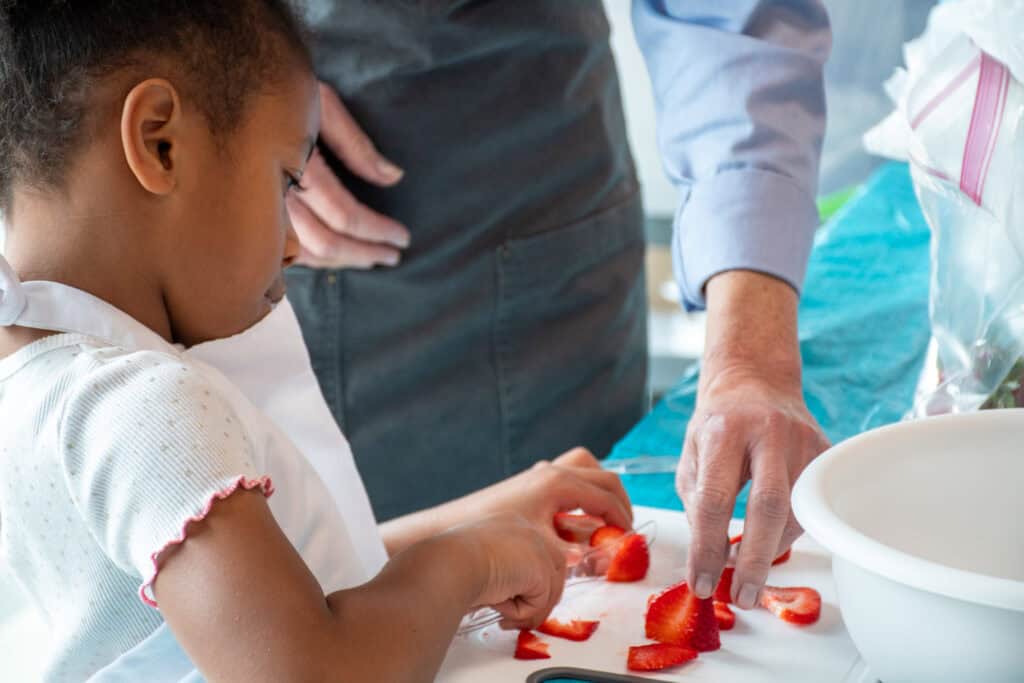
Marshallese girl cutting strawberries at a Marshallese cooking class to promote healthy nutrition. 

Marshallese girl cutting strawberries at a Marshallese cooking class to promote healthy nutrition.  

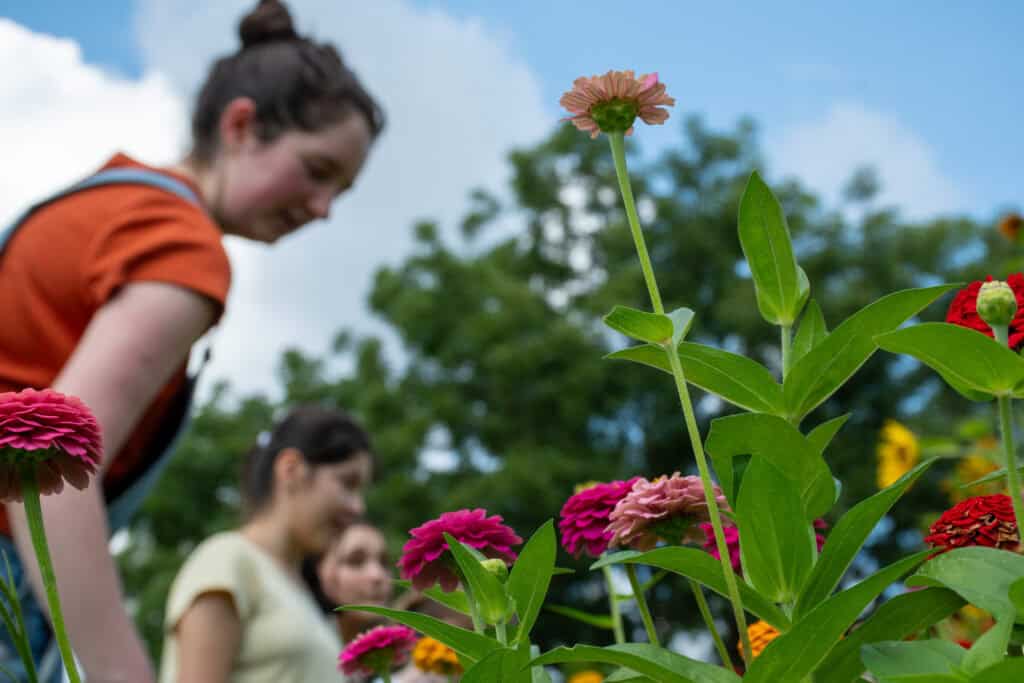
Apple Seeds students tending to the garden. 

Apple Seeds students tending to the garden. 

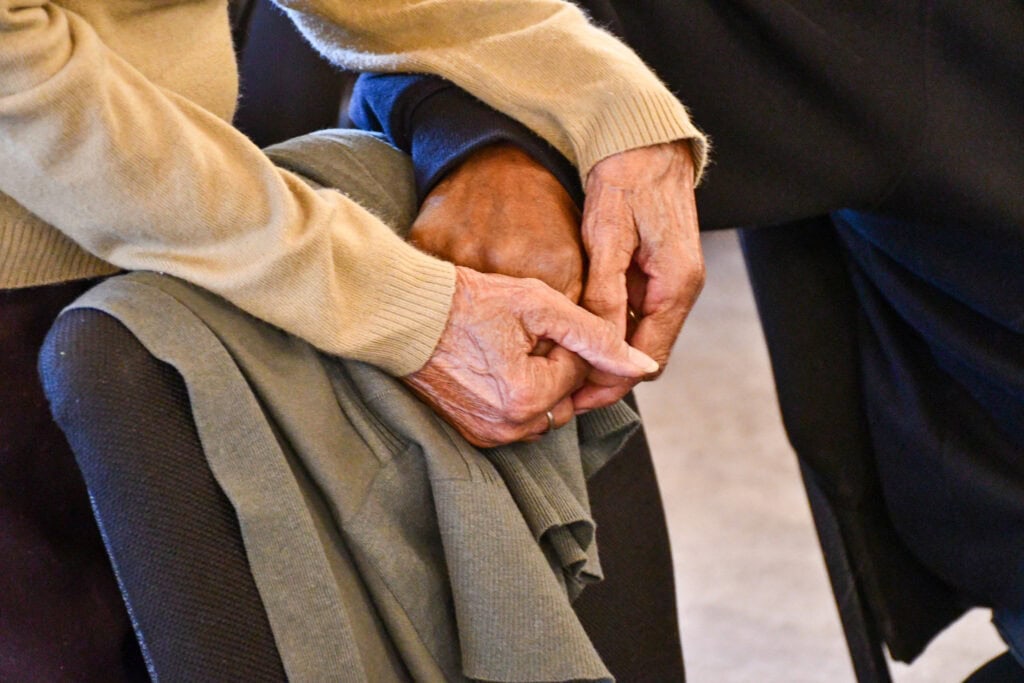
00-year-old grandmother holding her son's hand

100-year-old grandmother holding her son’s hand.

Filed Under: 13-images

Delta Hug

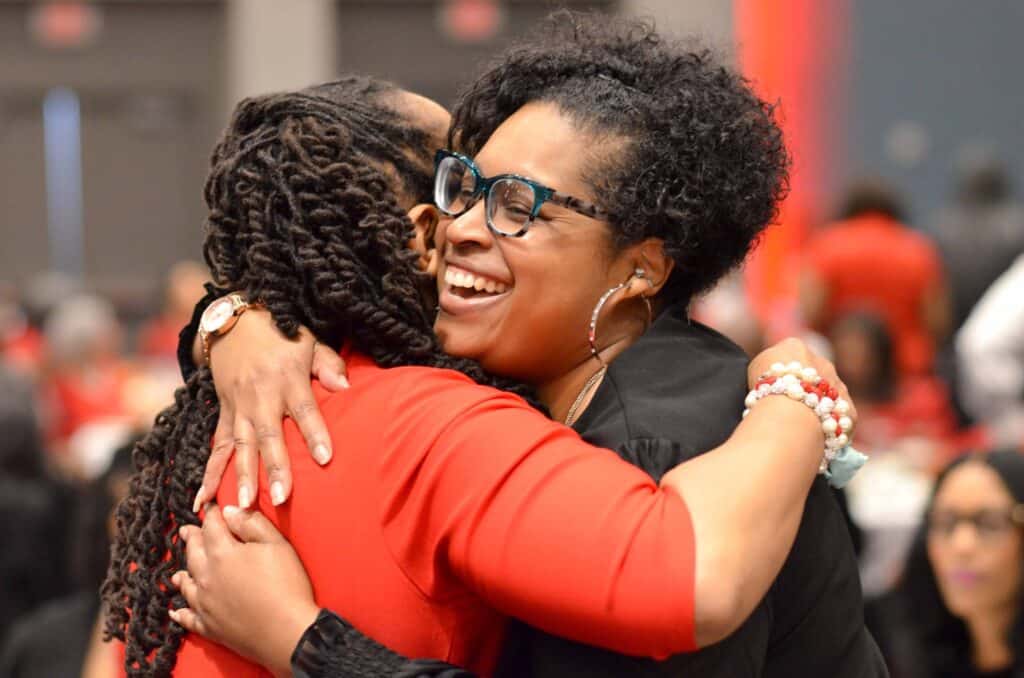
Two members of Delta Sigma Theta Sorority, Inc., share a tight hug, and laugh, during the intermission of a Little Rock community event.

Kev Moyé

Filed Under: 13-images

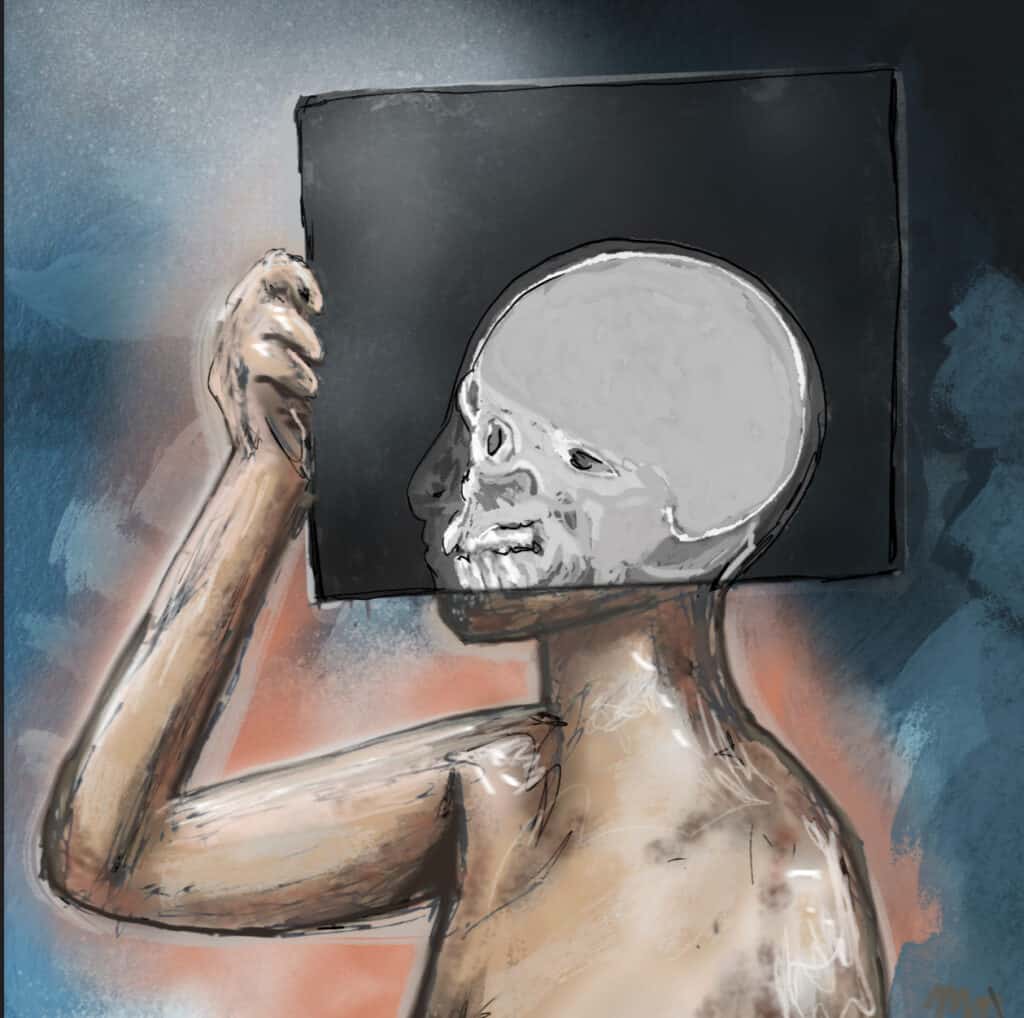
Through Their Gift, We See Within 

Through Their Gift, We See Within 

Through Their Gift, We See Within 

2026 

Mixed media honoring anatomical donors 

Mattie Grace Neighbors

Filed Under: 13-images

What Matters Most

What Matters Most

Mark Wren 

Photo caption: “What Matters Most” 

Filed Under: 13-images

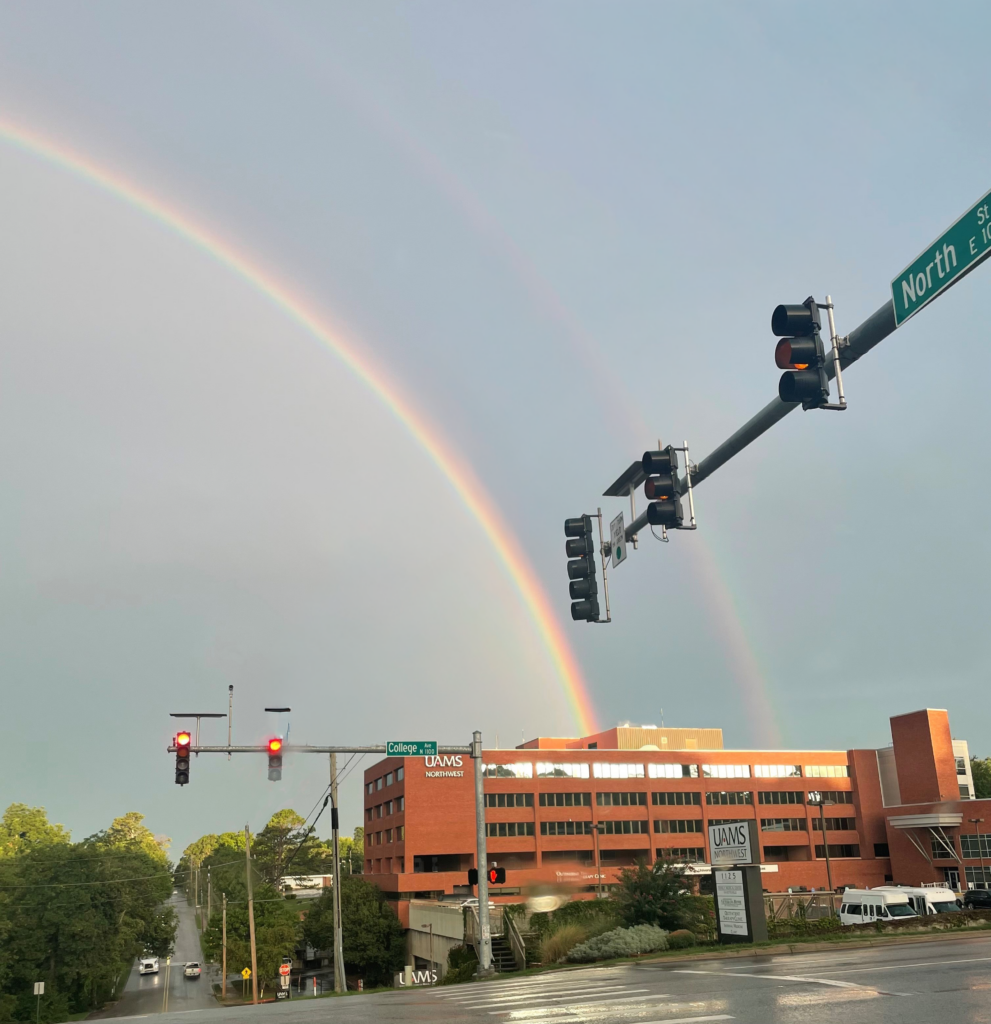
UAMS NW Double Rainbow 

UAMS NW Double Rainbow — I took this photo on my way to work one morning when I saw that the UAMS Northwest building was the pot of gold at the end of the rainbow.

UAMS NW Double Rainbow — I took this photo on my way to work one morning when I saw that the UAMS Northwest building was the pot of gold at the end of the rainbow. 

David Wise

Filed Under: 13-images

How Do You Remember Me?

By Vivikta Iyer

I have often wondered: How do you remember me?
Do you remember me as the daughter who ran away, leaving home to chase a crazy dream across the ocean? Do you remember me as the student silently scribbling notes in a lecture hall for five years? Do you remember me as the frantic intern, running through hospital corridors searching for a room, or as the exhausted girl crying in the on-call room because the weight of it all was suddenly too heavy?
Do you remember me as the doctor you trusted with your life? Or do you remember me as the doctor who finally had to tell you there was nothing more we could do?

I remember you.
I remember you as the frail 80-year-old man who walked into my clinic with a soft voice and eyes that held a lifetime of stories. You reminded me of my grandfather — a familiarity that hit me with a pang of homesickness. I remember your hands resting on your knees, trembling with a rhythmic shake. It seemed a cruel irony; you told me you had been a war photographer. For decades, your hands had been steady enough to capture history in a split second. Now, the shutter of your mind was beginning to blur.

I remember admitting you the first time because you were falling and forgetting too often, and the medications just weren’t doing their job. It seemed that we were in a similar place — both of us away from the comfort of the familiar even though we were in different walks of life. I remember adjusting your dosages, hopeful as I watched you walk out of the hospital, steady once more.

I remember you returning for our research study. We tested your cognitive function, asking you to navigate the geography of your own mind. I remember your wife sitting beside you. She spoke of the life you had built together over sixty years, and how rapidly it unspooled in the last six months. She clung to the small details that brought her joy, while you struggled to remember what you had eaten for dinner. I watched the fear in her eyes as she realized she was losing the only witness to her life’s history. I remember your wife telling me that the children drove back and forth, anxious to find the supportive father they had always relied on who encouraged them to chase their crazy dreams.

I remember you thanking me for helping you participate. In a moment of clarity, you encouraged me to keep going, to have courage in my own uncertain times. You saw the young doctor in me, even as I was studying the fading patient in you.

But then, I remember you coming back.
This time, you were not the gentle photographer. You were lost in confusion, thrashing against the bed, trying to pull out your restraints and IV lines. I remember the terror in your wife’s eyes. I remember the nurses paging me, asking what to do. I remember trying to talk you down. But you were fighting invisible enemies, shouting abuses, trying to run.

I remember administering the medication that finally stole your consciousness to buy you peace. I remember returning hours later to the silence of your room, checking to see if you were still agitated.

When you woke, you didn’t know where you were. You didn’t believe your wife was who she said she was. I remember trying to ground you, telling you that you were safe. And in the midst of that fog, you looked at me and said, yet again, that I felt familiar.

I remember going back to the on-call room and weeping. I cried for the fact that this is the work: that sometimes, no matter how hard I try, no matter what medications I tune up or how many cognitive tests I run, I cannot stop the erasure happening inside your head.

I remember the end. I remember your children asking a multitude of questions I did not have the answers to. I remember consulting psychiatry, only to receive a poor prognosis. I remember the “Goals of Care” meeting, the heavy decision to shift to comfort measures only.

I remember the day they wheeled you away to palliative care. I remember your wife thanking me with a sincere gratitude I didn’t feel I deserved. She told me that I had tried so hard, and that sometimes, it’s okay that it wasn’t enough.

I also remember getting so busy with the living that, for a moment, I forgot about you.
Until six months later, when I opened the newspaper and found your obituary. I remember reading through the summary of your life — the wars you photographed, the history you witnessed — and tearing up.

I looked at your photo and wondered: How did you remember me?
Did you remember me as the familiar face in the fog? Did you remember me as the doctor who tried? Or, in the end, did the disease take that too? Perhaps you didn’t remember me at all.
But I remember you.

Filed Under: 13-Fiction

  • Page 1
  • Page 2
  • Page 3
  • Next Page»
University of Arkansas for Medical Sciences LogoUniversity of Arkansas for Medical SciencesUniversity of Arkansas for Medical Sciences
Mailing Address: 4301 West Markham Street, Little Rock, AR 72205
Phone: (501) 686-7000
  • Facebook
  • X
  • Instagram
  • YouTube
  • LinkedIn
  • Disclaimer
  • Terms of Use
  • Privacy Statement
  • Legal Notices

© 2026 University of Arkansas for Medical Sciences