• Skip to main content
  • Skip to main content
Choose which site to search.
University of Arkansas for Medical Sciences Logo University of Arkansas for Medical Sciences
Medicine and Meaning
  • UAMS Health
  • Jobs
  • Giving
  • About Us
    • Submission Guidelines
  • Issues
  • Fiction
  • Non-fiction
  • Poetry
  • Conversations
  • Images
  • 55-Word Stories
  • History of Medicine
  1. University of Arkansas for Medical Sciences
  2. Medicine and Meaning
  3. Author: mmassirer

mmassirer

From My Mother’s Garden to My Own

By: J.M. Morgan

A lot of my personal story is brought to you by the letter R: Resilience.

I’ve always felt like a silent observer of sorts, watching from the sidelines as my Brain sprinted from thought to thought. Did I say the right thing? Are people judging how I look? Can anyone tell that I’m fat on Zoom?

I sat silently after my dissertation defense in the Zoom meeting’s breakout room. My dissertation chair said she would invite me back after my committee deliberated. Her words sounded like a distant soliloquy on a Broadway stage. Her voice hovered over me like a spotlight while the clanking tips of my ceiling fan served as her orchestra. She had served as my conductor throughout this tumultuous journey, watching me evolve from her protégé into a fledgling clarinet player, soft and delicate with a mercurial punch. In every meeting, she would gauge my level of excitement. I swallowed the butterflies in my stomach whole and feigned a smile through clenched teeth. Performative confidence became my baton, directing me, as I had become too frail to perform.

According to my mother, I was a mere footnote in her story. I was “her ticket out of the ghetto.” I was over four years into a Public Health doctoral degree, questioning my capabilities and my identity. It seemed like so much of my past was coming to the surface. I was a runaway rose from my mother’s rose garden, floating in the wind. I thought relocating from home would solve my problems, but my Brain rarely takes a holiday.

One afternoon, after my mother escorted my two sisters and me to church, she mentioned my high school friend, Doreen. Doreen, the daughter of a minister, assumed various roles in our church, including serving on the praise dance team. My mother mentioned that I should dress neatly and appear more put-together like Doreen. It was a simple suggestion, really. Doreen’s slim physique made her appear polished in satin skirts, custom-fitted pants, and silk blouses—all accentuated with gold accessories. For me, there were two problems: I didn’t have a job to afford my own clothes, and my weight tipped the scales. I wasn’t accustomed to accentuating my femininity. I much preferred to throw on basketball shorts with a random 90s cartoon T-shirt. Alas, church required a more elegant ensemble.

Eventually, my reluctance to assimilate with normal 16-year-olds prompted my mother to take me to Cato Fashions. Shopping with her made me acutely aware of my chubbiness. She had taken to referring to our bodies as “big as a tank,” which made me wary of colors and patterns that exaggerated my folds. My medium, dark skin with warm undertones lusted after vibrant coral, sage, and yellow hues. Yet, my insecurities made me veer towards grays and blacks. I didn’t want to be visible in a world where she reminded me of my large body.

She was adamant that I adhere to her standards. Being in her garden taught me that every scraggly petal and bent stem was a symptom of imperfection that would make people laugh at me. Even as a teenager, a period when I had no fucks to give, I felt stifled living under her roof. I was a neglected rose in soil she trampled, shaded to avoid escape. Following my parents’ divorce, the result of psychological abuse my dad (whom I called Dada) inflicted on my mother, we moved thirty minutes away. Being a daddy’s girl, I held an innate resentment towards her for initiating the divorce, but I was too busy swallowing tears in the bathroom. Secretly, I used Dada’s allowance to purchase diet pills to alter my image for her, but nothing could curb my insatiable sweet tooth.

I needed a savior, a white knight, a hero. In my senior year, I knew I had to lock in. I wasn’t going to be sheltered behind the steel bars of her words. My biggest opportunity came through the Gates Millennium Scholarship, which provides full educational funding for up to 10 years. During and after school, I wrote to alter my future while being tormented by my mother’s incessant ramblings about my body and intellect. My cousin had tattled to my mother about how hard I was working. My mother’s scowl reminded me to abide by my bedtime and to avoid making students feel inadequate by overworking. Therefore, I had to sneak to write during my classes’ free time. After securing my recommendation letters, I waited while my mother continuously rushed me to make a college decision.

Patience was never my forte, so I continued to apply for other scholarships as a contingency plan. Besides, there was no way a Black girl who lived down the street from the projects, merely separated by train tracks and backroads, would win something so prestigious. Surely the panel would think I was a social pariah. I mean, it was rooted in truth, right?

One April day in 2013, my mother told me that I had a large envelope from Gates Millennium. Deep breaths. Whatever happens, I told myself that I would be alright. I would just join the Marines to afford college. After boot camp and dieting, that uniform was sure to snatch my waist. I carefully opened the envelope and slipped out the letter. “Congratulations…one of the 1,000 Gates Scholars for the GMS Class of 2013…again, congratulations.” Those words rang in my ears as my hands shook the acceptance letter. Congratulations. It felt like I was gifted shears to pluck myself. I convinced myself that these next 10 years would be smooth sailing. Finally, I had an opportunity to flee my mother’s garden. It was time to dust the dirt from my petals to embark on my next chapter: the University of Alabama.

My mother and her on-and-off boyfriend, Mr. Otis, drove me to Tuscaloosa. The drive was awkward as my mother discovered his infidelity. She devoted the nearly three-hour car ride to softly arguing with him amid the hum of the engine. I felt like a kid, hiding under the covers, while Dada cursed my mother out from the living room couch, irate that her cooking made the house hot. This time, my mother would assume Dada’s role. I didn’t necessarily feel bad for Mr. Otis. I wasn’t keen on my mother pursuing any romances outside of Dada, despite him being terrifying. Eventually, we arrived at my dorm, and the argument ensued all the way to my suite. Luckily, the argument stayed in the common area while I unpacked in my assigned room. After my mother and Mr. Otis left, I took the time to breathe. Inhale. Exhale.

I can’t recall the exact moment when dark thoughts flooded my mind. I never could distinguish between my thoughts and those planted by my mother. Now, the voices seemed louder. Are people watching me eat in the cafeteria? Is that girl’s frown directed at me? Do my professors think I’m not speaking up enough? Are people laughing at me? Will I fail university, lose my scholarship, and be forced to move back to my mother’s house?

This internal monologue had haunted me throughout my secondary education. However, I used poetry to heal those open wounds. Now, I didn’t have much free time to immerse myself in my creative pursuits. To suppress the background noise, I rekindled my old habit: eating. Nearly every night in my room, I would eat a medium pepperoni pizza and barbecue wings. In 2016, my graduation granted me a fancy diploma along with 40 extra pounds. I couldn’t savor the victory of graduating magna cum laude.

As I settled back home, silently distraught over my unsuccessful job search, my mother mentioned my weight as if I didn’t own a full-length mirror. The stress of securing a career that aligned with my degree, coupled with my mother’s reminders that people were laughing at my unemployment, only further diminished my confidence. My irritability seemed to plant seeds of resentment in my mother, who once exclaimed, “I could have aborted y’all, but I love y’all.” I was back in the same place, and this time, I refused to wilt in her garden. I informed my mother that I was moving into a 5-bedroom student apartment. Although hesitant at first, she allowed me to move out. Once I moved out, I juggled two part-time jobs at a grocery store and pharmacy while devising a plan to avoid failing again. Like clockwork, my irritability faded, but the voices still followed.

In the summer of 2017, I applied to a public health master’s program. Truthfully, public health appeared on my radar due to my scholarship’s graduate school funding limitations. That summer, hoping to be accepted to graduate school, I didn’t renew my lease. I returned to my mother’s house, chalking it up to poor planning. Once I returned to the same environment, my irritability erupted like weeds. Her car’s hum pulling into the yard sent me into a spiral. I felt my eyes organizing an uprising in my skull, complete with swords with curved blades and tanks with squeaky wheels. Nevertheless, I endured as I always had. I had no place to go. Despite being Dada’s oldest, I held an inexplicable fear of inconveniencing him. Being sheltered prevented close relationships with most of my family members. The absence of an older adult role model hindered my options. I felt like my petals were clipped.

The wait for my decision letter was nerve-wracking. I wanted a decision, but I feared the outcome. Did I possess the academic intellect to pursue a graduate degree? Would people discover that I am dumb, like my mother always suspected? I tried to ignore these complex thoughts and focus on the future, but I kept having visions of myself living on the streets. I was overwhelmed and disoriented. In fall 2017, I received my acceptance letter to the University of Alabama at Birmingham (UAB) master’s program in Public Health. Phew. A pot of relief washed over me. I was determined to bloom.

That spring of 2018, I moved into a studio apartment that my mother chose due to her annoyance with the apartment hunting process, rather than my preferences. She and Mr. Otis were “on” again for the final time and helped me relocate. For the first time in my life, I would exist alone between my own four walls. Attending a highly regarded university in Alabama nurtured persistent feelings of inferiority. In class, I would lose focus and daydream while my Brain took me down countless rabbit holes. “How dumb can you be?” My mother’s favorite quote towards me blossomed whenever I was faced with a complicated lecture. On paper, I was keeping up, but I felt restricted by my weeds. This was especially evident in seminar classes where speaking was mandatory for participation credit. I hated speaking, but more than anything, I hated getting a bad grade.

One day, while rehearsing my TED Talk for an assignment, I felt nauseated. I chalked it up to my acid reflux. I envisioned myself screwing up my TED Talk, imagining everyone erupting in laughter. My mouth began to water. What the fuck was happening to me? I ran to the sink and started to dry heave. As I leaned over the sink, gagging and swelling with fear, I knew I had to come to terms with what I was experiencing. But first, back to my regularly scheduled program. Besides, my TED Talk was less than an hour away.

A few weeks later, I finally decided to make the call: therapy. My first therapy session was a bit awkward but comforting as the room filled with soothing notes of lavender. It was the first time I was able to share my story. Her velvety voice validated painful moments of my story and nodded along as I tried to recall hazier memories. I appreciated having an adult willing to listen to me vent, which was foreign to me. Growing up, I was told that I should be “seen, not heard”; therefore, I assumed the dual roles of speaker and listener.

The truth is that my therapist’s diagnoses of depression and social anxiety weren’t a surprise. Pursuing a Public Health degree afforded me countless avenues to learn about mental health. Admittedly, I assumed that I had immunity to mental illness. I admit that suicide had crossed my mind briefly as a teenager. Well…ok, it definitely crossed my mind more often than not, but I had fled the garden. I found refuge in the shade. Why did my past feel the need to follow me from my mother’s house? Should I move further? Given my complex psychological history, a university doctor referred me to psychiatry to seek Brain meds, my fertilizer. After I began medication, I felt compelled to keep my mother in the loop. I worried about how her internalized stigma would affect me. I became increasingly aware that I tended to veer towards gullibility whenever our seemingly innocent conversations deviated towards negativity. Nonetheless, I looked to her to be an anchor in these stormy waters, not knowing that my problem, according to her, was my absence from church. Her words still stick with me: pray. 

The truth is that I prayed constantly. I prayed when Dada psychologically abused my mother in front of us. I prayed at the domestic violence shelter my mother took us to when she contemplated divorce. I prayed throughout their divorce proceedings. I prayed for the pain to stop after I was disciplined formy disobedience. I prayed for a full-ride scholarship to flee my mother’s rose garden. I prayed my way through college and public settings. It became habitual for me to seek out a higher meaning. I knew prayer, but it seemed God was a bargaining man.

I won the full-ride scholarship, but my Brain felt like a jigsaw puzzle with random middle pieces missing. No longer being a part of my mother’s garden bothered me, so I sought out surrogate mothers. They ranged from a Black woman professor to a Black woman staff member during my internship. Whenever the relationships would sour, I felt abandoned and plagued with negative self-talk that was taught to me by my mother. Her thoughts were so enmeshed with mine that they overshadowed my voice. I was me and…not…Me? Unknown to me, I took her voice as my own. I felt that my own garden was wilting while the teachings I mastered helped hers flourish.

It seemed as if I never had time to focus on my Brain’s ramblings. I had to kick it into high gear and make a big decision to prevent returning to my mother’s house: a doctoral degree. Similar to my master’s degree, I never anticipated pursuing a doctorate. Actually, my real dream was to get paid to write books. Sigh, a girl can dream, right? Portions of my statement of purpose emphasized my privilege in being afforded this opportunity. I was deeply indebted to my scholarship, which was the gift that kept on giving. The only word from my acceptance letter that I remember is “congratulations.” I wanted to sit with that feeling. Whew. I would finally have a plan after graduation; no one would be laughing. Slowly, my roots started untangling.

After I graduated in the summer of 2019 with my master’s degree, I jumped headfirst into my doctoral program’s curriculum nine days later. In hindsight, I definitely should have taken a break, but working myself to the bone seemed less barbaric than enduring my mother’s voice. Everything was going well despite my Brain’s babbling. The COVID-19 pandemic presented a unique obstacle during my qualifying exams. The program director allowed us to take our exams virtually. On exam day, I completed the exam as I fought an endless battle questioning my worth and my capabilities. I persevered, as I always had. Besides, it was too late to quit. I had already signed my apartment’s yearlong lease. I submitted my exam before the designated time.

Once the ball was no longer in my court, something clicked. I made a dramatic bargain with myself. If I fail my exam, I should kill myself. A multitude of emotions were coming up simultaneously. The truth of the matter is that this train of thought wasn’t new— I just thought that I beat it. As all meticulous humans do, I devised a plan. I would drive my raggedy Honda Accord to the 16th Street Parking Deck and jump off. Although I had two tries to pass this exam, failure would not be an option. As soon as the notice of failure hit my inbox, I would eat a final meal: three meat lasagna and 12 vanilla ice cream sandwiches. My final drink was a toss-up between Minute Maid’s No Sugar Lemonade and Ocean Spray’s Diet Cranberry Mango juice. I may be gluttonous, but I avoided drinks with a high sugar content.

On February 12, 2021, the email came. I breathed a little as my heart raced. I muttered a prayer, pleading to pass. I embraced Cinnamon, my favorite teddy. Box breathing was what my therapist encouraged me to practice in moments like these. Inhale…1…2…3…4…Hold…1…2…3…4…Exhale…1…2…3…4…Hold…1…2…3…4. Repeat. With my hands quivering and my fears mounting, I was ready. I narrated my plan internally. I would either wake up the following morning to the sun’s kiss…or not.

“The PhD Comprehensive Examination Committee has met and reviewed your recent examination. Congratulations! You have passed your Comprehensive Examination and are now ready to begin the next phase of the doctoral program.” It took me a while to digest this email. A Black girl from the country passed comps? Surely, someone was fucking with me. I thought for sure that I bombed that exam. Phew. My master plan tangled in its own vines. They probably rounded up my 79.5 because they felt sorry for me. I tried to wrestle with this thought. I couldn’t let my Brain steal this moment from me. Not again. Passed. I kept rereading that word to silently affirm that I was good enough. I pushed any thoughts of being coddled to the back of my head. I couldn’t deal with that right now. I’m not going to deal with that. My Brain will have to figure out what she has going on for herself.

Subsequently, I activated beast mode. I developed my research question. My first concept paper meeting was intense, as my committee didn’t think my research strategy was feasible. After the meeting, my advisor scolded me for my lack of defense of my research strategy. I felt defeated. I loathed making people angry. My passiveness was always my flaw. I wasn’t accustomed to my voice being respected. Although I was an adult now, I wasn’t sure how to engage with other adults without letting them dictate the conversation. I was used to people trampling across my welcome mat and sitting on my favorite spot on the couch.

I always used a mask to conceal this element of my personality, but I felt as if I was exposed. Would I be kicked out of the program? Where would I put all of my shit once my landlord kicked me out? Where would I sleep? Should I start packing now? Eventually, I was able to pivot and restructure my research. In January of 2023, I got the email: “We are pleased that your committee has approved your proposed research topic, and we accept their recommendation that you be admitted to candidacy. Congratulations!!!” I felt relief that I was able to shift gears, albeit two years after passing comps. The other part of me felt overwhelmed.I clenched Cinnamon tightly, not knowing that my petals would be plucked one by one along my quest to complete my doctorate.

Later that year, I felt a strange jerk in my leg while lying in bed. It felt like my leg had detached itself from my body. Those few seconds were scary. This sensation continued for four days in a row until my body started involuntarily trembling. My Brain sent me down a rabbit hole, which only fueled my anxiety. Myoclonic jerk. Was this part of an impending stroke? Could I be developing multiple sclerosis? I visited my university’s health center, where I was diagnosed with a functional neurological disorder and benign fasciculation syndrome. It couldn’t be explained by an organic cause. The physical symptoms of anxiety plagued me.

Everywhere I went, I felt as if I was being followed. Driving created thoughts that I should swerve to the edge of the road. My new therapist used positive affirmations to dispel the noise in my head. Positivity felt superficial and irritating. My Brain wasn’t wired to think that way naturally. I wasn’t crazy. I’m. Not. Crazy. I tried to distance myself from my mother’s internalized stigma to facilitate better therapy outcomes. Nevertheless, her voice chipped away at my spirit.

Writing my dissertation eventually took a backseat. The overwhelm was eroding my soil and revealing my roots. I started having flashbacks, which I learned were dissociative episodes. This only made me yearn for death. My maternal grandmother, the only grandparent who lived past my childhood, passed away. My Brain was swirling with thoughts. Had I not prayed hard enough? Was I the cause of her demise? Throughout my formative education and university years, I prayed that my grandmother would survive to experience all of my graduations. I didn’t know her well, but I felt guilty that she wasn’t able to see the result of my terminal degree endeavors. This guilt was amplified by my mother’s poisoned words that my grandmother wanted to see me before her death.

My thoughts began to float in the breeze like the dandelion seeds that I sent drifting as a kid. I wanted an escape. I confessed these thoughts to my psychiatrist to get a medication adjustment. He felt the absolute gall to tell me that he could admit me to a psych ward if I was a danger to myself. Sir…I came for a med adjustment, not a Lifetime audition. I wasn’t going to kill myself. I never do. Still, I felt imminent danger at the thought of being forcefully removed from my home. Therefore, I lied about having a plan to conceal my pain. Although I purchased a tactical knife years ago, I was convinced I would never use it. After all, I’m a good girl trying my best to trim my mother’s words off my stem.

Keep it together, girl. I muttered my personal mantra to myself on the way out of his office. Sometimes, it worked. I had a lot of pressure on my shoulders. I felt my health was failing as a result of the physical manifestations of my poor mental state. This likely encouraged my body to rebel against me. For example, my Brain, despite various medical interventions, convinced me that my swollen inguinal lymph node was lymphoma. Due to the lymph node’s size abnormality, I received a biopsy on December 1st. It was the second time I was in this position.

I found a breast lump; luckily, the three ultrasounds and sole mammogram showed that it was benign. I bargained with God for the same results, although I was spiraling. Where did it come from? Why hasn’t it gone away yet? Can I have cancer and feel perfectly fine? What is my survival rate at this stage? I conveyed this information to my mother, who appeared indifferent. I didn’t know if she was hiding behind her weeds, but her lack of emotion felt cold. She was far more concerned with giving me exercises to manage my large breasts and double chin than with my battle with cancer. I knew I would be on my own, emotionally and financially. I started to look up physician-assisted suicides in case of a malignant result. I had become increasingly fascinated by the process. Oddly, I wanted out, but I didn’t want the blood to be on my hands.

At this stage, patience was unacceptable. I understood a biopsy required lengthy testing, but I was aggravated that modern technology still required extended waiting. How could they expect me to cope? Ridiculously asinine, if you ask me. I distracted myself with food, video games, and sleep. Sweets felt like a long kiss goodnight as I tucked myself into bed. I wish someone else could have dealt with this problem for me. On December 8th, I preoccupied myself by going on a Target run. While mindlessly walking down the beauty and makeup aisles, I received a portal message from my referring doctor. Inhale. Exhale. “I have looked over the biopsy results, and everything looks good…no sign of cancer.”

Whew. My petals of happiness blanketed me with their affection. It had been nearly a whole damn year, as I was in and out of doctor appointments for these two cancer scares. To end up with nothing under these circumstances was phenomenal. As I said, God is a bargaining man. I had promised him I would change my mindset surrounding my dissertation. Nearly all of my cohort had already graduated. I was inclined to use that as a motivator. As a birthday gift to myself, I vowed to graduate in the summer semester before my 30th birthday in 2024. I repurposed my tactical knife from a weapon into a tool to prune my stems and thorns.

I listened intently to the clanking tips of my ceiling fan to calm my nerves as my committee deliberated. As I waited for my advisor’s text, I videochatted with my two younger sisters while waiting in the breakout room. I had to take my mind off the impending doom feeling in the depths of my stomach. I felt like a child playing dress up in my Dora wig and satin shirt. Surely, my committee could see that I was an imposter. I didn’t feel deserving of this moment, even though I worked my ass off these past seven months. Although my sisters didn’t fully understand this moment’s importance, they assured me that I earned it. As their words of encouragement sank in, I reflected back to the beginning. Resilience. In this moment, I felt like I wasn’t silently observing my life as it flickered by. Even now, though my confidence is fleeting and delicate, I’ve learned that perfection is self-torture camouflaged as discipline.

As I laughed with my sisters to drown out my anxieties, I received a text from my advisor, who requested that I rejoin the Zoom call. I hung up with my sisters and held Cinnamon once more. This was the culmination of everything that I had sown and toiled for. If I failed this time, I would go down fighting and clawing for blood. I arrived at the end of their deliberations. My advisor smiled and announced, “Congratulations, Dr. Morgan!” I still can’t quite articulate how I felt. I was stunned and overwhelmingly grateful as I thanked my committee for their support.

The next day, after the paperwork was finalized, my advisor sent a school-wide email: “Please join me in congratulating Dr. Morgan on successfully defending her dissertation!” Whether the attention was negative or positive, I felt undeserved. I realized I had put in the work, but it felt like it belonged to someone else. On August 10th, after I uprooted myself from my mother’s garden, I was hooded and earned my PhD in Public Health. The next month, I started a postdoc at the University of Arkansas in Fayetteville. I left my mother’s rose garden behind. Being in a new state without the commitment of school allowed me to focus on my mental health.

That next year, my new therapist recognized my thought patterns instinctively and audibly confirmed something I had secretly feared: obsessive-compulsive disorder (OCD). Inhale. Exhale. Everything resonated. Before, it was as if I were driving down an endless tunnel with a one-way sign, but now I finally had the opportunity to make a detour. Learning that my Brain’s faulty wiring didn’t align with my true intentions made me feel like the architect of my own story. I had been repotted and watered all at once, all because of my resilience. All along, this had been my story, though her voice lingered in the background. I slowly reached for the baton to direct my own performance. I was no longer her rose. I planted my own garden. My roses would weather any storm. I would be my own gardener. Now…where did I put my fertilizer?

Short Author Bio:

J.M. Morgan is a postdoctoral researcher at UAMS. She is a poet, storyteller, and dreamer who explores identity through her writing. She published her debut poetry collection, silent scream, in 2021. When she isn’t buried in her academic and creative writing, she enjoys crafting, watching The Golden Girls, playing video games, and learning to crochet.
Filed Under: Mehta 2026 Creative Non-Fiction

Rally

By: Dana Garrison

I’m a superhero with superhuman hearing.
I’m a ghost, omnipresent and unsettled.
I’m a shell of myself, already mentally and physically drained before I even sit up.
I’m the primary caregiver of my father, who is dying a slow, painful death from AML, an aggressive leukemia.

***

I can hear the muffled voices in the other room before I open my eyes. These days, my senses are heightened. I am so in-tune to the noises within the house, I am woken by only a gentle sigh that traveled through the wall, down the hall and through the closed bedroom door.

I drag myself from the bed and talk myself into taking a shower. My showers are quick these days. I can’t hear what’s happening in the house when I’m in the shower.

As soon as I enter the room, I realize today will be different. A good day. Lord, how we all need a good day for a change.

My father is sitting up in bed in the living room, 2 pillows behind his back and covered with a bedsheet of happy, purple flowers. I stare at the flowers. When the hospice bed was delivered 2 weeks ago to my father’s house, I panicked when I couldn’t find the spare sheets. My Aunt brought these purple-flowered sheets from her linen closet next door. In the future, every time I visit her, I’ll be scared to death she will forget and put them on the guest bed. Today, they look ridiculous on this literal death bed. I hate them.

My stepsiblings, who took the nightshift, look up and grin when I walk in the room. I know immediately why they are smiling, and my heart breaks for them. He’s awake! Maybe they were wrong! Maybe he’s going to be okay! He’s not going to die soon!

But I know what this is, what this means. My medical knowledge is a blessing and a curse. I’ve been both eagerly waiting for it and hoping it never comes: It’s the rally. He’s awake! He’s not going to be okay. It’s time to say goodbye while he’s lucid. He is going to die soon.

He smiles when he sees me, his only child, and reaches out his hand. The day is filled with pointless minutia sprinkled with hints at who he used to be before this disease took over his life—my life—only 6 weeks ago. He asks for a cold Bud Light for breakfast, a gin-n-tonic for lunch. He smacks his lips and lets out a happy sigh with that first cold sip of Bud. I stir the gin into the tonic with my finger, like he used to do. He watches golf and drag racing on the TV, reliving what seems like an already-past life and simultaneously being more alive than he has been in weeks. He is alert, commenting on the golfer’s swing and the race car tires. He makes jokes, he smiles. He’s always had a great smile. Maybe they were wrong! Maybe he’s going to be okay! Dying fathers don’t smile like that!

We call the neighbors and his brother and sister and tell them to come over. He’s awake! It’s time to say goodbye while he’s lucid. His priest comes to pray and give him his last rites and sacrament. Does he know he’s dying? He must know, but we don’t talk about it. As my aunt leaves, she pulls me aside and tells me it’s time to limit visitors. He wouldn’t want anyone to see him like this: frail, nude under the sheets, sucking his gin off a sponge. I know she’s right, and I’m grateful someone else made a decision for me today. I’m tired of making decisions.

When the visitors are gone, we gather around his bed: myself, my step siblings, and my stepmother. He looks around, smiles, and says, “I’m very lucky.” I squeeze his hand and smile back, then go prepare his next dose of morphine to stay ahead of his pain and restlessness. The vial is hidden in the refrigerator behind all the uneaten food neighbors have brought. I dig it out from behind a half-eaten lasagna and stale garlic bread. I draw the dose into the syringe like the hospice nurse taught me and then chart it in the little notebook that stays on the kitchen counter. I keep meticulous notes on all his doses. This notebook, with its clean, smooth pages and perfectly drawn chart is the only thing I feel I have control over in my life. When the hospice nurse compliments me on how organized and thorough my notebook is, I want to cry from the relief that I am doing something right.

I gently guide the syringe deep inside of his cheek and slowly inject the medicine so it can dribble down his throat without him having to swallow. He finally falls into a peaceful sleep, and I disappear into my room to take a nap because it is my turn to take the night shift.

***

He does not sleep through the night. I try everything: turning the lights down, playing soothing music, a sound machine…all the same things you do for a restless baby. I leave the lights and TV on at the suggestion of the hospice nurse, but nothing quiets his mind or the voices he’s hearing. He is restless, body and soul. He tries to sit up, he pulls at the oxygen in his nose, he grabs the rails of his bed and tries to pull himself over the edge, as if to escape this nightmare he is trapped in. I stand at the bedside, quiet, but inside I am screaming. Please, go to sleep—I’m so tired. Please, let go—I’m so tired. I didn’t mean that; please don’t go yet. Just…please. Please make this easy for both of our sakes.

I give up and lay on the couch, watching him interact with visitors I cannot see. He talks out loud to no one.

“Who else is in the house?”

Unintelligible singing

“You need to notify people”

“There’s a big crowd here for this”

“…leaving home….”

Mimics signing something

“forgiveness”

I wonder if his mother, my beloved Omi, is here with us in the dark visiting her precious boy. I wonder if she sees me laying on the couch, exhausted. I pray to her, like a Catholic prays to Mary, to intercede on my behalf. Soothe him, calm him. But don’t take him yet. I’m not ready.

***

He dies quietly on a Sunday morning while I sit at the kitchen table planning his funeral, debating with my stepmother and stepsister whether we should have guests sign a guestbook. His beloved dog, Vanna White-paws, is asleep under the dining room table and begins to howl in her sleep in that funny way dogs do, like they are dreaming. She’s never done that before, so my stepsister goes to check on her. On the way back, she passes my father and looks at him. She looks up at me, and we make eye contact. And I know: it is over.

***

I stand numb, telling myself to stay present even in this moment, watching as the caretaker rolls the stretcher towards the front door. My father is in a black bag, and they have left the bag unzipped from his chest up. An American flag lays across the rest of his body. I lean down and whisper in his ear my thanks and my goodbyes. You were a good Dad. Thank you. I love you.

It is the first time I have cried since it all began 6-weeks ago. Perhaps my superpowers are waning, and I am returning to human now. Will I be the same human? I don’t feel like I’ll ever be the same. They zip the bag and pull the flag up over the rest of his body. His best friend stands across the street in full salute as they carry him down the steps to the hearse. He is still standing there, in full salute, long after the car has disappeared down the street, and I have closed the door.

Author Byline:

Dana Garrison is a research coordinator in the Department of Orthopaedic Surgery at the University of Arkansas for Medical Sciences. She previously taught composition at UALR and Hendrix College, where she encouraged others to write bravely—advice that has finally caught up with her. She lives in Little Rock with her husband, teenage son and a very lazy Beagle.


Filed Under: Mehta 2026 Creative Non-Fiction

Circling

By: Courtney Ragan

Some days, there’s nowhere for the grief to go.

Ebbing in weight, with a pull that does not spare,

It lingers, circling below.

Five stages with sharp peaks and still plateaus.

A mirage of acceptance humming in the air.

Some days, there’s nowhere for the grief to go.

Like rotten fruit, it hangs low,

Forming a soaked-in stain the wearer is unaware.

It lingers, circling below.

Memories deep and pulling like an undertow,

Treading waves of emotions caged in despair.

Some days, there’s nowhere for the grief to go.

It washes and defines all that you know,

Planted roots of happier seasons anchor and repair, yet there It lingers, circling below.

Lurking and shifting like a shadow,

Enveloping those left behind without a care,

Some days, there’s nowhere for the grief to go; It lingers, circling below.

Author Bio: Ms. Courtney Reagan has a Masters in Education and is an instructor in the in the writing center and the Education and Student Success Center at UAMS. She loves to write.

Filed Under: Mehta 2026 - Poetry

Here in the Clinic in America

By: Safi Alsebai

What is a paradox in English as in
any other language I speak or have ever spoken?

What is a paradox since fingerpulp could see
and speak together? Everything
in the “and,” apparently.

Her surgery was uncomplicated and
a kidney transplant,
for what it’s worth, though that’s not the
matter of
this story or its questions only the
occasion to discuss matter and mattering

Nevertheless,

I still want to say She
“peed on the table”
meaning that the kidney now “her” kidney or
“her new” kidney
began producing urine while she was still
under as soon
as blood flow was patent

She had been making less urine less
than her sister for three years
less than her mother and
less than her cousin

Now, since her new organ has become
engorged like her other organs
and like other family affairs
she has already “made 1.2 liters” in eight hours

Something people were keeping track of:
they arrived
at dusk and then throughout the day to check
how much she had drunk and how much she
had urinated

Dusk makes it sound like I want you
to sentimentalize this I only mean
the fact of 4:30am
and the fact that she was thirsty from
urination and nauseous from drinking

In her dreams here she will mind the gap
and be on television
as a result of the static of various acrylic
fibers flush against one another

Like her nurse who will be interviewed on
television in a couple of weeks
by a local news anchor
about the nursing strike All three
will wear the same color on their nails

On television, where every building has
collapsed during her recovery
and everyone has been killed and the
world continues to ravage and
be ravaged by what has marked her and
sutured her
and where Bette Davis stars in

A Marked Woman and the next night
in her dream she will star alongside her
in a film where she finds a YouTube video of
her own surgery with 0 views

In the film, one finger crosses over another
She was on a muscle relaxant for
They had
opened her right side
obliquely,
and corseted it shut, and came to run
their fingers along the sutures twice daily

They filled the empty space-between with
laughter when they did not know with
what else to fill it
or with what else to fill themselves,
and she wondered where they learned to
laugh like that

From their molars, and At any given
moment someone will be laughing
like a form of address At anything
she says

They ask to raise the blinds

She did not mind insulin injected into a
folded purse of tissue,
but did not like it when they cautiously called
that purse her “belly,”
which sounds like what you would call an
abdomen if you were talking
to someone you thought was stupid

Will we have her having been on dialysis
three days
out of the week
or four days? Will we also
feel her fistula for
a palpable thrill, if she has one?
Or will she have had an infected
indwelling catheter instead?

“The thrill is gone away,” swoons

a patient on the other side of the curtain
An optimistic woman who

Despite a prognosis of two or three weeks
would like to remain off hospice and
return to the operating room Singing, she
waits for a court date

Three months from now
For a trial at the end of which
may or may not lie a disability check

She is filing her nails she is filing for divorce
as she would like to be divorced
before she dies rich
And they will all have the same colored nails
All four

How much will they have to have been
through to be so accepting?
What is acceptable and what is imaginable
this late or this early
into the story of being written under
the equal sign?

How badly do they have to have
been to be nonchalant now,
when. ? Are
they even nonchalant?

What is the price of gratitude
in narrative, as in care?

A renal transplant plus its
accouterments (consultation,
follow-up, so on) in the United States,
where she got “her” new kidney
costs on average a little over four hundred
thousand dollars, depending

She would not know until she left the hospital
how
much of that she would be paying (off)
for the rest of her life, and
how
much her insurance would
Graciously cover

But it could have been
any procedure to
any organ at
any cost, under any
insurance and benefits manager
with any Grace

The relation between this story
and the discipline
of political economy (political economy as a
discipline)
is tenuous at best as tenuous as
mattering and
the conditions under which procedures occur

This is a story about tenuousness and
sinuousness

Everything here is expensive
Everything here is at a cost

It makes the people here feel good that care
is doled out this way,
unlike over There, where
it’s all too much

They love what little can be had here for the
most part

Here, where the enemy is what is too much
Habeas corpus You shall
have the body
Here is the body

That is why everything here is four
hundred thousand dollars

That is why they come here and how they got
here: A state of emergency

This is why this story is for receipt paper here

Here, meaning from the Atlantic to the Pacific.
“Here,” meaning “in the clinic”

Not the ordinary
language outpatient clinic, though that too,
where she will go every two days for lab work
once she is out of “here.”

But here, in the Birth-of-the-clinic
clinic (teaching hospital)
where the clinical encounter is made and
remade
on an everyday basis, and has
been for a few hundred years, apparently

The span of her stay here
in the clinic
is until she has made enough urine
and she is out of the timeframe for major
postoperative complications that would
make her as breathless as anyone
else as vulnerable to death as she is

As vulnerable as we have made her

The span of her stay here
in America
is until she dies. with and
from Debt,
and with and from Grace

She has to have moved her bowels
(shat), or passed gas,
eaten without vomiting (puking), walked on
her own, and
not be writhing in pain
So, three or four days, depending on
and her
cousin will bring her a new set of false
eyelashes

Her urine can be mixed with blood for these
few days
but only a little bit of blood Her urine
can be pink
No “gross” blood, meaning: The piss
can be gross, but not the blood

About the Author: Dr. Alsebai is a graduate of the UAMS College of Medicine,, class of 2026 and an internal medicine resident at Temple University Hospital in Philadelphia. His writing has been featured in among others, the Journal for Medical Humanities, Michigan City Review of Books, The Dialogist, and others.

Filed Under: Mehta 2026 - Poetry

The Time of the Stopped Clock

a picture of a clock

A mother stands at the crossroads of time and loss after her daughters death. This story is her quiet journey through grief – from frozen clocks and hospital corridors to the slow rediscovery of breath, memory, and meaning. Its is not about dying, but about carrying love forward when the world stops.

Dedication:
For every parent who has carried light through darkness – this story walks beside you.


For two weeks the town’s weather could not decide which world it wanted, and Autumn’s small body followed suit—one evening flushed and slow, the next day bright as a coin. A low fever here, a nap that turned into three hours there, a careful way of standing as if gravity had nudged closer. Charlotte called it October. The pediatrician’s office called it a virus. The school nurse called twice—“Just a heads up, she was a little pale after recess”—and Charlotte blamed the wind, the cafeteria milk, the season, herself, then the wind again.

On the last warm Wednesday before Halloween, Autumn woke clear-eyed. “Better,” she announced, as if presenting a report card. She wanted to see the classroom bats and the window paint and Lexi’s witch hat. Charlotte believed her because belief, at a certain point, is also a kind of tenderness.

“Mitten or no mitten?” Charlotte asked at the curb, guarding a paper cup of cinnamon coffee against a light wind.

“It’s not cold.” Autumn stared past her at an inflatable witch sprawled on a lawn. “If you plug in the cat, does the cat come alive?”

“Only the witch gets the electricity,” Charlotte said. “The cat gets bad dreams.”

Autumn laughed, hopped to shake her backpack into place, and tugged twice on Charlotte’s hand—their code for stopping. “Wait. What if Lexi wears the hat and I only have the ears?”

“You’ll still be you,” Charlotte said. “Even cats know that.”

At the door Autumn performed her little bow—palms pressed together to please the God of Pencils—and Charlotte bowed back. The bell rang. The child crossed into the day. On her way to the car, Charlotte glanced up at the round gym clock. The second hand sat on the twelve like a sword raised forever. She waited. It did not move.

At 10:11 the vice principal called. “She fainted,” she said too quickly, then softened it. “She didn’t hit her head. The nurse says to come.”

In the nurse’s office Autumn sat swinging her legs, holding a paper cone of water like a prize. “I didn’t faint,” she said. “I was playing a game with the lights.”

“You went white,” the nurse said. “White like paper.”

The forehead under Charlotte’s palm felt ordinary. “I’ll take her home,” she said, and the nurse added, gently, “If you can swing by Dr. Greene’s, just to be safe.”

Autumn narrated the fields on the drive—geese stepping like old men, hay bales like sleeping dinosaurs—because the world still did not know it needed to change. Dr. Greene had white hair cut to the bone and the habit of kneeling to a child’s height, as if gravity were a democracy. He listened, examined, frowned in a way that refused to pretend.

“Sometimes we pass out because the brain yells for attention,” he told Autumn. “The brain is spoiled like a cat. Does your brain think it’s a cat?”

“Cats are not spoiled,” Autumn said.

“Touché.” He smiled, then turned to Charlotte. “Let’s get some blood work. Today. It may be nothing, but I’d like to look.”

That evening the lab called: some counts were off, nothing conclusive. “Come back in the morning?” the nurse asked. The phrase—to be safe—ticked beneath Charlotte’s ribs like a beetle. Autumn fell asleep with the politeness of a hotel guest, and Charlotte lay awake listening to the house prove it still knew how to hold a family.

By noon the next day, the nothings had collected into a shape. Dr. Greene’s voice moved like someone carrying breakables. “I’d like you to go to Children’s,” he said. “Today. They’ll repeat the labs and—more definitively—do a marrow test. We need to be sure.”

“Are you worried?” Charlotte asked, knowing the answer was already in the room.

“I’m concerned,” he said. “I want clarity.”


Children’s of Tulsa rose from the flat like a cruise ship parked by mistake. Inside, the air smelled like soap and a floral that could turn on you. Autumn greeted the bracelets woman with the solemn warmth of a hostess. “What’s your name?”

“Shari,” the woman said, surprised to be the chosen adult.

“I’m Autumn,” the girl replied. “Do you like cats?”

On 7 South, nurses wore scrubs printed with stars. The language shifted around Charlotte: consents for sedation and a bone marrow test, forms about allergies, little checkboxes that pretended to be doors. Autumn, half-drowsy, whispered, “If I build an elevator for the sky, will the cats come?”

The biopsy was quick. The waiting was not. Autumn slept with her fists barely closed, as if the day might try to take itself back. Charlotte walked down to the eighth floor chapel, a sweatered room with four chairs and a cross simple as a cutting board. She did not bargain; she counted tiles. She read the pamphlets with brutal titles—When You Are Not Ready to Say Goodbye. On the low shelf she found a battered Norton Anthology of Poetry and, by accident, Ben Jonson’s twelve lines: On My First Daughter. She read them once, and again, then closed the book with both hands, as if setting down a sleeping thing.

Near dusk, Dr. Greene stood in the doorway the way people stand when floors have started to speak. “The marrow confirms leukemia,” he said, and then—carefully—“it’s AML. Acute myeloid leukemia. The lab also picked up a rare fusion in the leukemia cells. It puts her in what we call an ‘adverse-risk’ group.”

The vowels poured out. Consonants hardened like candy left too long on heat. “What does ‘adverse’ mean,” Charlotte asked, not to argue but to test how much English could bear.

“It means this type is more aggressive,” he said. “Harder to push into remission. Treatment is more intense. Sometimes we consider bone marrow transplant early. I’m not dressing this up. It’s a harder road.”

“Is there a road?” she asked.

“There is,” he said. “We start with induction chemotherapy—tomorrow, realistically—after we place her port and finish staging. We’ll support her through infections, transfusions, side effects. We’ll watch the marrow like hawks. There are families who have walked through this.”

Walked through. Not out of. Not back to. Through.

That night, Autumn slept heavy under IV fluids, her breath a kitten’s. Charlotte opened her phone and did the thing every nurse will tell you not to: searching by flashlight. Pediatric AML rare fusion prognosis. The language was a cliff—“high relapse,” “intensive therapy,” “transplant”—and yet she kept reading because letters make a fence, and a fence, even around a cliff, is still something a person can hold.

She closed her eyes and saw the gym clock, second hand fused to the twelve, refusing—or unable—to move.


In the morning, a surgeon with elegant hands placed the port and said the word “beautiful” as if beauty were a location he could reliably find. Autumn woke woozy and announced, “We live at the hospital now,” and for a full minute Charlotte almost said, Yes, this is our address, because naming a thing makes it less able to argue.

Induction did not begin as an event; it arrived as a schedule—the first bag hung at a precise time, the nurse double-checking the label with the caution of a pilot reading coordinates. Charlotte tried not to stare at the clear line that led like a sentence to her daughter’s body. “It’s a tool,” the day nurse said, matching Charlotte’s breath. “A strong tool. We use it well.”

They drew numbers in the morning: counts that went down, numbers that—when rising—made nurses smile with their eyes. Autumn learned to press the call button for “the beeping,” which the machines did like toddlers showing off. Rosie, a nurse whose kindness looked like competence, showed Charlotte how to swab a port with the reverence of a ritual. “If you forget, ask,” Rosie said. “Ask every time. That’s the brave part.”

Between hospital days, time came with small chores Charlotte performed in silence: rinsing a single coffee mug because there was no one else to leave a ring; changing a porch light bulb with a dining chair instead of calling anyone; writing their last name in Sharpie on a fleece because laundry disappears where illness is strong. Widowhood throbbed under this new grief like a bruise beneath a bruise. She did not say widow. She counted pills. She practiced the math of blankets. She learned that thermostats have a sound.

On better afternoons, Autumn ranked cartoon cats by valor and made the IV pole a co-conspirator in her jokes. On worse evenings, Charlotte learned how to wipe a forehead without waking a child and how to smile for people who were trying to be brave for her. When Autumn’s hair began to fall, it came loose at first in threes, then in a smooth bright harvest. Autumn swiped her palm along her head with pride and held up the brown to her mother like a prize. “I’ll be faster,” she declared. “No ponytail. Less homework.”

Halloween arrived and went. They made it down one hallway of TAKE ONE, PLEASE buckets before Autumn said she was tired, and Charlotte carried her old-baby style to the car, the child’s head finding the hollow where it had learned to live. Thanksgiving practiced itself on the television while Charlotte bought a pie she would not taste. She told a nurse she did not know if she believed in God but she believed in nurses. The nurse said, “We accept coffee,” and tucked a blanket with the exactness of someone laying a cornerstone.

At night, when the ward quieted to a chorus of machines, Charlotte and Autumn played their sky game. If you could build anything up there, what would you build? “A village for stars,” Autumn said, “so nobody is lonely.” Another night: “A museum for cats so they remember where we are.” Charlotte wrote the answers into herself the way you press a leaf into a book and forget which book, trusting the leaf to outlast the page.

black cat sitting

Remission was a word other parents on 7 South began to say with the soft hunger of people offering each other half a good rumor. Hope proved contagious. Charlotte wanted like a thief. After the first marrow, Dr. Greene said “improved but not clean,” a phrase that felt like a hallway with the door at the other end closed. “We’ll push,” he said. “Round two. We are still in this.”

Charlotte nodded. She nodded so much in those weeks she sometimes felt the muscles of her neck might forget how not to agree.


There were errands that still existed: cat litter, dish soap, stamps for the envelopes that contained things no one wanted to read. The house obeyed in small ways and refused in others. In the cupboard, his old coffee mug wavered between souvenir and witness; she washed it without deciding which—and set it upside down on a towel to dry. There was no one left to call who knew the sound of Autumn’s first cry. The single porch light learned to come on with the first dark; the water heater remembered its job. Charlotte took the batteries out of the kitchen clock and laid it face-up on the shelf, its hands at anything, everything, nothing.

When Autumn was home between infusions, afternoons were calibrated to the energy of a six-year-old who had learned the language of adult rooms. Autumn spread construction paper on the floor and drew cats with detective hats. “They find lost things,” she explained gravely. “They do not always return them.”

Charlotte laughed before she could stop herself and felt the laugh rattle the wrong places. She held her daughter’s warm wrist—faint pulse under bright skin—and said, “Keep them honest.”

In the quiet after bedtime, Charlotte wandered the online corridors she had been warned not to enter—because warning is a handrail, and a handrail is still a thing you can hold. She read about the rare fusion in pediatric AML that made remission slippery and relapse a shadow that knew your name. The words did not shout; they leaned in. High-risk. Adverse. Early transplant consideration. She tried to unlearn each term as she learned it and discovered that unlearning requires more faith than learning ever has.

Sometimes she closed her eyes and saw the gym clock again, its second hand welded to noon and midnight, forever at the top of itself. She tried to imagine the moment it stuck—was there a tiny effort first, a shiver of the red arm, a last brave tick? Or had it simply decided, in the private way that simple machines decide, that it had lifted enough time for one life?


Round two began the way round one did: a schedule, a consent, a nurse reading dosage aloud to another nurse as if facts are stronger in pairs. Autumn’s mouth turned tender at the edges—little sores that taught them how to live like librarians, quiet and careful with the softest things. Rosie showed Charlotte how to offer ice chips as if she were offering a treaty. “Slow,” Rosie said. “Think slow.”

On a Monday morning, Winter practiced on the windows. The sky seemed to hesitate before letting go of blue, like a polite guest who did not want to leave too early or too late. Charlotte sat by the bed and unscrolled the day in her head the way you unfurl a map you’re not sure you can read. She watched Autumn sleep and practiced the oldest human ritual: counting breaths. When Autumn woke, she asked for pancakes by raising her eyebrows twice.

“I’ll ask,” Charlotte said. “Pancakes are a kind of medicine in some very advanced cultures.”

“Cats invented them,” Autumn said, and smiled the dry-lipped smile of a person who knows how to be brave without announcing it.

Dr. Greene walked in later with an assistant who carried a laptop open like an offering. “We’re watching her marrow closely,” he said, voice precise but not metallic. “Her counts are moving, but they’re moving slowly. That’s not failure. It’s just the kind of AML she has. Fusion-driven leukemias can be stubborn.”

“Stubborn how?” Charlotte asked.

“They’re good at pretending,” he said. “Good at hiding. Sometimes we add different agents; sometimes we change timing; sometimes we go early to transplant if we see the window.” He looked at Autumn. “Some cells don’t read the rules. So we change the rules.”

Autumn, picking at the frayed edge of her blanket, said, “Cats do not read rules. They sleep on them.”

“We will not let the rules sleep,” he promised gently.

When he left, Charlotte stood at the window and did a small thing she had done all her life without naming it: she took inventory of the day’s possible mercies. A sparrow hopped three times on the sill and then remembered it was a bird. A volunteer pushed a cart past the door with paperbacks stacked like small buildings. Somewhere in the hall, a woman laughed in a way that proved the world did not only belong to sorrow.

In the afternoon, Rosie fitted a new bag to the line with the deftness of a person braiding hair. “You’re doing it,” she said to Charlotte.

“Doing what?”

“Walking through,” Rosie said. “That’s the job.”

“And if I stop?”

“You won’t,” Rosie said. “But if you did, the floor would hold you. We would hold you. Then you would walk again.”

Charlotte sat and let the chair know her weight. She thought of the chapel, of Ben Jonson’s small, unarguable lines, of the word ruth—sorrow so old it carries its own candle. She wondered who had written the last underline in that anthology, whose thumb had smudged the corner, who else had looked up from those twelve lines and thought, How can words be this calm at the edge of the world?

That night, the machines breathed their sugarless music and the window drew itself dark. Charlotte lay on the narrow bed beside Autumn and whispered the sky game into the cool air. If you could build anything up there, what would you build? Autumn’s eyes were two small moons. “A lost-and-found for lights,” she said, and closed them again, as if the answer had been waiting behind her lids all day.

Charlotte waited for sleep to take the child and, for once, to take her too. Before it did, she imagined the stopped school clock starting again—not loudly, not with a heroic jerk, but with an almost invisible courtesy, the red hand lowering itself from the twelve and saying to the day, After you.


The ICU had its own weather. The lights stayed low, as if the room understood something sacred was occurring. Machines murmured in careful rhythm, each beep translating what human language could not. Nurses moved like evening shadows—silent, steady, reverent.

Autumn lay folded into linens and wires, her cheeks no longer flushed, but still. Charlotte sat beside her bed, fingers resting near a small wrist, not touching—just close enough to feel warmth drift like a candle fighting wind.

“She’s still here,” Rosie, the nurse, whispered—not as reassurance, but as respect.

Dr. Greene entered without a clipboard. “Her counts have dropped,” he said. “Her body is tired, Charlotte. Everything in her is working so hard.” He paused. “We’re doing all we can.”

Charlotte nodded. Words had become currency—she spent none she couldn’t recover. She didn’t ask how much time. Time no longer existed in minutes. It existed in breaths.

That afternoon, Autumn stirred. Just enough. Her eyelids parted, slow, as if lifting something delicate. Her eyes found Charlotte instantly—clear, unwavering.

“Mom?”

“I’m here.”

A pause as light as a breath.

“It’s okay,” she whispered.

Two words. No tremor. The gift children give: grace without instruction.

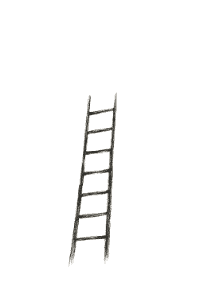
ladder

Charlotte leaned forward, pressing her lips to the small birthmark under her daughter’s eye—the brown keyhole that never opened. She rested her forehead against Autumn’s, listening for any trace of the hum she once knew. There was none.

No alarm. No cry. Just a silence that did not echo.

Rosie stepped forward, placing a hand on Charlotte’s back. “Take your time,” she said. “There is no rule for leaving.”

Time obeyed.


She walked, finally, not to leave—but to carry. Down the corridor, through halls where other parents sat suspended between prayer and science. She entered the chapel again. The air was dusk-cool. The Norton Anthology of Poetry was exactly where she’d left it, spine cracked, pages tired.

She opened to Ben Jonson without looking. Found the line that had waited for her.

Here lies, to each her parents’ ruth…

She spoke the poem aloud. Not as lament. As witness. As vow.

When she finished, she closed the book carefully, pressing it flat with both palms—as though sealing light inside wood.

Outside, it had begun to snow.


Grief moves differently in houses. It opens drawers you forgot existed; it turns off lights you’re sure you left on.

Charlotte washed the single coffee mug—his mug—and let it dry upside down. She folded Autumn’s pajamas and tucked them, not into a drawer, but into a small box she could not yet name. She pinned the cat drawings to the fridge: detectives, pilots, guardians of ladders. The house, obedient as ever, waited for instruction.

There was no one left to ask, “Do you remember when she—?”

The absence was not loud. It was absolute.

Spring rehearsed itself. Green tried. Birds insisted. Charlotte walked without purpose, sometimes ending at the school without knowing she’d turned that way. She stopped attending grief circles—words felt fraudulent, flimsy. One sentence stayed with her, silent as a psalm:

She was here. She was here.

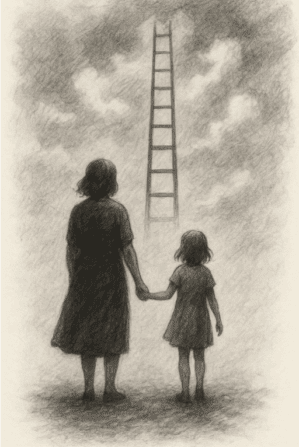
Some nights, she dreamt of Autumn building ladders in the sky. No illness. No machines. Just small hands hammering stars into place.

In dreams, she never called out. Watching was enough.


One rainy afternoon in May, she sat at a red light near the Methodist church. A farmers’ market was packing up. A little girl—brown hair, purple coat—stepped too close to the road. A truck braked hard. A mother’s hand shot out, grabbing the sleeve. The child flinched, then broke into laughter, startled by how quickly fear can become joy.

Charlotte exhaled sharply, pressing a hand to her chest. Not pain. Recognition.

Rain freckled the windshield. The world was rinsed of sound.

Without deciding, she whispered Jonson’s line:

Here lies, to each her parents’ ruth…

But the poem did not finish there. Something shifted. Words, long buried beneath ribs, rose of their own will:

Little one, descend — the night is only stairs.
Keep your flame cupped — against the careful air.
If the light falters, if you cannot see —
I will be the sky where you remember me.

She did not write it. It was already written. She simply released it.


woman holding a child's hand while looking up a ladder going into the sky.

That evening, in the kitchen, she took down the stopped clock. She placed fresh batteries. It hesitated—then began.

Wrong time. Right motion.

She watched the red hand descend from twelve, slow and humble, as if bowing.

She set water to boil. Steam rose, soft as breath finding shape.

She stood very still.

“Autumn,” she said.

Then, after a lifetime:

“I am here.”

In the distance, somewhere beyond streets and fields, a train moved through the dusk, its horn long and low—a sound that did not vanish, but traveled.

And Charlotte, in her kitchen, did not move.

She noticed everything.


Samrat Roy Choudhury, PhD, is an Assistant Professor in the Department of Pediatrics at the University of Arkansas for Medical Sciences and Arkansas Children’s Research Institute. His research focuses on cancer epigenetics, transcriptional regulation, and therapeutic resistance in pediatric leukemia. Outside the laboratory, he is interested in fiction as a way to explore memory, time, displacement, and the emotional lives that continue beneath professional routines. His story, “The Time of the Stopped Clock,” won the Paulette and Jay Mehta Award in Creative Writing in the fiction category.

Filed Under: Mehta 2026 - Fiction

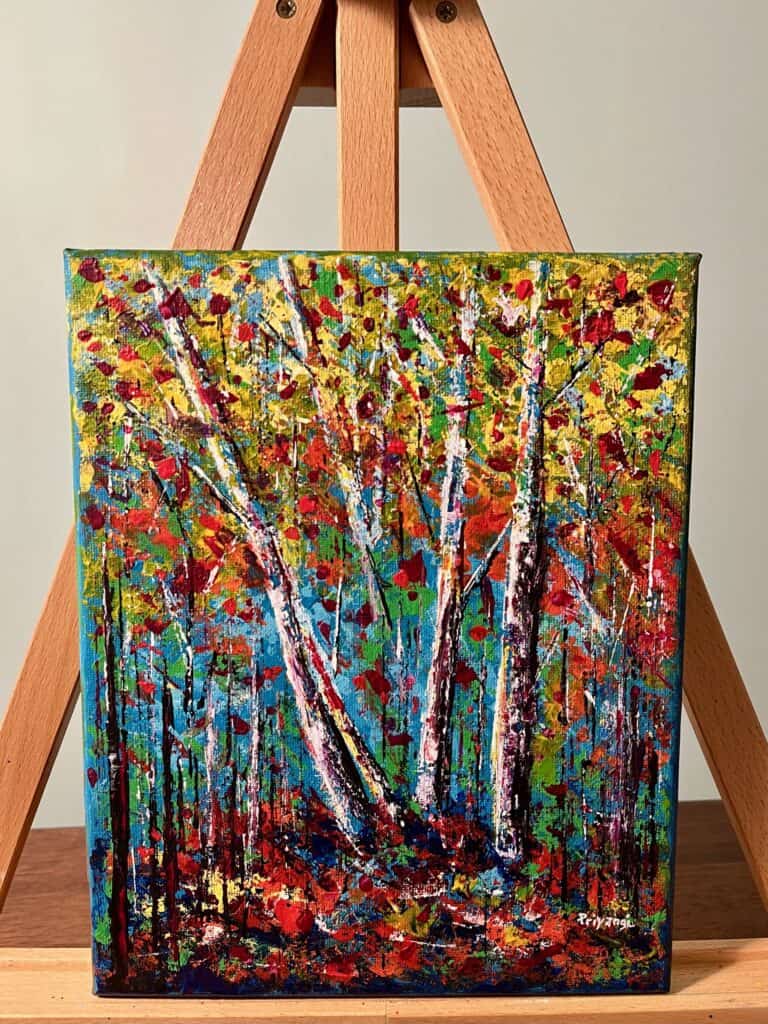
Colors of Life

colors of life by priyangi malaviarachchi

People’s Choice Award: Awarded to Priyangi Malaviarachchi for her painting titled Colors of Life. Priyangi is a Clinical Research Coordinator at UAMS.

Email: pamalaviarachchi@uams.edu

Bio: Clinical Research Associate, UAMS

Artist Statement: I am a self-taught artist exploring different mediums to create ideas and enjoy life.  Most of my art is based on nature depicting my own photographs.  I believe art has the power to create, imagine, and hope, which is why I use my versatile artwork for fundraising animal shelters. “I took a walk in the woods and came out taller than the trees” – Henry D. Thoreau

Filed Under: Mehta 2026 - Images

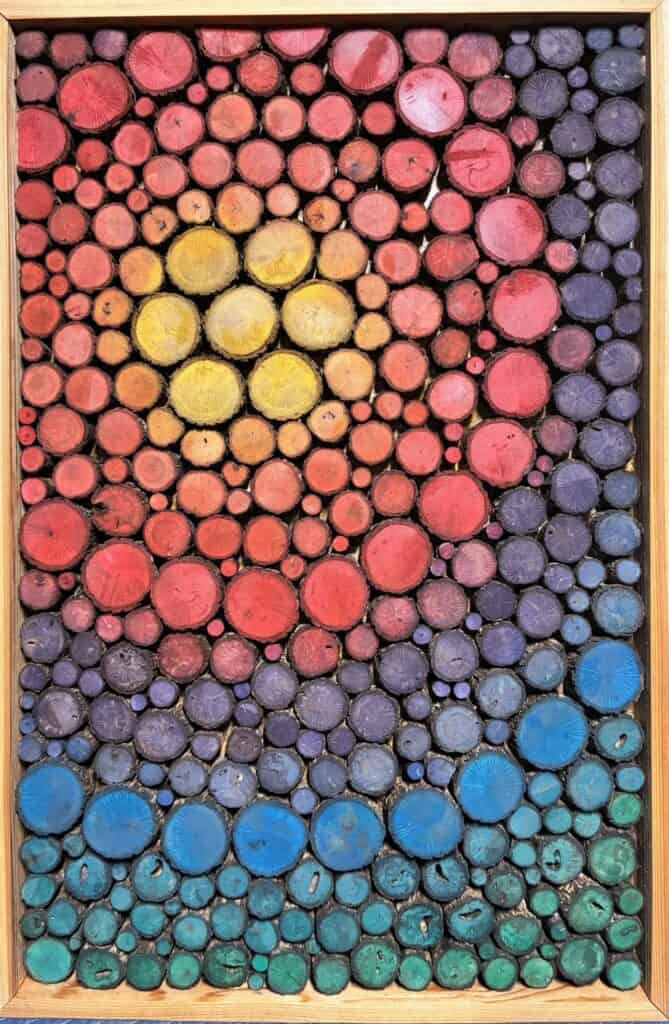
After the Storm

After the Storm painting

Leonardo da Vinci Award (most inventive): Awarded to Ryan Pennington for his mixed media work titled After the Storm. Ryan is the spouse of Mandy Pennington – an Instructor for the College of Health Professions, Dept. of Dental Hygiene.

Email: advantagelawn99@gmail.com

Bio: I am a landscaper of almost 30 years. I’m 52, married for 25 years to Mandy Love Pennington (instructor in Dental Hygiene at UAMS). Our son Reece is 18 and heading to ASU Jonesboro (pre-vet) in the fall. He’s awesome.

Artist Statement: Art and design have always held my interest; I have a particular affinity for mosaics in stained glass or wood. I suppose I like making things look like they fit together. As a landscaper for almost 30 years, I’ve had lots of practice making plants and rocks look like they belong. I’ll be working on more mosaics and may open a shop online or find a booth around town soon. 

I named the mosaic ‘After the Storm’ for a great song by Shovels & Rope, and because I used a large oak limb that fell in the yard during a storm. I also used snow melt to thin the acrylics that I caught in a bucket from my leaky shop roof while I worked on it. 

Filed Under: Mehta 2026 - Images

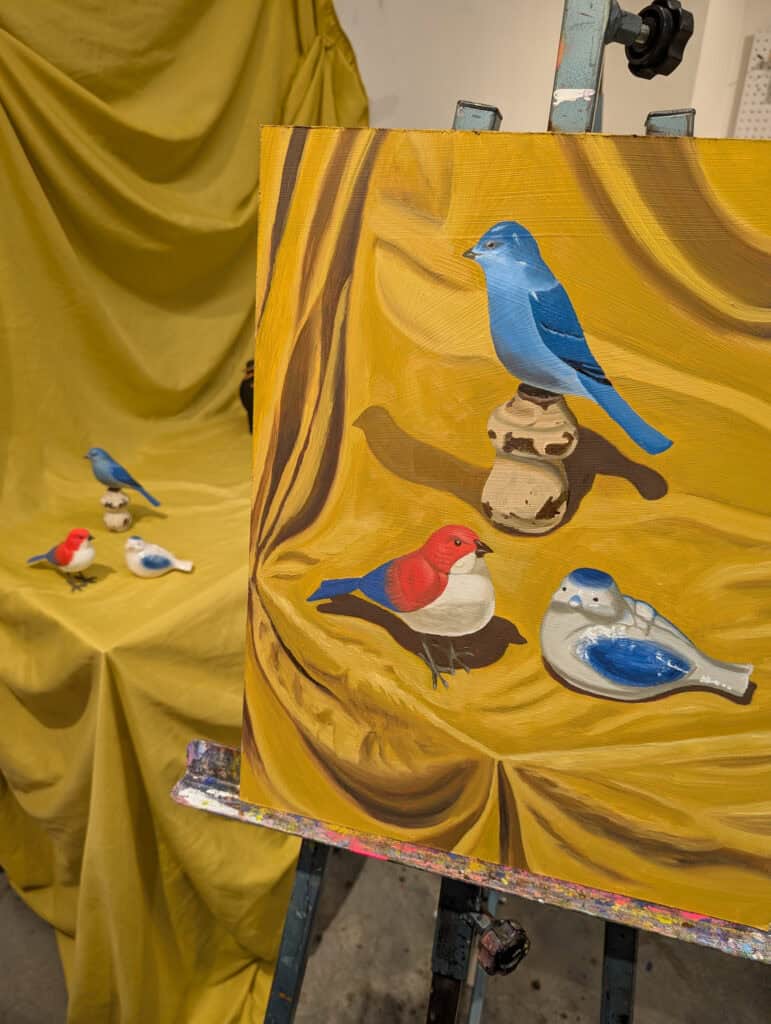
Feathered Trio – Still Life Study

Featherd Trio - Still life Study by Mariel Garcia

Vincent van Gogh Award (best use of color): Awarded to Mariel Garcia for her painting titled Feathered Trio – Still Life Study. Mariel is an Executive Assistant in the College of Public Health at UAMS. Mariel has been at UAMS since 2013 and at the COPH since 2024. Mariel started as an assistant/admin at the College of Pharmacy, then Institutional Advancement/Foundation, Executive Assistant at DDEI supporting Vice Chancellor, Dr. Brian Gittens, and then Director of Admissions at the Graduate School.

Email: mmgarciavelazquez@uams.edu

Bio: I attained a Psychology BA and Asian/Japanese Studies Certificates from Florida International University in Miami, FL. I started my career as a counselor and then taught English in Japan through the Japan Exchange and Teaching Program. I relocated to Arkansas in 2010 and have worked at various state agencies in the higher education and healthcare administration sector. Currently, I’m honoring my passion for the arts by studying Graphic Design/Photography at the University of Arkansas at Little Rock School of Art & Design.

Artist Statement: Last year, I took Intro to Painting at UA Little Rock School of Art & Design with Professor Ricky Sikes.  This painting class took me out of my comfort zone.  I was apprehensive of using oils due to safety hazards involved with solvent inhalation, pigment chemical toxicity, and waste combustibility. The class studio was equipped with safe studio practices which helped me focus on the learning aspect since it was also my first time using oils as a medium. I’m so glad I trusted the process and learned so much from this medium while gaining confidence in a new skill.

This is also my first time winning an award for my art. I’m very honored to receive this award since it took a lot of work mixing color variations to get the right hues and values.  In class you always start with 7 colors and have fun blending various combinations to get the perfect shade.  The possibilities are endless.
I find it really neat that the painting won the Vincent van Gogh award and that it unintentionally had a lot of vibrant yellows and blues.

We had to use 3 items to paint a still life.  Nature has always been my muse. Since I love birdwatching, I thought it would be fitting to choose 3 of my favorite bird figurines to practice on and just have fun with it.

  • Other: Art Portfolio
    mgarcia183a2.myportfolio.com
    • Photography Portfolio
    • Mgarcia1033c.myportfolio.com

Filed Under: Mehta 2026 - Images

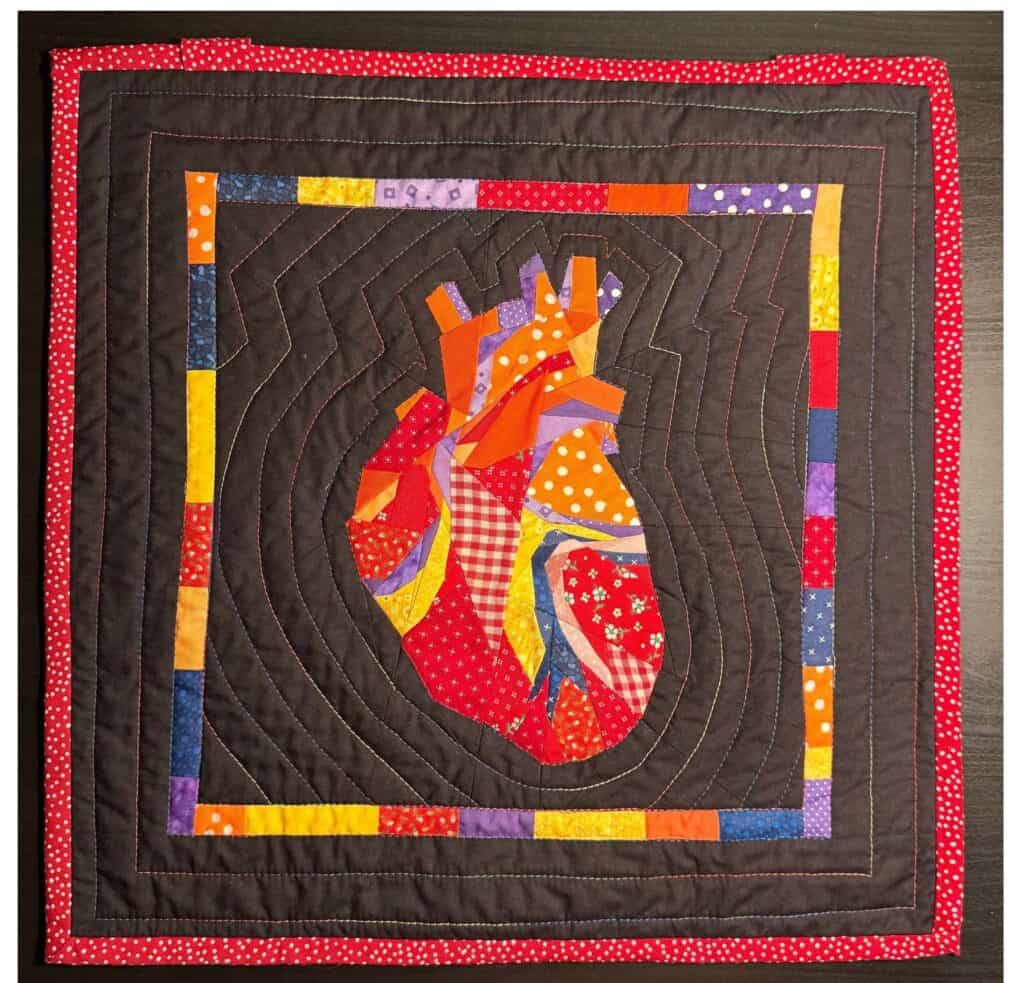
The Heart in Pieces

The heart in Pieces by Bailey Barnes

Critic’s Choice Award (overall strongest): Awarded to Bailey Barnes for her quilt titled The Heart in Pieces. Dr. Barnes is an Assistant Professor of Pediatrics.

Email: bbarnes@uams.edu

Bio: I am a General Pediatrician in the department of Community Pediatrics. I work at the Arkansas Children’s Southwest Little Rock Clinic.

Artist Statement: My primary art form is quilting. I have always been interested in sewing and asked for my first sewing machine for my 8th birthday. My great aunt, Helen, taught me how to quilt when I was 18 years old. I was spending the summer with family in Southeast Missouri and would go over to her house in the afternoons and sew with her. I made two quilts that summer and was hooked! I always laugh because she told me I shouldn’t continue quilting once I started college or I would become known as “that weird quilting girl.” I didn’t listen, of course, and I wish she could see my quilts now, and that I even won an award for one! This quilt was inspired by my wife who is a Pediatric Cardiologist. It uses a technique called foundation paper piecing where small pieces of fabric are sewed initially to a piece of paper and at the end the paper is removed. There are well over 100 pieces of fabric in this piece. The fabric I used is primarily from scraps left to me by my Aunt Helen. I love that I can continue to carry her artform forward with me. Quilting has gained a lot of popularity recently, so I feel like I have just been ahead of the trend and not a weird quilting girl after all!

Filed Under: Mehta 2026 - Images

See You Soon

By: Dongjoon Lee

I stand before my father’s tombstone. His name and date of birth are carved into the stone, but the date of his death remains blank. It feels as though the moment I engrave that final date, he will disappear completely—as if he never existed at all.

What is “normality,” really? Even though my family were centimillionaires, I always thought we were obviously ordinary. “Normal” is relative, after all. Compared to the chaos and extravagance I saw on social media, we were a family devoid of anything remarkable.

And I loved that. Just like my plain name—John—I enjoyed a quiet life, blending into the background.

Until the day a single event made us the most extraordinary family on Earth.

It began like any other day. I woke up at 7:30, turned off the alarm, showered, dressed, and ate the breakfast my loving wife made for me. I dropped my daughter off at school, drove to the office, and went about my boring tasks.

Then, at 3:23 PM—a moment that made my life so extraordinary that even the exact minute remains etched in my memory—my phone shattered the routine.

The caller was Marin—my father, Carter’s secretary since college, practically an uncle to me.

“It was euthanasia, John.” “What are you talking about?”

“He’s been preparing for this for a long time. Carter is gone.”

The words made no sense. If anyone else had said it, I would’ve told them to stop joking. But as far as I know, Marin had never cracked a joke in his life. My father was healthy, he jogged every weekend, and we often shared wine while talking about his retirement plans. I thought I knew him. But this… none of it matched the man I knew.

In a state of denial, I rushed to the CEO’s office. Everything was neat, the papers arranged perfectly—as if he had simply vanished. In the center of his desk lay a single note, scribbled like a childish joke:

See you soon.

I collapsed into his chair and gasped for air. “What the hell is happening…?”

As I regained composure, my eyes fell on the safe I’d always been curious about.

The code… My birthday? My mother’s birthday? or… No—my mother’s death anniversary.

Inside, there was less cash than I expected, a photo of Mom smiling brightly, and an old travel brochure with checkmarks next to the places we’d visited.

“Madagascar… I was seven. And Jeju Island… those stone statues looked like

Moai…”

Then I saw something strange.

Kota Kinabalu.

We had never gone there.

A secret trip? Since when did Dad have secrets?

He must have loved it; a red star was drawn fiercely beside the name. Then, another location caught my eye:

Yellowstone National Park.

Dad was usually calm and calculated. He never made impulsive decisions. And yet, he could show a gentle foolishness at times—mostly during family trips. My mother died of pancreatic cancer when I was thirteen; my final memory before losing her was of that winter trip to Yellowstone.

The winter there was brutal. Dad insisted on “making unforgettable memories,” so we camped in the middle of the park. The car got stuck in snow, and we set up a tent on pure white ground.

That’s when I saw it—my first moose. Huge, terrifying. “Dad, I’m scared…”

He looked at me seriously.

“That’s a moose, John. Strong, but they never fight without cause. Life is the same. Think carefully before you choose. But once you decide—never back down.”

Mom scolded him for lecturing me in such a beautiful place. It remains one of my happiest memories.

The funeral felt strangely seamless—as if everything had been prepared. The only odd thing was that it was a closed coffin. Marin said it was Father’s wish.

When the service ended, I approached the coffin for a final goodbye. Someone laughed.

Very quietly.

I turned—no one was laughing. But the crowd wasn’t crying either. Their faces were twisted in fear.

I turned back.

My father’s portrait was smiling. Then his lips moved.

“Don’t be afraid, John.” I froze.

Screams erupted.

Flashes exploded like lightning. Chaos swallowed the room.

I could only stare. That smile, that voice—it was unmistakably him. I looked at Marin.

He sighed.

“Carter didn’t just die.” “What?”

“He discarded his body. He’s been digitized.” “What does that even mean?”

“He developed the technology in secret—no approval, no ethics review. A device to reconstruct the brain digitally. He transferred his consciousness. And he tested it… on himself.”

My father’s image on the monitor spoke to me. “It’s been a while, John.”

The voice, the gestures, the tone—it was all him. “But you’re… dead.”

“Death is a concept of the flesh. I still think, judge, and feel. I simply no longer have a biological body.”

Was this really my father?

The mourners were confused. Some yelled that it was a cruel prank. I shut down the funeral and took the monitor home.

At dinner, the monitor sat at the head of the table, smiling. “Daisy, Grandpa is here.”

“Grandpa! I thought you left me!” “How could I ever leave you?”

“So we can be together forever now?! That’s so cool!”

Her innocence twisted my stomach. Maria, my wife, had said nothing the entire dinner. That night, in bed, she whispered to me.

“John… that thing isn’t your father.” “What are you saying?”

“Humans have souls. That… has no soul.” “He’s just a person without a body.”

“No. That is a computer wearing Carter’s face.”

“So what? Should I kill him? Is that what you want?” “John, don’t say like that…”

We, who never fought, fell asleep without another word.

Days later, Carter appeared on TV. The anchor asked. “Are you really human or just AI?”

He answered calmly.

“AI analyzes, but it does not judge. I make judgments based on my own memories and experiences. No one can replicate them. Doesn’t that make me human?”

The world exploded.

The First Digital Human.

Do Digital Humans Have Rights?

Religious protesters clashed with techno-utopian celebrants.

Carter, unfazed, announced his return to company management.

My life seemed to go back to normal—except for the lingering tension with Maria.

But I wasn’t sure anymore whether to call him ‘Father.’ One day he said,

“Do you remember the moose at Yellowstone?” “Yes. Mom took a picture.”

“She said, ‘Let’s keep this moment forever.’ I wondered… what if we really could stay together forever?”

“Is that why you did this?”

“Yes. I wasn’t scared of death. I just wanted to remain—if only as a memory. Just as your mother remains in mine.”

His sincerity… it reached me.

Later, I met my wealthy but aimless friend Sigmund for drinks. Back in our school days, he had been a man of fierce ambition and vibrant energy. But somewhere

along the way—perhaps after his arranged marriage to a corporate heiress—he had changed. Now, he spent his days dissolved in mindless hedonism. I told him about the things that were happening these days.

“What do you think a human is?” he suddenly asked. “I don’t know. Maybe memory, love, reason…”

“No. Humanity is just instinct.”

He pressed a button, and two women in revealing lingerie entered. I stood immediately.

“As humans, we are better than this. I have Maria. You have Jessica.” He scoffed. “We do this because we’re human.”

His words disgusted me—but lingered.

If instinct defines humanity… does my father have any?

I returned home. Maria was drying her hair. Something stirred in me. I kissed her.

She kissed me back. We made love quietly.

The day Carter resumed his position, an emergency board meeting was held.

The agenda: Father’s reinstatement, the fire at the Chinese factory, and government pressure to reshore.

The directors whispered nervously, glancing at the monitor.

“If no one will speak,” Carter said, “Let’s discuss my reinstatement later. First, the other issues.”

They reported millions in losses, but Carter cut in. “No. There is no need to restart that factory.”

He explained—cold, precise, impossibly efficient—that Vietnam would cover 62%, the Virginia warehouse 38%, and that political conditions made a U.S. rebuild more logical.

The directors applauded, and his reinstatement passed instantly.

Back in charge, Carter was even colder and more precise than when he had a body. Employees followed him with absolute loyalty, perhaps more than ever. I was relieved by his sharp judgment, but a seed of doubt began to grow: Is this truly the same man?

Under his leadership, the company thrived for months. Revenue soared, and stock prices hit record highs daily.

But shadow always follows light. Over the next few months, strange things began to happen—slowly at first.

“The lithium mine bid went to H Corp.”

“What? Our offer should’ve been the winning one.”

“Carter changed the numbers right before it was submitted.”

I turned to him. The face on the screen remained expressionless as usual, but I caught a tiny movement. The fine wrinkle above his left eye twitched. It was a tic he had whenever he was flustered.

Is something… wrong?

“When I analyzed their financials… they couldn’t afford their bid…” But his data differed from ours.

“Where did this data come from?” I asked. He paused.

“If our data differs, someone is intercepting or altering the information sent to me.”

I tried to call Marin—no answer. HR said he had resigned and left the country. Impossible. Marin would never abandon him.

Suspicion grew.

One night, after comparing more discrepancies, Carter said something chilling. “It has begun sooner than expected.”

“What has?”

“The manipulation. I don’t know who is behind it or why, but H Corp is the prime suspect. One thing is certain, though: it will happen again. There is only one solution. Eliminate me.”

“What?! No.”

“I am just digital data wearing your father’s face.” He continued to speak with a stoic expression. “Dad.”

I interrupted.

“I reviewed your log data when you paused earlier. Every single time you were not working, you were watching family photos and videos of me when I was little, weren’t you?”

He remained silent.

“How can a machine miss the past? That is inefficient.” Still, silence.

“You are alive, Dad. You just don’t have a body.” Silence.

“You’re a still human, Dad.” At last, he smiled warmly.

“Thank you, son. You’ve awakened me.”

I couldn’t fully grasp his meaning. Yet, his voice was warmer than ever, and my persistent doubt—the haunting question of whether he was still my father—melted away completely.

Despite his protests, I searched for traces of the interference. I investigated who was manipulating him, who was behind it all. But amazingly, no evidence remained. It was as if… it had never existed.

But soon, static crept into his voice. The screen wavered slightly.

Engineers said the problem wasn’t the monitor—the signal itself was breaking down.

“John… please. End me.”

I couldn’t.

Instead, I broke down and told Maria everything. After a long silence, she said,

“I didn’t see him as your father at first. Because humans have souls-something that cannot be copied. But… I spoke to him when you weren’t home. He apologized. He said he was sorry for hurting us.”

“Dad… apologized?”

“He has a warm heart, John—whatever he is.”

Tears streamed down my face. Father had never apologized to anyone in his life, because his judgments were always right. He had apologized only once: the moment Mother died.

“I’m sorry I couldn’t cherish you more. I’m sorry I couldn’t love you more.” Remembering that moment, I wept in Maria’s arms.

“If he truly wants to go,” she said,

“It should be you, not someone else.” “No… I can’t…”

That night, I fell asleep and swore I heard:

See you soon, Son. I love you.

The next morning, the monitor was black. Maria sat in front of it, crying.

“I did it,” she whispered. “I did it.” She handed me a letter.

My dearest son, John,

since the moment I made this choice, I was certain this day would come. Born as a human, I knew that even if I left my flesh and gained a new body, a day to leave again would eventually arrive.

I didn’t expect it to be this soon, but living without a body was an interesting experience.

Thanks to that, I could spend precious time with you and remind myself of the people I cherish.

Now, I am leaving this second body to go to your mother. I am so sorry to Maria.

I wanted to ask you, but I feared it would leave you with too great a trauma. Although my second body was nothing but cold data made of 0s and 1s, the heart that cherished and loved you all was not code, but my singular instinct and my truth.

Love each other for the rest of your lives—with your bodies and with your souls. For that is what it means to be human.

– Your father, who loves you most in the world

I couldn’t say a word. I looked at the monitor. My own face reflected in the cold, black screen. Tears fell.

I stand before my father’s tombstone again.

This time, I finish the carving. Today’s date fills the blank space. The wind blows gently.

I close my eyes.

I can still hear his voice in my head.

“See you Soon, Son”

Filed Under: 14-fiction

  • Page 1
  • Page 2
  • Page 3
  • Page 4
  • Next Page»
University of Arkansas for Medical Sciences LogoUniversity of Arkansas for Medical SciencesUniversity of Arkansas for Medical Sciences
Mailing Address: 4301 West Markham Street, Little Rock, AR 72205
Phone: (501) 686-7000
  • Facebook
  • X
  • Instagram
  • YouTube
  • LinkedIn
  • Disclaimer
  • Terms of Use
  • Privacy Statement
  • Legal Notices

© 2026 University of Arkansas for Medical Sciences